Ancient · The Bronze Age
When Gojoseon was founded, the world was deep in the Bronze Age
Published
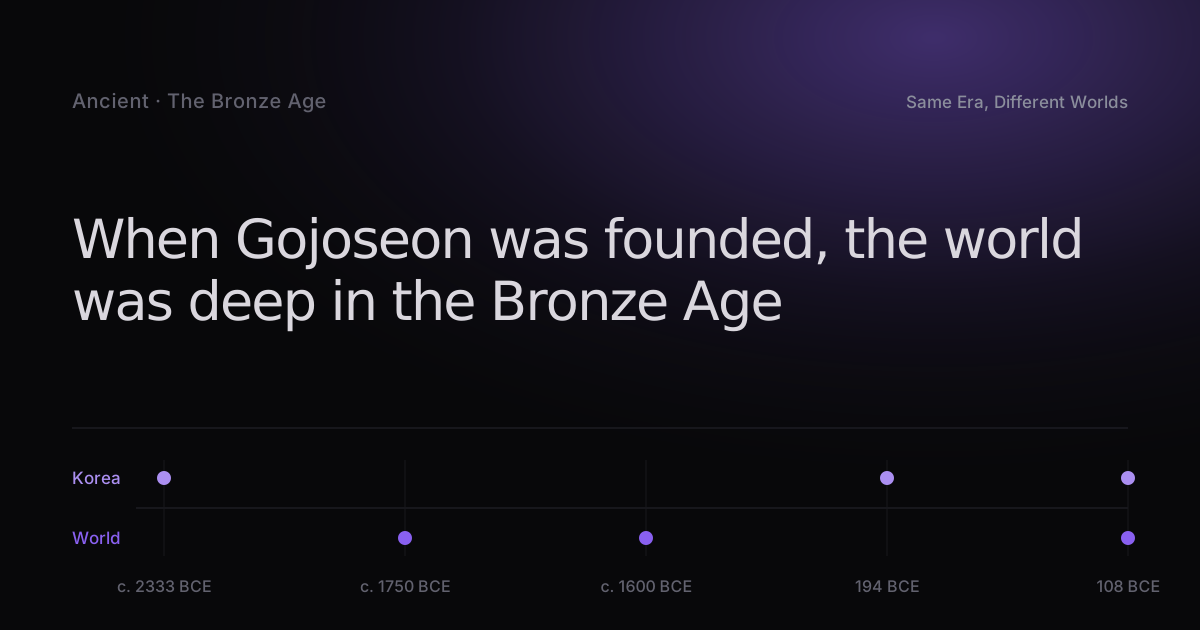
Korean history textbooks open with a single sentence: in 2333 BCE, Dangun Wanggeom founded Gojoseon. To a Korean reader that date sounds impossibly remote — the beginning of everything. Place it on a world timeline, though, and something else appears. By 2333 BCE, other parts of the world had already spent centuries, in some cases well over a thousand years, running cities and writing down laws. Seen from that angle, the founding of Gojoseon shows how late, and how independently, the Korean peninsula joined the Bronze Age world.
Mature civilizations, and a kingdom just beginning
In Egypt, the many small polities along the Nile had been unified around 3000 BCE into a kingdom ruled by a pharaoh. Hieroglyphic writing, a solar calendar, and the elaborate craft of mummification were already established. Mesopotamia was earlier still: around 3500 BCE the Sumerians built city-states that kept their administration in cuneiform and raised ziggurats above the plain. The traditional date for Gojoseon's founding, 2333 BCE, falls roughly 700 years after Egypt was unified and nearly 1,200 years after Sumerian civilization first appeared.
Gojoseon, in other words, emerged on a base of Bronze Age culture only after the world's first civilizations had reached maturity. This is less a story of falling behind than a plain consequence of geography. The Korean peninsula sits far from the cradles of early civilization — the Fertile Crescent and the Nile — and the raw materials of statehood, bronze technology, social ranks, and organized government, needed that much time to reach Northeast Asia.
Ruling by law: the eight articles and the Code of Hammurabi
No account of Gojoseon omits its code of eight articles, of which only fragments survive. A person who kills another is put to death at once; a person who injures another compensates in grain. Provisions like these tell us that the society already recognized private property and social rank, and was trying to regulate both by law. As it happens, the most famous law code in world history, the Code of Hammurabi, was proclaimed in Babylon at a comparable moment — the 18th century BCE. That code, known for the principle of an eye for an eye, was likewise the law of a stratified society, prescribing different punishments for different ranks.
What makes the pairing interesting is that both codes embody the same principle: that the state, not the injured party, does the punishing. Two civilizations that developed independently, half a world apart, arrived at a similar conclusion. Gojoseon's own story continued from there. In 194 BCE, a migrant named Wiman took the throne, and the state that followed — Wiman Joseon — adopted iron technology and prospered as an intermediary in trade between Han China and the south. In 108 BCE it fell to an invasion by Emperor Wu of Han, and the first state on the Korean peninsula came to an end.
What the comparison tells us
The point worth taking from this comparison is that starting late is not the same as lagging behind. Gojoseon absorbed the technologies and institutions of already-established civilizations quickly and rebuilt them into a state of its own. That societies took in the same materials — bronze, then iron — and produced quite different polities suggests that the spread of civilization is never simple copying. It is a process of reinterpretation, shaped by the conditions of each place.
The memory of Gojoseon outlasted the state itself. Later dynasties invoked Dangun as the progenitor of the Korean people to affirm their own legitimacy, and in the modern era he returned again as a symbol of national identity. Just as each of the world's early civilizations left its own founding myth, Gojoseon left the people of the peninsula their first answer to the question of where they came from.
Debate about Gojoseon's territory and its concrete character is still live. Whether its center lay in the Liaoning region or in the Daedong River basin, and how many of the eight articles are actually preserved, remain unresolved because the sources are so thin. That uncertainty is itself telling: it is exactly what one expects of a Bronze Age polity, from a time when written records were rare.
The trap in setting the dates side by side
To make this comparison honestly on a timeline, though, one thing has to be said first. 2333 BCE is not a date established by archaeology. It is a regnal year reported by the Samguk yusa, a text compiled in the thirteenth century CE — some three and a half thousand years after the event it dates. Iryeon aligned Gojoseon's founding with the accession of the legendary Chinese sage-king Yao. That is not an observation recorded by a witness; it is a coordinate calculated later, to establish legitimacy by placing the Korean founding on a par with the Chinese one. The dates for Egyptian unification and the Sumerian city-states are of an entirely different kind, cross-checked against excavation layers and king lists. The moment two such different sorts of number are placed on the same line and used to say Korea was "700 years late," the comparison looks precise and is in fact out of joint.
Archaeologically, bronze culture on the Korean peninsula is attested from roughly the fifteenth to tenth centuries BCE, and Chinese sources describing Gojoseon as something recognizably a state date from the seventh to fourth centuries BCE. The eight articles are likewise not a law code from Gojoseon's own hand: they survive as hearsay recorded by Ban Gu in the geographical treatise of the Book of Han, in the first century BCE. On that reckoning the real gap between the Code of Hammurabi (eighteenth century BCE) and the eight articles is not five centuries but more than fifteen. This is precisely why this site sets its timelines side by side and still names the source of each entry.
Why civilization began on the great rivers
Why should there have been a gap at all? The usual answer — that it took time for things to spread — is not enough on its own. The decisive condition that let Mesopotamia and Egypt build states early was irrigation. Controlling the flood of a great river and carrying its water to the fields demands labor on a scale no single village can supply, and sustaining that labor demands someone to give orders, someone to keep records, and a surplus to feed them both. Writing, bureaucracy and kingship grew out of that necessity. The state, in short, was the answer to a problem the river posed.
The Korean peninsula never faced a problem of that scale. Its rivers are short and steep, and its plains are cut into small basins by mountains. In such terrain, farming is possible on the cooperative labor of a single village, and the pressure toward enormous organization is correspondingly weak. State formation here therefore took a different road — not irrigation but bronze weaponry and control of trade routes — and the record of Wiman Joseon prospering as a middleman between Han China and the polities to the south is the visible trace of that road. It is closer to the truth to say not that the peninsula started late, but that it was solving a different problem.
At a glance
| Period | Korean history | World history |
|---|---|---|
| c. 3500 BCE | — | Sumerian civilization (cuneiform, ziggurats) |
| c. 3000 BCE | — | Egypt unified (hieroglyphs, pyramids) |
| 2333 BCE | Gojoseon founded (Dangun Wanggeom, the eight articles) | — |
| c. 1800 BCE | — | Code of Hammurabi (Babylon) |
| 194 BCE | Wiman Joseon established | — |
| 108 BCE | Gojoseon falls to Emperor Wu of Han | Expansion of the Former Han |
Read next
- Era guide: Prehistory and Gojoseon
- While the Three Kingdoms took shape, Rome entered the age of emperors
References
- Samguk yusa, "Gojoseon" in the Giyi chapter — the source of the Dangun founding date
- Book of Han, geographical treatise, Yan section — the report of the eight prohibitions
- National Institute of Korean History, Korean History Chronicle — entries on Gojoseon and Wiman Joseon
- South Korean high school world history curriculum — Mesopotamian and Egyptian civilization, the Code of Hammurabi
The facts follow the sources above; the comparisons and interpretation are our own.
You can compare the other events of this era directly in the timeline.
Explore the timeline