Era guide · P1 Prehistory and Gojoseon
Prehistory and Gojoseon — the Korean peninsula while civilization was learning to write
Published
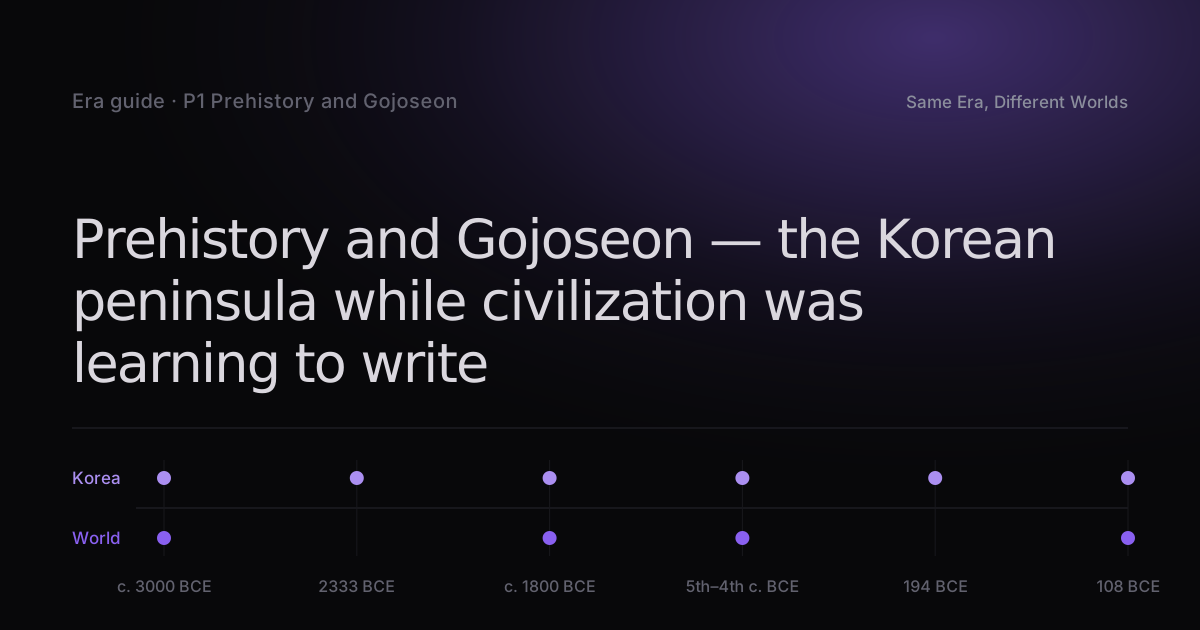
P1 is by far the longest stretch in the timeline. From the beginning of the Paleolithic some 700,000 years ago to the fall of Gojoseon before Han armies in 108 BCE, most of human history sits in this single row. A long era also means a thin record, and that is the first thing to keep in mind when reading the columns side by side.
Korea: objects speak first, texts arrive late
The Korean Paleolithic is known through chipped stone tools and cave sites, the Neolithic through comb-pattern pottery and shell middens, the Bronze Age through mandolin-shaped daggers and dolmens. The evidence for this era is, in other words, mostly what came out of the ground. The widely cited founding date of Gojoseon, 2333 BCE, is of a different kind: it comes from the Dangun narrative recorded in the Samguk yusa, written by the monk Iryeon in the thirteenth century CE. In the timeline both "2333 BCE" and "the fall of Wanggeom-seong in 108 BCE" appear as numbers, but they are not the same sort of number. The first is a symbolic date preserved by a much later text; the second is supported by near-contemporary Chinese records such as the Shiji together with archaeological context.
Gojoseon comes into clearer focus from the fourth and third centuries BCE, when it was substantial enough to stand against the Chinese state of Yan and when iron technology was reshaping its society. Wiman Joseon, founded in 194 BCE after Wiman displaced King Jun, prospered on intermediary trade until Emperor Wu of Han destroyed it in 108 BCE and established commanderies in its place. The moment the peninsula first enters the written record of East Asian politics is, ironically, the moment Gojoseon leaves the stage.
The same centuries elsewhere: writing, law and empire
The world column has the opposite density. Cuneiform in Sumer around 3500 BCE and Egyptian hieroglyphs around 3000 BCE meant that events could be kept as records. The Code of Hammurabi around 1800 BCE, the oracle bones of Shang China around 1600 BCE and the Zhou feudal order around 1046 BCE follow in turn; then the Greco-Persian wars and Athenian democracy in the fifth century BCE, and Alexander's eastern campaign in 334 BCE. The unification under Qin in 221 BCE and the founding of Han in 202 BCE lead directly into Gojoseon's fate.
So although the two columns cover the same span, the density of the record differs. The world column is crowded not because more happened there but because more of it was written down. Reading the blank spaces as "nothing happened" is the single most common mistake in this era.
Where the two currents actually meet
Two points of genuine contact stand out. The first is iron: its arrival on the peninsula around the fifth to fourth centuries BCE changed both farming and weaponry, and it belongs to the same diffusion that accompanied China's Warring States period. The second is Han expansion. The fall of Gojoseon in 108 BCE cannot be explained by internal Korean affairs alone; it happened because Emperor Wu, campaigning against the Xiongnu, treated Gojoseon as an obstacle to remove. That is why the Gojoseon and Han entries sit so close together in the timeline.
How the dates for this era are obtained
Entries in P1 carry an unusual number of qualifiers — "about," "around," "circa." That is not vagueness in the writing but a consequence of how the dates are obtained in the first place. Three methods are at work. The first is radiocarbon dating, measuring the decay of carbon-14 in organic remains; it comes with a margin of error, typically decades to centuries. The second is stratigraphy, establishing sequence by the layer an object was found in. The third is a date from a text.
The difficulty is that these are of entirely different kinds. The founding date of Gojoseon, 2333 BCE, comes not from the first two but from the thirteenth-century Samguk yusa, where Iryeon aligned it with the accession of the Chinese sage-king Yao. The dates for Egyptian unification or the Sumerian city-states on the same line are cross-checked against excavation layers and king lists. Put two such numbers on one line and read off how many years one region "lagged," and the comparison looks precise while being out of joint. That is why this site leaves the approximations in P1 visible. Naming the kind of evidence is more honest than a number that merely looks exact.
What farming produced was not only food
The real change running through this era is not the material of the tools but the appearance of surplus. Paleolithic societies shared on the day what they obtained that day, and hierarchy is hard to build on what cannot be stored. Neolithic farming and pottery made storage possible, and once there was something to store, those who held more diverged from those who held less. By the Bronze Age that gap had hardened into something visible.
The evidence is the dolmen. Moving a capstone weighing tens of tons requires the ability to mobilize hundreds of people's labor for the death of one person. The size of a tomb is the number of people one can command, and that is what power means. That the slender bronze dagger was both a functional weapon and an object of prestige tells the same story. Comparable things were happening everywhere in these millennia. The pyramids of Egypt, the ziggurats of Mesopotamia and the dolmens of Korea differ in material and in form, and they are different shapes attesting the same social fact. A state appears when that gap has hardened into institutions.
Films and series set in this era
The titles that land here are almost all Mediterranean or West Asian. Noah (2014) and The Ten Commandments (1956) take up biblical narrative, Troy (2004) the twelfth-century BCE Aegean, 300 (2006) Thermopylae in 480 BCE, Alexander (2004) the campaigns of the fourth century BCE. That almost no feature film corresponds to the Korean column is itself revealing: there is not enough recorded incident and character to dramatize. Watching any of them with the Korean column open gives you the coordinate that matters — while those figures moved on screen, the peninsula was passing from bronze into iron.
At a glance
| Year | Korean history | World history |
|---|---|---|
| c. 3000 BCE | Neolithic cultures | Egyptian civilization |
| 2333 BCE | Founding of Gojoseon (per the Samguk yusa) | — |
| c. 1800 BCE | Bronze Age | Code of Hammurabi |
| 5th–4th c. BCE | Iron culture arrives | Greco-Persian wars · Athenian democracy |
| 194 BCE | Wiman Joseon established | — |
| 108 BCE | Fall of Gojoseon; Han commanderies | Expansion under Emperor Wu of Han |
Read next
References
- National Institute of Korean History, Korean History Chronicle — Prehistory and Gojoseon
- South Korean high-school world history curriculum — early civilizations and ancient empires
- Iryeon, Samguk yusa (Gojoseon section) — source of the Dangun narrative
The facts follow the sources above; the comparisons and interpretation are our own.
You can compare the other events of this era directly in the timeline.
Explore the timeline