Ancient · The Three Kingdoms and Rome
As Korea's Three Kingdoms took shape, Rome entered the age of emperors
Published
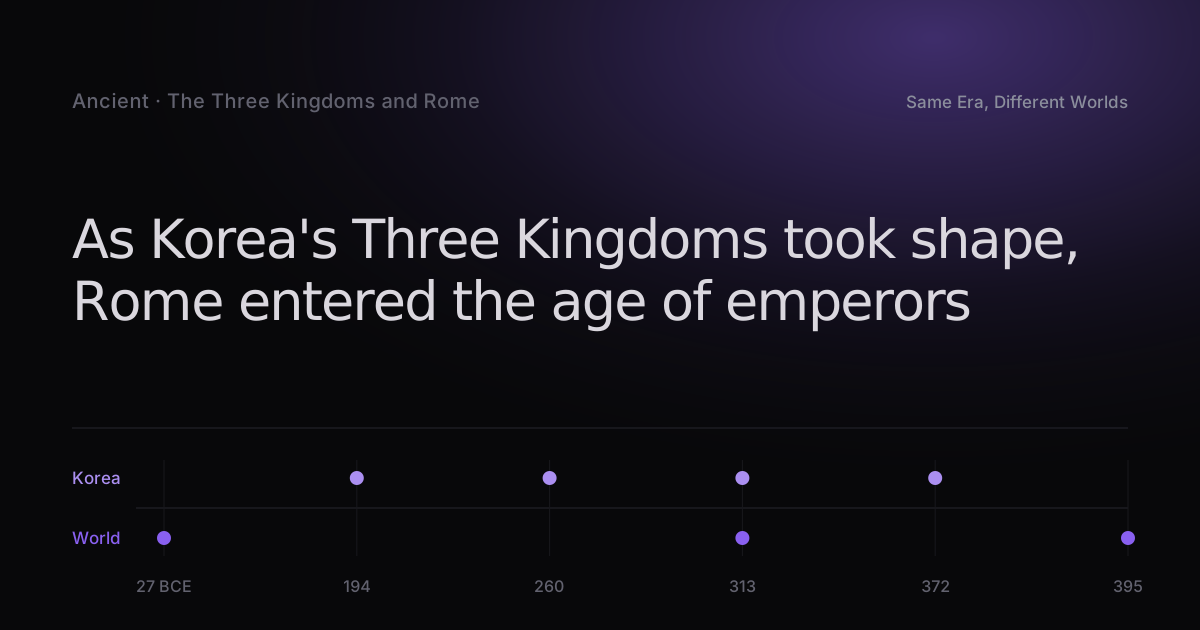
Silla in 57 BCE, Goguryeo in 37 BCE, Baekje in 18 BCE. Korea's three kingdoms opened their doors within about forty years of one another. What makes the timing striking is that at almost the same moment, on the far side of Asia, Rome was moving in the opposite direction. Where the peninsula was dividing into separate states founded by different men, Rome was closing the book on centuries of republic and gathering itself under a single ruler.
Three kingdoms born, one empire remade
By tradition, Bak Hyeokgeose founded Silla — then the small state of Saro — in the Gyeongju region in 57 BCE; Jumong, known posthumously as King Dongmyeong, came south from Buyeo and founded Goguryeo at Jolbon in 37 BCE; and Onjo, of the same lineage a generation younger, founded Baekje at Wiryeseong in the Han River basin in 18 BCE. Each began as one small polity among many, and each grew by exploiting its own geography: Silla a defensible basin, Goguryeo mountains that favored a warrior state, Baekje the rich farmland of the Han River.
In the same years, Octavian was bringing the civil wars that followed Caesar's assassination in 44 BCE to a close. In 27 BCE the Senate conferred on him the title Augustus, "the revered one." The forms of the republic were preserved, but in substance this was the moment one man took hold of the army, the treasury, and the administration — the beginning of the empire. The roughly two centuries of peace and prosperity that followed came to be called the Pax Romana, the Roman Peace.
Kingdoms expanding, Rome at its height
Over the following centuries the three kingdoms competed with one another and built up their states in the process. In the 4th century King Geunchogo of Baekje conquered Mahan and attacked Goguryeo's Pyongyang; in the 5th, King Jangsu of Goguryeo moved his capital to Pyongyang and pressed south; in the 6th, King Jinheung of Silla took the Han River basin and raised stelae to mark his progress through the conquered land. None had yet unified the peninsula. Each reached its peak in turn, and the balance kept shifting.
Rome, meanwhile, enjoyed its own zenith from 96 to 180 under the five emperors later called the Five Good Emperors. In those years the empire stretched from Britain to Mesopotamia, and the Mediterranean was in effect a Roman lake. While the three kingdoms contested a narrow peninsula, Rome presided over an entire sea as a superpower. The difference in scale is enormous, but the direction of growth — build the institutions of a state, then extend the territory — is recognizably the same.
What the comparison tells us
Set the two side by side and another coincidence appears. When the fall of the Western Roman Empire in 476 closed the ancient world, the Korean peninsula was still divided, its three kingdoms locked in conflict. Silla finally completed unification in 676 — exactly two centuries after Rome fell. That one region achieved its unification long after an empire elsewhere had already ended is a useful reminder that history runs on a different clock in every place.
Rome's legacy survives in European legal systems and in the Romance languages that grew out of Latin. The three kingdoms left legacies of their own. Silla's gold crowns and the Cheomseongdae observatory, Goguryeo's Gwanggaeto Stele, and the faintly smiling Buddhist sculpture of Baekje still testify to the craft and the sense of beauty of that age. For all the difference in scale, both civilizations left cultural assets that have carried through the millennia since.
Nor was Rome as calm inside as its peak suggests. The 3rd century saw emperors replaced so often, and civil war so frequently, that it is known as the age of the soldier-emperors, and that instability was one of the reasons the empire was eventually split east and west. Those fractures behind the brilliance show that even a vast empire holds together only through constant management of its own unity.
Why one region split and the other converged
In the same span of years the peninsula divided into three and Rome consolidated into one. It is easy, and wrong, to explain that difference by national character or capability. What decided it was the cost of moving people and goods. At the center of Rome's territory lay the Mediterranean, and an ancient ship could carry a given weight for a small fraction of what the same cargo cost overland. That is why Rome could feed the city on Egyptian grain and pay legions stationed in Britain. The sea was not a barrier dividing the empire; it was the highway that held it together.
The geography of the Korean peninsula worked in exactly the opposite direction. The Taebaek and Sobaek ranges cut it lengthwise, and the plains between them sit apart from one another. In country like that, conquest is possible but holding is expensive. That is the reason Goguryeo could press south, Baekje north, and Silla seize the Han River in turn without any of them monopolizing the peninsula for long. The three kingdoms coexisted for the better part of seven centuries not because none of them was strong enough to unify it, but because a three-way division was the most stable equilibrium that terrain allowed.
The same external pressure, opposite endings
The endings are more interesting still. Rome collapsed in 476 and Silla unified the peninsula in 676, and behind both events stood the same kind of cause: the arrival of a formidable outside power. For Rome it was the migration of the Germanic peoples; for the peninsula it was the pressure of Sui and then Tang, after China was reunified. The outcomes ran opposite. Rome was broken apart by that pressure, while Silla used it as leverage, allying with Tang to bring down first Baekje and then Goguryeo.
What made the difference was not the magnitude of the pressure but the number of options available in response. Beyond Rome's frontier there was no organized state that could serve as a counterpart at the negotiating table; the Germanic peoples were something to absorb or hold off, not someone to strike a bargain with. For the three kingdoms, Tang was a threat and simultaneously a party one could deal with — and Silla chose to deal. The price was steep. The Silla–Tang War of 670–676, fought immediately after unification, was the renegotiation of the terms of that bargain, and Silla had to settle for holding the land south of the Daedong River. A strategy that borrows the strength of an outside giant always comes with a bill attached.
At a glance
| Period | Korean history | World history |
|---|---|---|
| 57 BCE | Silla founded (Bak Hyeokgeose) | — |
| 44 BCE | — | Assassination of Caesar; Roman civil wars |
| 37 BCE | Goguryeo founded (Jumong) | — |
| 27 BCE | — | The Roman Empire founded (Augustus) |
| 18 BCE | Baekje founded (Onjo) | — |
| 96-180 CE | The three kingdoms contend | Rome at its height (Five Good Emperors, Pax Romana) |
Read next
- Era guide: The Three Kingdoms and Gaya
- Rome and the peninsula in the years Jesus was born
- Era guide: The North–South States, after unification
References
- Samguk sagi, the annals of Silla, Goguryeo and Baekje — the founding dates
- The Gwanggaeto Stele (414) — a contemporary record of Goguryeo’s southern campaigns
- National Institute of Korean History — entries on the formation of the Three Kingdoms and the Silla–Tang War
- South Korean high school world history curriculum — from republic to empire, the Pax Romana
The facts follow the sources above; the comparisons and interpretation are our own.
You can compare the other events of this era directly in the timeline.
Explore the timeline