Era guide · P9 Contemporary Korea
Contemporary Korea — industrialization and democratization along a Cold War line
Published
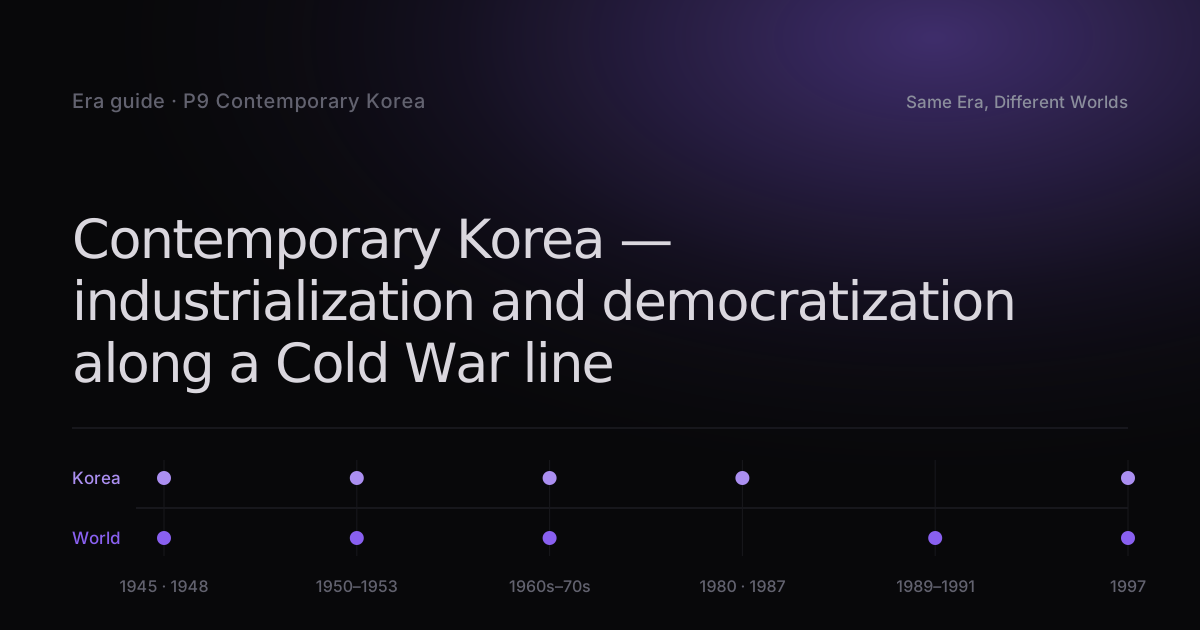
P9 runs from liberation in 1945 to the present. It is the one stretch of the timeline that is not yet finished, and the one where interpretations diverge most sharply, so this page concentrates on international context rather than judgement.
Korea: three tasks at once
After liberation the peninsula was occupied by American and Soviet forces divided at the 38th parallel, and in 1948 separate governments were established. The war that began in 1950 lasted three years, left millions dead or displaced, and stopped with an armistice in 1953. It did not end; it has remained suspended ever since.
After the April Revolution of 1960 and the coup of 1961, state-led industrialization through the 1960s and 1970s moved the economy from light manufacturing to heavy and chemical industry. Behind that growth lay long hours, low wages and restricted political freedom. Through the events of 1979, the Gwangju uprising of 1980 and the June Democratic Struggle of 1987, direct presidential elections were restored. The financial crisis of 1997 restructured the growth model, and Korea has since been deeply integrated into world markets through semiconductors, cars and cultural exports. This is why the period is so often cited internationally as a case of passing through industrialization and democratization within a single generation.
The same decades elsewhere: Cold War, its end, and after
The Cold War that began with the Truman Doctrine in 1947 split the world in two, and the Korean peninsula was one of the few places where the line was drawn physically. The founding of the People's Republic of China and of NATO in 1949, the Cuban missile crisis of 1962 and the Vietnam War followed. The Berlin Wall fell in 1989 and the Soviet Union dissolved in 1991 — yet Korea's division remained.
After the Cold War came globalization and regional integration, the information-technology revolution, the financial crisis of 2008 and a return to protectionism. Korea's 1997 crisis has been studied internationally as a demonstration of what an age of mobile global capital can do to a newly industrialized economy.
Where the two currents actually meet
In this era the relation is less contact than causation. Division was not the outcome of Korean domestic politics but of the postwar settlement between the United States and the Soviet Union, and the war of 1950 became an international conflict immediately. Fought by Korean, United Nations and Chinese forces, it was both an early Cold War proxy war and the event that set the military order of East Asia.
The economy was tied to the world system just as directly. Export-led growth in the 1960s and 1970s depended on access to American and Japanese markets, capital and technology, with procurement during the Vietnam War and the Middle East construction boom supplying foreign currency. The global spread of Korean popular culture today likewise rests on a change in the world's distribution structure — the internet and streaming. That titles such as Pachinko and Kingdom appear in this site's film column at all is itself a facet of P9.
Why industrialization and democratization arrived within one generation
What is distinctive about contemporary Korean history is that both happened in succession, and within a single generation. The rapid growth that began in the 1960s and the democratization of 1987 are usually narrated as separate events, and the second is in part a product of the first.
Economic growth produced an urban middle class, a college-educated population and a large industrial workforce. These groups were the product of developmental authoritarianism and simultaneously the bearers of demands that system could no longer explain away. The argument that the government had solved the problem of making a living and should be left to handle politics loses its force once making a living is no longer the problem. The moment office workers — the so-called necktie brigade — joined the June Struggle marks that turn.
Other countries followed the same path: Taiwan lifted martial law in 1987, and the Philippines forced Marcos out in 1986. Comparable conditions did not produce identical results, though. China blocked the same demands at Tiananmen in 1989. Conditions only open a door; passing through it is the work of a particular society — as the divergent endings across those years demonstrate.
The bill that compressed growth deferred
Read this era only as a list of achievements and you see half of it. Changing a great deal in a short time carried costs, and the bill generally arrived late.
In labor, low wages and long hours were a condition of growth, and the death of Jeon Tae-il in 1970 and the YH incident of 1979 show how far that condition was pressed. In the environment, pollution around industrial complexes surfaced belatedly. Across regions and sectors, a strategy centered on export conglomerates turned regional gaps and the gap between large firms and small ones into structural features. The financial crisis of 1997 revealed that this growth model had reached a point it could not carry, and the restructuring that followed reshaped forms of employment.
Set on a world line, the trajectory is not unique to Korea. Britain paid for its industrial revolution over decades through public health and labor legislation, and Japan met its pollution reckoning after the rapid growth of the 1960s. What distinguishes Korea is that having compressed every stage, it received the costs compressed as well. Reading this era accurately means setting those costs beside the growth rates.
Films and series set in this era
Ode to My Father (2014) runs from the Hungnam evacuation through the miners sent to Germany and the Vietnam deployment; 12.12: The Day (2023) treats the coup of December 1979; A Taxi Driver (2017) the Gwangju uprising of 1980; 1987 (2017) the June struggle. On the world side sits The Crown (2016–). That all four Korean titles were made after 2014 is information in itself: how long it took before these events could be treated openly tells you something about the era.
At a glance
| Year | Korean history | World history |
|---|---|---|
| 1945 · 1948 | Liberation; two governments | Cold War begins (1947) |
| 1950–1953 | Korean War; armistice | People's Republic of China founded (1949) |
| 1960s–70s | April Revolution; industrialization | Vietnam War |
| 1980 · 1987 | Gwangju uprising; June Democratic Struggle | — |
| 1989–1991 | — | Fall of the Berlin Wall; dissolution of the USSR |
| 1997 | Asian financial crisis | Deepening globalization |
Read next
- Liberation and division: the line the Second World War left behind
- Previous era: the colonial period
References
- National Institute of Korean History, Korean History Chronicle — contemporary period
- South Korean high-school world history curriculum — the Cold War and after
The facts follow the sources above; the comparisons and interpretation are our own.
You can compare the other events of this era directly in the timeline.
Explore the timeline