Contemporary · Liberation and the Cold War
Behind the joy of liberation fell the new shadow of the Cold War
Published
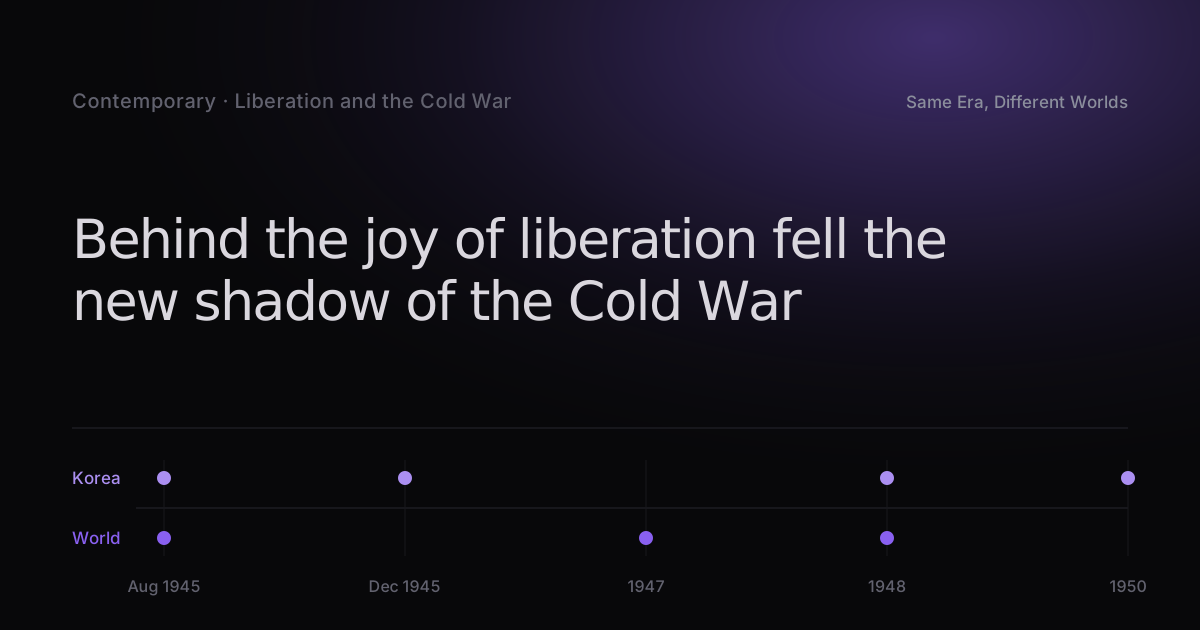
August 15, 1945, is the most dramatic single day in Korean history. Thirty-five years of colonial rule ended and the country was liberated — and the same day marked the end of the most devastating war humanity had fought. But the end of the war did not lead straight to peace. In its place came a new structure of confrontation: the Cold War.
The war ends, and a peninsula divides
The Second World War, begun in 1939 with Germany's invasion of Poland, grew into the largest conflict in history, with the Axis — Germany, Italy, and Japan — against the Allies. Fighting Japan in the Pacific, the United States dropped atomic bombs on Hiroshima and Nagasaki in August 1945, and Japan soon announced its unconditional surrender. With that, the Korean peninsula was released after thirty-five years of Japanese rule.
Liberation, however, did not lead directly to full independence. On the pretext of disarming Japanese forces, Soviet troops entered north of the 38th parallel and American troops south of it. When the Moscow conference of foreign ministers at the end of that year decided on trusteeship for Korea, domestic political forces split bitterly into left and right over it. Before the joy of liberation had faded, the shadow of division was already falling across the peninsula.
The Cold War begins, with Korea on the front line
The Second World War ended in Allied victory, but the victors were already fracturing. The free world led by the United States and the communist bloc led by the Soviet Union ended their wartime cooperation and slid into the confrontation known as the Cold War. The Truman Doctrine of 1947, in which the United States declared it would contain the spread of communism, was the signal that the Cold War had formally begun.
Korea was the leading example of a country placed on its front line. Governments of opposing systems were established north and south of the 38th parallel — the Republic of Korea and the Democratic People's Republic of Korea, both in 1948 — and that division finally exploded into the tragedy of the Korean War in 1950. This is why the fracture the Second World War left behind has burned hotter, and lasted longer, on the Korean peninsula than anywhere else on earth. That the elation of liberation and the tragedy of division began in the same year captures the fundamental contradiction running through modern Korean history.
What the comparison tells us
That liberation and division began in the same year is the key to understanding modern Korea. The Second World War is remembered as a just war that defeated an unambiguous evil in fascism, yet its ending did not automatically bring peace everywhere. On the contrary, an arbitrary line drawn during the postwar settlement — the 38th parallel — became the seed of decades of division and war, a cold reminder that the end of a war is not the same as the beginning of peace.
The Korean War that broke out in 1950 lasted three years before the guns fell silent under the armistice of 1953, but no peace treaty has ever been signed. Legally, the peninsula remains in a state of armistice in a war that has not ended. The Cold War itself closed with the collapse of the Soviet Union in 1991, yet its legacy in the division of Korea survives more than thirty years later — the one remaining fossil of that era.
Another legacy is the separated families. Those divided by war and partition have lived for more than seventy years without so much as confirming whether their relatives are alive. The question of separated families testifies to how a vast history of ideological confrontation between states cut through countless individual lives, and to the fact that the Cold War is not yet entirely in the past.
Internationally, the division of Korea is regarded as the Cold War in miniature. That sixteen countries fought under the United Nations flag in the Korean War shows this was more than a civil war between North and South: it was one of the few genuinely hot wars in which the free and communist blocs came to blows.
A line drawn in thirty minutes
How the 38th parallel was chosen reveals the character of this division. On the night of 10 August 1945, with Japan's surrender imminent and Soviet forces already moving into Manchuria and the northern part of the peninsula, the American State-War-Navy Coordinating Committee had to fix an occupation line in a hurry. Two colonels — Dean Rusk and Charles Bonesteel — stepped into an adjoining room, opened a National Geographic map, and settled on the 38th parallel in about thirty minutes. Their criterion was single and simple: a line that kept Seoul in the American zone and that the Soviets might still accept.
Not one Korean took part in the decision. And the Soviets accepted the line as drawn. The boundary that cut the peninsula came, in other words, from administrative convenience rather than geography, history or the distribution of population. The signs were there earlier still. In the Cairo Declaration of 1943 the Allies promised Korean independence with the qualifying phrase "in due course" — and only after liberation did it become plain that the vague words meant trusteeship rather than immediate independence.
Why Austria was not divided
Occupation in zones does not automatically produce a divided country. Austria was also occupied in 1945 by four powers — the United States, Britain, France and the Soviet Union — and Vienna, like Berlin, was quartered. Yet in 1955 the Austrian State Treaty made it a permanently neutral country, independent and whole. Why did comparable conditions produce opposite outcomes?
The decisive difference was whether separate governments were established during the occupation. In Austria a single provisional government recognized by all four powers represented the whole country almost from the start, and that arrangement held for a decade. On the Korean peninsula, after the US–Soviet Joint Commission broke down, separate governments were established in the South and the North in 1948. Once two governments exist, each with its own army and bureaucracy, unification ceases to be a negotiation and becomes the disappearance of one side. It is therefore more accurate to date the point at which Korea's division became irreversible not to 1945, as is usually said, but to 1948. The 38th parallel was meant to be temporary; the two governments were not.
At a glance
| Year | Korean history | World history |
|---|---|---|
| 1939 | — | The Second World War begins |
| August 1945 | Liberation; division at the 38th parallel | The Second World War ends |
| Late 1945 | The Moscow conference; the trusteeship controversy | — |
| 1947 | — | The Cold War begins (the Truman Doctrine) |
| 1948 | Separate governments established north and south | — |
Read next
- Era guide: Contemporary Korea, since liberation
- The March First Movement and the world of 1919
- Era guide: The Japanese colonial period
References
- The Cairo Declaration (1943) — the phrase "in due course"
- State-War-Navy Coordinating Committee papers and Dean Rusk’s recollection — how the 38th parallel was set
- The Austrian State Treaty (1955) — a different ending to four-power occupation
- National Institute of Korean History — entries on liberation, the US–Soviet Joint Commission and the founding of governments
The facts follow the sources above; the comparisons and interpretation are our own.
You can compare the other events of this era directly in the timeline.
Explore the timeline