Era guide · P8 Japanese colonial period
The colonial period — thirty-five years between two world wars
Published
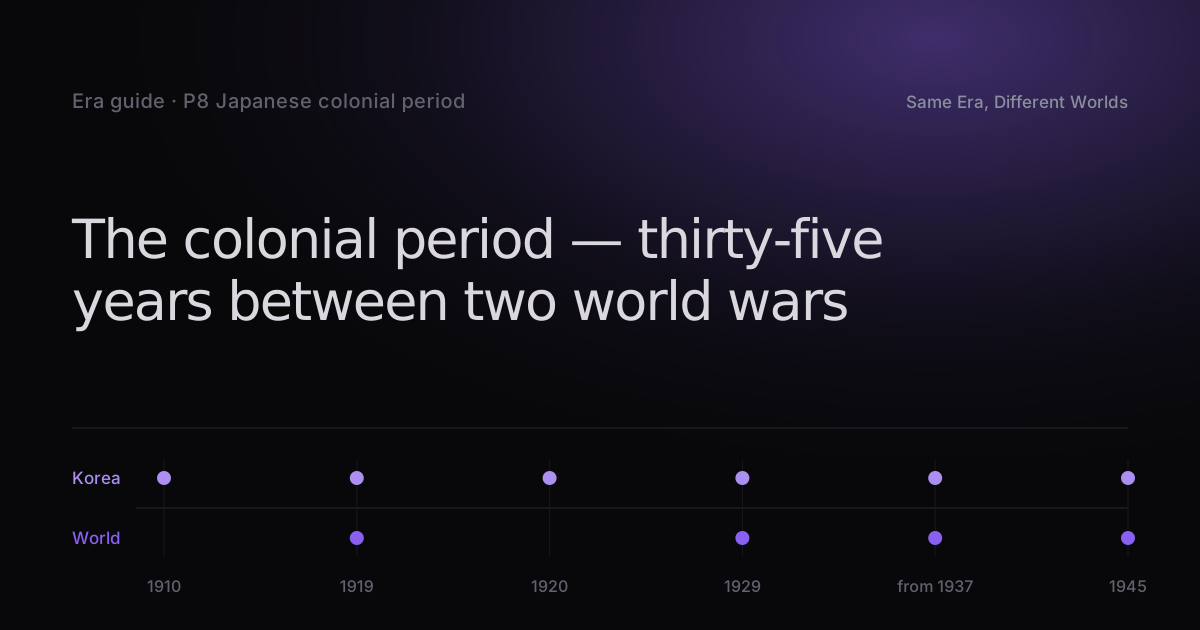
P8 runs the thirty-five years from annexation in 1910 to liberation in 1945. No other era locks the two columns together so directly, because almost every turn in the independence movement came with a shift in the international situation.
Korea: thirty-five years in three phases
The 1910s were the period of military rule, policed by gendarmerie. A cadastral survey reorganized landholding and pushed many farmers into tenancy or emigration. The March First Movement of 1919 was the watershed: nationwide non-violent demonstrations ran for months, colonial policy shifted to so-called cultural rule, and the Provisional Government of the Republic of Korea was established in Shanghai.
Through the 1920s and 1930s the movement divided by method: armed struggle in battles such as Bongodong and Cheongsanri; self-strengthening through the native-goods campaign and the effort to found a private university; united-front attempts such as the Singanhoe; and the targeted actions of the Uiyeoldan and the Korean Patriotic Corps. From the late 1930s the Sino-Japanese and Pacific wars brought intensified mobilization, the policies of cultural erasure — forced name changes and shrine worship — and forced labour and the "comfort women" system. Reading the era flatly misses that the methods available to people differed from phase to phase.
The same decades elsewhere: between self-determination and war
The First World War ended in 1918 and Wilsonian self-determination became the stated basis of the postwar order. That the March First Movement broke out in March 1919 was no coincidence: the Paris peace conference, the language of self-determination and the February Eighth declaration by Korean students in Tokyo were its immediate background. Yet self-determination was applied in practice only to the colonies of the defeated powers; Korea, a colony of victorious Japan, was excluded. That gap between international principle and actual application was the wall this movement met.
The Depression of 1929 drove states toward closed economic blocs and authoritarianism, and on to Japan's invasion of Manchuria in 1931 and the war with China in 1937. When the Second World War began in 1939 and the Pacific war in 1941, the Provisional Government declared war on Japan and formed the Korean Liberation Army. The Cairo Declaration of 1943, in which the Allies first committed to Korean independence in writing, was a product of that war. Liberation in 1945 was therefore the result of both accumulated resistance and Allied victory, and how to weigh those two factors has been argued over ever since.
Where the two currents actually meet
The most direct link is 1919 itself. The March First Movement belongs with China's May Fourth Movement and India's non-violent campaigns of the same period as parallel anti-imperial responses that erupted across Asia just after the First World War. They were not coordinated; they were similar answers to the same international conditions.
The second is diaspora. Departures for Manchuria, the Russian Far East, Japan and Hawaii rose sharply in these years, and those movements created the bases of the independence movement — armed organizations in Jiandao, the provisional government in Shanghai, fundraising networks in the United States. The roots of today's Zainichi Korean and Koryo-saram communities lie here.
Why the forms of resistance diverged
After the March First Movement the independence struggle divided rather than consolidated. This is usually explained as a clash of lines, and the real reason for the split lies in what March First had demonstrated: an entire people had spoken nonviolently, the international community had not moved, and the regime had held. What, then, came next? The answers ran three ways.
Armed struggle based itself in Manchuria and the Russian Maritime Province. It won victories at Bongodong and Cheongsanri in 1920 and proved hard to sustain against Japanese reprisals and the loss of its bases. Diplomacy was the Provisional Government's path, seeking recognition in Paris and Washington while the powers gave priority to their relations with Japan. Building capacity meant developing strength through education and industry, and because it operated in the legal space — movements such as the campaign to buy Korean goods — it could not easily escape the Government-General's control.
All three carried decisive limits, which is why an attempt at unity across left and right appeared in the Singanhoe of 1927, only to dissolve four years later. Contrast the Indian National Congress in the same period, which held a single axis around Gandhi. One factor in the difference is the size of the legal space. British India had elections and legislatures, however restricted; colonial Korea had no such channel at all, so its movements had to go abroad or underground.
How to handle the "colonial modernization" debate
Arguments have long been advanced that modernization proceeded in this period, citing railways built, factories established and school enrollment rising; counter-arguments have accumulated in reply. This site does not settle that debate. From the standpoint of running a timeline, though, one thing is worth stating: what a given statistic proves depends on the question being asked.
"Did modern facilities increase in Korea?", "Did those facilities improve Korean lives?" and "Whom were they designed for?" are different questions requiring different evidence. That the rail network was drawn along the logistics lines of continental invasion, that the industrialization of the late 1930s was tied to waging war, and that access to higher education was severely restricted do not contradict the answer to the first question while changing the answers to the other two.
So through P8 this timeline carries entries on industry and institutions alongside entries on extraction and mobilization. Carrying only one side is not summary but editing. Judgment belongs to the reader; what a timeline can do is avoid omitting the material that judgment requires.
Films and series set in this era
Assassination (2015) treats the operations of the 1930s between Gyeongseong and Shanghai; Pachinko (2022–) follows four generations of a Korean family from the colonial period to the present. On the world side stand 1917 (2019) and Schindler's List (1993). Set in 1933 and 1943 respectively, Assassination and Schindler's List show what state violence looked like in Europe and East Asia within the same decade. And Pachinko is the clearest reminder that this era did not end in 1945 but continued into the lives of later generations.
At a glance
| Year | Korean history | World history |
|---|---|---|
| 1910 | Annexation; military rule | — |
| 1919 | March First Movement; provisional government | End of WWI (1918); Paris peace conference |
| 1920 | Battles of Bongodong and Cheongsanri | — |
| 1929 | Gwangju student movement | Great Depression |
| from 1937 | Wartime mobilization; cultural erasure | Sino-Japanese War; WWII (1939) |
| 1945 | Liberation | End of the Second World War |
Read next
References
- National Institute of Korean History, Korean History Chronicle — colonial period
- South Korean high-school world history curriculum — the world wars and the interwar years
The facts follow the sources above; the comparisons and interpretation are our own.
You can compare the other events of this era directly in the timeline.
Explore the timeline