Early modern · Exploration and Joseon
While Columbus crossed the Atlantic, Joseon set its house in order with a law code
Published
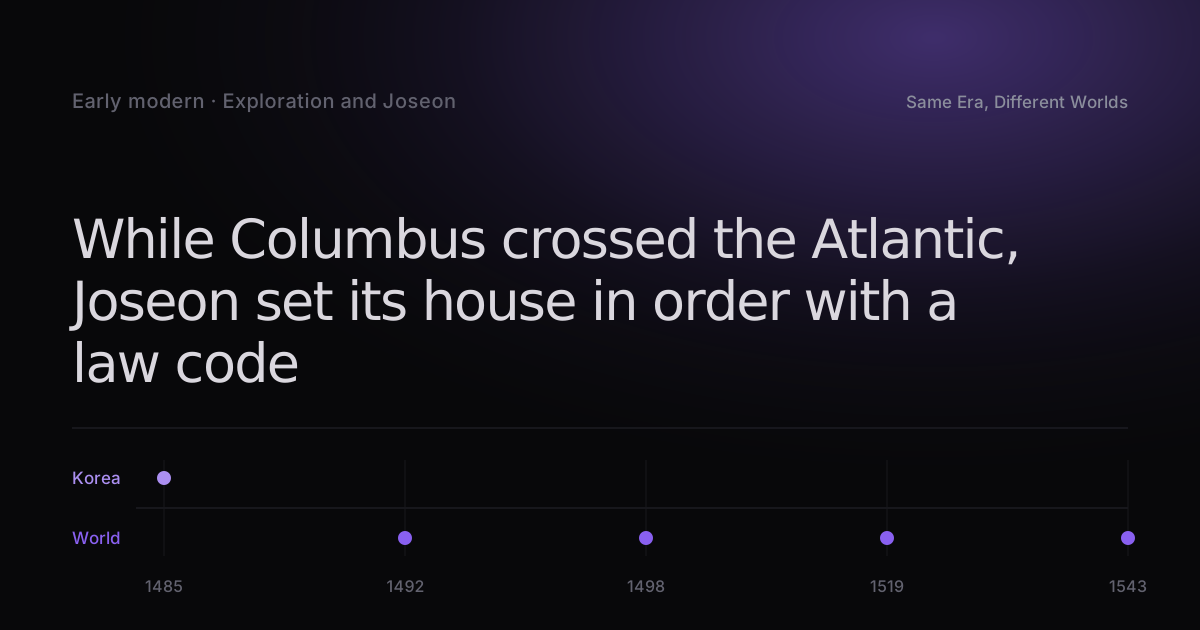
In the late 15th century, Europe and Joseon were facing in opposite directions. Europe pushed outward across unknown seas; Joseon completed, in written law, the order it had already built at home. Each choice was an answer to what its own age was asking.
The Gyeongguk daejeon: a blueprint for a state
Begun under King Sejo, the Gyeongguk daejeon was completed and put into force in 1485 under King Seongjong. Divided into six sections corresponding to the six ministries — personnel, taxation, rites, military, punishments, and works — it set out almost every rule of government, from the appointment of officials to taxes, penalties, and inheritance. Earlier, in 1466, the office land law had granted land only to officials in active service, steadying the state's finances. The late 15th century was the moment Joseon translated a century of institution-building since its founding in 1392 into written law.
Europe, meanwhile, opened the age of exploration in 1492, when Columbus crossed the Atlantic with Spanish backing and reached the Americas. Magellan's fleet set out in 1519 and completed the first circumnavigation in 1522, demonstrating in practice that the earth is round. At precisely the moment Europe's navigators were looking beyond borders and continents, Joseon was perfecting the fineness of its government within the territory it already held.
Stability and expansion: what each choice produced
The contrast is not mere coincidence. Joseon had already fixed its borders in the early 15th century with the four commanderies and six garrisons under King Sejong, and had laid cultural foundations with the creation of its own alphabet. What it needed now was not expansion but consolidation. Europe, by contrast, badly needed new trade routes as the Ottoman Empire took control of Mediterranean commerce, and that need drove the ventures across the Atlantic.
Europe's expansion led, over the following centuries, to the colonization of the Americas, the Atlantic triangular trade, and ultimately a Europe-centered world order. Joseon's stability produced an era of peace into the early 16th century, but it also left the country less attentive to changes beyond its borders. Exactly a century later, in 1592, Joseon would feel the shifting balance of East Asia in the most painful way, when Japan invaded.
What the comparison tells us
It is hard to declare either choice correct. Europe's expansion cast the long shadow of colonial rule, while Joseon's stability succeeded in strengthening the interior but never built the capacity to respond to a rapidly changing outside world. What mattered in the end was not choosing between stability and expansion but how keenly a country watched the changing world from whichever road it took — a point the invasion of 1592 proved at bitter cost.
Columbus's voyage set off what is now called the Columbian Exchange, sending American crops such as potatoes, maize, and chili peppers around the world. The chili is a curious case: carried from the Americas in these years, it reached Joseon around the time of the Imjin War and became a defining element of Korean food. The global network the age of exploration opened was already reaching the peninsula, by the unexpected route of cuisine, in the very period Joseon was inclined to keep its doors shut.
One engine of the age of exploration was hunger for the spice trade. Europeans risked their lives at sea for pepper and its like, and that pursuit turned into a race to secure direct routes to Asia. While Joseon sought stability within a Neo-Confucian order, Europe had already internalized a logic of commercial expansion that would carry it to the far side of the globe in search of profit.
Joseon's tongsinsa missions were East Asia's own network of exchange in this period. Regularized from the mid-15th century, they were nothing like the drama of European voyaging, but as a channel through which Joseon maintained diplomatic and cultural contact with its neighbors they show an openness of a different kind.
How far an order to stop can reach
The question of why Joseon did not go to sea cannot actually be answered by looking at Joseon alone. In the same period the dominant power of East Asia, Ming China, was a state that had already mounted the largest ocean-going voyages in the world and then stopped of its own accord. Zheng He's fleets crossed the Indian Ocean seven times between 1405 and 1433, reaching the east coast of Africa on a scale that bore no comparison to Columbus's little squadron sixty years later. Then the voyages were discontinued, and the Ming went further, restricting private maritime activity under the haijin sea-ban policy. Not for want of technology: it was a decision to stop.
What mattered was how far that decision could reach. When the Ming stopped, all of East Asia inside the tributary order stopped with it. In Europe, by contrast, no one could stop the whole. When Portugal held the route to India, Spain went west instead; when the two divided the world between them under papal arbitration, the Dutch and the English ignored the agreement and pushed in anyway. Voyaging continued not because Europeans were morally bolder but because no one held the authority to call a halt. That structure is precisely what accounts of Joseon's "choice" as idleness or insularity leave out.
The world was already inside the closed door
More striking still is that choosing stability did not place Joseon outside the world economy. Sixteenth-century Joseon sat on the corridor of an entrepôt trade linking Japanese silver to Ming silk and raw thread, and that flow was never wholly stopped by official control. The global circulation of silver created by the age of exploration did not halt at Joseon's border.
Nor did goods. Chili peppers and tobacco, potatoes and sweet potatoes from the Americas arrived and changed both the table and the field long before Joseon ever decided to open its doors. That the chili pepper, the emblem of Korean food today, is a product of the exchange Columbus set in motion is an answer in itself. Globalization does not ask permission. What Joseon could control was the movement of people and ships, not the flow of goods and crops already folded into a world market. The question was never whether to open the door or close it, but how accurately one read the changes that were already inside.
At a glance
| Year | Korean history | World history |
|---|---|---|
| 1466 | The office land law takes effect | — |
| 1485 | The Gyeongguk daejeon completed and enacted | — |
| 1492 | — | Columbus reaches the Americas |
| 1498 | The literati purge of 1498 | — |
| 1519-1522 | — | Magellan's fleet circumnavigates the globe |
Read next
- Era guide: Early Joseon
- The Imjin War and the Armada — two wars paid for in silver
- Hangul and Gutenberg are seven years apart
References
- Gyeongguk daejeon (1485) — the statutory code of the Joseon state
- History of the Ming, biography of Zheng He and records of the haijin policy
- National Institute of Korean History — entries on early Joseon foreign relations and the tongsinsa
- South Korean high school world history curriculum — the age of exploration, the Treaty of Tordesillas, the Columbian Exchange
The facts follow the sources above; the comparisons and interpretation are our own.
You can compare the other events of this era directly in the timeline.
Explore the timeline