Era guide · P5 Early Joseon
Early Joseon — the road Korea chose while Europe was exploring and reinventing itself
Published
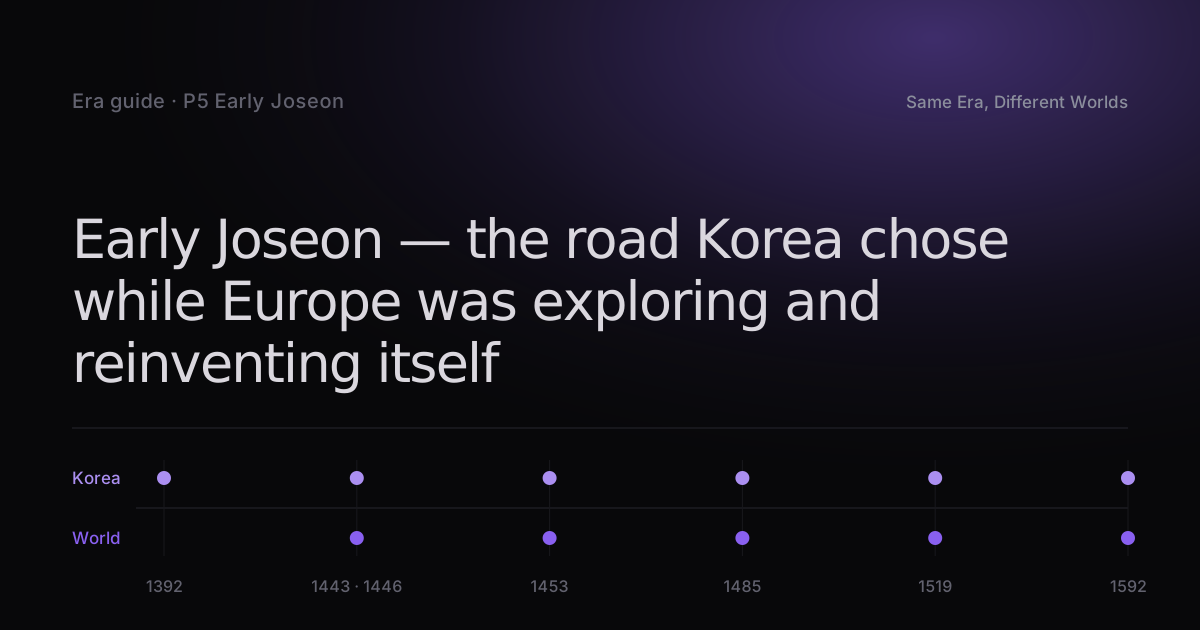
P5 spans exactly two hundred years, from the founding of Joseon in 1392 to the Japanese invasion of 1592. In Korean history it is the era in which institutions and a script were made; in world history it is the era in which Europe went outward. Few stretches of the timeline show the two columns pointing in such different directions.
Korea: two centuries of building inward
Joseon took Neo-Confucianism as its governing ideology and built a centralized bureaucracy. King Taejong abolished private armies and introduced identity tags so that the state held population and force directly. Under King Sejong the Hall of Worthies produced Hangul (created 1443, promulgated 1446), instruments such as the rain gauge and the scaphe sundial, and practical works such as the Nongsa jikseol on farming. The legal system was completed with the Gyeongguk daejeon in 1485. This was the assembly of the machine called a state.
In the sixteenth century the conflict between the entrenched meritorious elite and the rising sarim literati broke out as a series of purges, and Jo Gwang-jo's radical reform programme collapsed in the purge of 1519. As the sarim took power, factional politics formed, and the Neo-Confucian debates of Yi Hwang and Yi I deepened its intellectual life. Then, in 1592, the invasion of a newly unified Japan broke over everything these two centuries had built.
The same centuries elsewhere: two centuries of going out
Gutenberg's press around 1450 collapsed the price of information; the Ottoman capture of Constantinople in 1453 closed the eastern Mediterranean route. Columbus crossed the Atlantic in 1492 and Vasco da Gama opened the sea route to India in 1498. Luther's Ninety-five Theses of 1517 spread on printed sheets and became the Reformation, splitting Europe between Catholic and Protestant. Copernicus in 1543 and the defeat of the Spanish Armada in 1588 stand at the end of the sequence.
What matters is that these events interlock. The land route was blocked, so Atlantic routes were sought; New World silver flowed into Europe and produced a price revolution; without print the Reformation would have stayed a local quarrel. This stretch of the world column is not a list of events but a single chain.
Where the two currents actually meet
First, script and print. Hangul in 1443 and Gutenberg's press around 1450 are seven years apart. Both changed who could hold knowledge, but by opposite routes: Hangul was a script a king made for his people, while movable type spread as a commercial technology — one from the top down, the other sideways from below. It is fair to read the later information structures of the two societies as diverging from there.
Second, gunpowder and silver. Silver mined in the Americas flowed into China and reshaped the Ming economy, while the arquebus that Portuguese traders brought to Japan overturned the balance of its warring states. That gun was the main weapon of the army that invaded Korea in 1592. The age of exploration, in other words, was not a distant matter unrelated to the Imjin War; it supplied that war's weapons. Once that link is visible, the two columns of P5 finally become one story.
Why this state left so many records
A fact often forgotten about early Joseon is that it was among the most prolific record-producing states of its age anywhere. The Veritable Records of the Joseon Dynasty cover 472 years of events; the Diaries of the Royal Secretariat log a king's day almost minute by minute; the uigwe registers record the procedures, the costs and even the names of the artisans mobilized for state ceremonies.
What made this possible was not diligence but institutional design. Court historians wrote down the king's words and acts at his side, and those draft histories could not be read by the king himself. The principle that a ruler could not revise his own record is what made the record credible; the Veritable Records were compiled only after a king's death and stored in separate archives. The anecdote that King Taejong asked for his fall from a horse not to be written down, and that the request itself was written down, follows from this structure.
Set against European chronicles of the same period, generally written by individuals under monastic or courtly patronage, the difference is stark. Joseon's choice was to make record-keeping the business of an office rather than the virtue of a person. This is also why the Korean column of this timeline is unusually dense through the Joseon centuries. It is detailed because the material is abundant, not because the era mattered more. The density of a timeline reflects the density of records, not of events.
Why the science of the fifteenth century did not continue
The three decades of King Sejong's reign are the densest stretch in the history of Korean science. The rain gauge of 1441 was a standardized instrument for measuring rainfall numerically, the self-striking water clock automated timekeeping, and the Chiljeongsan calculated celestial motion for the latitude of the capital. Europe in the same years was still a century short of Copernicus, whose work appeared in 1543.
These achievements did not continue, and the reason lies in who paid for them. Science in Joseon was a state undertaking, and its life span was tied to a king's interest. When Sejong died and the politics changed, the offices and the people dispersed. European science a century later came to rest on several legs at once — universities, printing, competition among patrons, learned societies — and continued elsewhere when any one patron withdrew.
The structure recurring through P5 appears here too. Tie an achievement to a person and that person's lifespan becomes the lifespan of the achievement. Early Joseon reads correctly only when the brilliance of its fifteenth century and the stagnation that followed are held in view together.
Films and series set in this era
The Face Reader (2013) treats the coup of 1453, Luther (2003) the Reformation of 1517, Elizabeth (1998) the English court of the sixteenth century, and Hansan: Rising Dragon (2022) the naval battle of 1592. Put The Face Reader and Luther on the same row and you get two scenes textbooks never place together: a prince manoeuvring for the Korean throne, and a German monk posting theses on a church. That juxtaposition is exactly what this site is for.
At a glance
| Year | Korean history | World history |
|---|---|---|
| 1392 | Founding of Joseon | — |
| 1443 · 1446 | Hangul created and promulgated | Gutenberg’s press (c. 1450) |
| 1453 | The Gyeyu coup | Ottoman capture of Constantinople |
| 1485 | Gyeongguk daejeon completed | Columbus sails (1492) |
| 1519 | Purge of 1519 | Luther's Reformation (1517) |
| 1592 | Imjin War begins | Defeat of the Spanish Armada (1588) |
Read next
- While Columbus crossed the Atlantic, Joseon completed its law code
- While Luther lit the Reformation, Jo Gwang-jo's reform failed
- Next era: Late Joseon
References
- National Institute of Korean History, Korean History Chronicle — Early Joseon
- Gyeongguk daejeon; Veritable Records of King Sejong
- South Korean high-school world history curriculum — Renaissance, exploration, Reformation
The facts follow the sources above; the comparisons and interpretation are our own.
You can compare the other events of this era directly in the timeline.
Explore the timeline