Early modern · The Imjin War and Europe
As the Imjin War began, England had just broken the Spanish Armada
Published
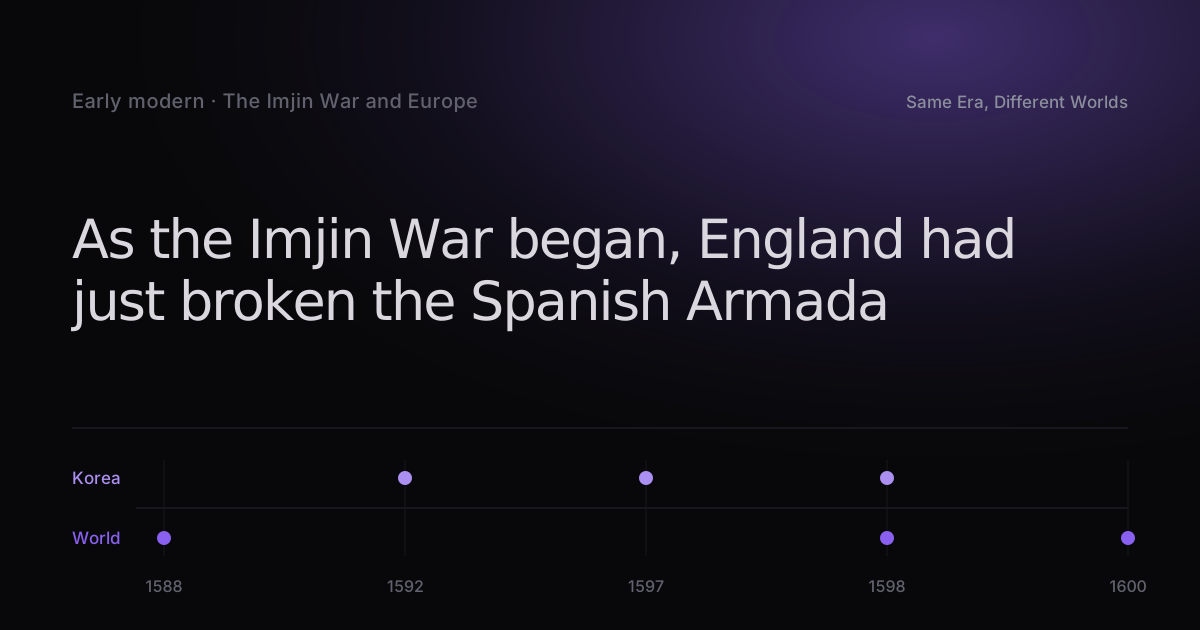
What was Europe doing during the Imjin War? That question is the reason this site exists, and the answer turns out to be closer than expected. In exactly the years Joseon was enduring a seven-year catastrophe, Europe was passing through a decisive turn of its own, in which one naval power fell and another rose.
Japan unified, the Armada broken: two events, one era
In 1590 Toyotomi Hideyoshi ended more than a century of civil war and unified the Japanese islands. His appetite for expansion did not stop at home. In 1592, just after unification, he invaded Joseon on the pretext of asking passage to attack Ming China. The war that followed — held off only by the combined effort of Admiral Yi Sun-sin's navy, volunteer "righteous armies" across the country, and Ming reinforcements — is known in Korea as the Imjin War.
Four years earlier, in 1588, another naval battle was fought on the far side of the world, in the English Channel. The Spanish Armada, reckoned the strongest fleet in Europe, set out to invade England and was driven back by the English navy and by storms. That defeat began the erosion of Spanish maritime supremacy, and England rose in its place as a new sea power. At the very moment Toyotomi was preparing to invade the continent, the myth of a maritime empire that had dominated a century was collapsing in Europe.
Post-Reformation Europe, and a war in East Asia
Late 16th-century Europe was split between Catholic and Protestant in the wake of Luther's Reformation of 1517. Spain cast itself as the champion of the Catholic side and stood against Protestant England; the Armada expedition was an extension of that religious conflict. In France, meanwhile, Henry IV issued the Edict of Nantes in 1598, drawing a line under the wars between Catholics and Protestants — the same year the Imjin War ended. In the very year Europe tied off its long religious conflict, a seven-year war was ending in East Asia.
In those same decades Copernicus' heliocentric theory was belatedly gaining ground in Europe, and Galileo would soon support it by observation. As Joseon began rebuilding from the ruins of war in the late 16th and early 17th centuries, Europe stood at the threshold of the scientific revolution and of absolutist monarchy, on the far side of its age of religious war. Within one century, two entirely different worlds were passing through upheaval in their own ways.
What the comparison tells us
Coincidences like these invite us to see the Imjin War not as a war between Joseon and Japan alone but as an event set within the larger currents of 16th-century world history: the expansion of the age of exploration, the realignment that followed the Reformation, and the spread of gunpowder weapons. Behind Toyotomi's dream of invading the continent lay the matchlock musket, a new weapon introduced from Europe — evidence that technological exchange between East and West was already changing the shape of war itself.
The war left Joseon with wounds that were slow to heal, but it also reset the international order of East Asia. The Toyotomi house lost its footing in the aftermath, and Tokugawa Ieyasu took power and opened the Edo shogunate. Joseon and Japan later restored relations through the tongsinsa, the diplomatic missions Joseon sent to Edo — each country's own attempt to close the wound the war had opened.
The scars ran deep into the structure of Joseon society. With state finances ruined, the government issued blank patents of office for sale in such numbers that the hereditary status order began to loosen, a distant background to the changes in social rank in the later Joseon period. Europe, too, spent lives and strength heavily in its religious wars. For East and West alike, the 16th and 17th centuries exacted a full price for war.
The technology of the Joseon navy — the turtle ship and the panokseon — represents a line of development every bit as independent as the contemporary European galleon. Yi Sun-sin's tactics are still studied in naval history around the world precisely because this was not a local skirmish but a stage on which the finest naval technique of the age met head-on.
The same gunpowder, two doctrines diverging
Only four years separate the waters off Calais in 1588 from those off Hansando in 1592. Gunpowder decided both battles, and yet the two sides used it in opposite ways. The Spanish fleet still stood on a Mediterranean doctrine of closing with the enemy and sending soldiers across: pack the galleons with troops, come alongside, and settle it hand to hand. The English simply refused to let them close, answering instead with broadside gunnery at a distance. The Armada lost not because its ships were weak but because its doctrine was a generation behind.
The same structure repeated itself in East Asia. Japanese naval tactics called for suppressing the enemy deck with matchlock fire and then boarding. The answer Joseon arrived at was, in substance, the English one. The panokseon rode high, which made boarding difficult, and it carried heavy cannon designed to settle matters by bombardment from a distance. When Yi Sun-sin drew the Japanese into open water and spread his line in the crane-wing formation, he was arranging precisely for that distance. That two navies on opposite sides of the world, wholly ignorant of each other, reached the same conclusion — do not close; shoot — suggests that when a new variable like gunpowder is introduced, rational answers converge.
Who paid for these wars
What paid for such expensive wars? Here the two events stop being a coincidence and join into a single chain. The sixteenth century was the century of silver. The Armada could not have been assembled without American silver from the mines of Potosí, and Toyotomi's invasion rested on the explosive growth of Japanese silver production, above all at the Iwami mine. Japan at that moment accounted for a large share of world silver output, and that silver flowed toward the enormous demand created when Ming China converted its taxes to silver payment under the Single Whip reform.
So at the very moment silver dug in the Americas and silver dug in Japan were both being drawn into the single reservoir of China, the two powers holding that silver launched wars, one in the Atlantic and one in East Asia. Read the Imjin War as a war between Joseon and Japan alone and this structure stays invisible. The two wars of the late sixteenth century broke out at opposite ends of one world economy — and making connections like that visible is exactly why this site sets its timelines side by side.
At a glance
| Year | Korean history | World history |
|---|---|---|
| 1517 | — | Luther's Reformation (the Ninety-five Theses) |
| 1588 | — | England defeats the Spanish Armada |
| 1590 | — | Toyotomi Hideyoshi unifies Japan |
| 1592 | The Imjin War breaks out | — |
| 1598 | The Imjin War ends | France: the Edict of Nantes ends the religious conflict |
Read next
- Era guide: The Imjin War and Late Joseon
- The Byeongja War and the Ming–Qing transition
- The age of exploration and later Joseon
References
- Nanjung ilgi (Yi Sun-sin’s war diary) and the Veritable Records of King Seonjo — contemporary records of the war
- Jingbirok by Ryu Seong-ryong — a contemporary reckoning with the war’s causes
- National Institute of Korean History — entries on the Imjin War and the loosening of the status order
- South Korean high school world history curriculum — the Armada, the Edict of Nantes, New World silver and the price revolution
The facts follow the sources above; the comparisons and interpretation are our own.
You can compare the other events of this era directly in the timeline.
Explore the timeline