Early modern · Script and print
Hangul and Gutenberg are seven years apart — same problem, different answers
Published
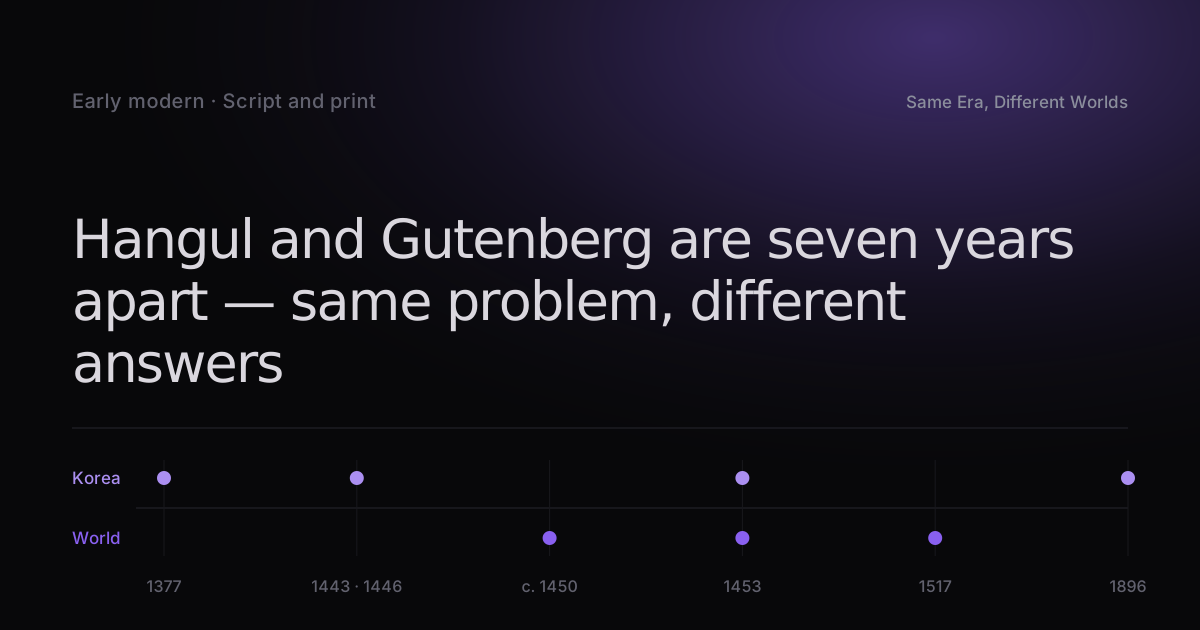
In the timeline, 1443 and 1450 sit almost on the same row. The first is the year King Sejong created Hangul; the second is when Johannes Gutenberg is thought to have made movable-type printing practical. Neither knew of the other, yet both addressed the same problem: why can only a few hold knowledge, and how do you lower the threshold?
The problem was the same: the threshold was too high
In fifteenth-century Korea, literacy meant mastering Chinese characters — thousands of them, requiring years, a teacher and books. In practice it was confined to men of the scholar-official class. The preface to the Hunminjeongeum names that structure exactly when it says that many among the common people "have something they wish to say and in the end cannot express it."
In Europe the threshold was not the script but the price of a book. The Latin alphabet was not hard to learn, but books were copied by hand: months of work in a monastery, on expensive parchment. People could read and still have nothing to read. Two regions faced the same outcome — a monopoly on knowledge — for different reasons, and so their solutions differed too.
The answers differed: a script designed above, a technology that spread sideways
Hangul is a script designed by a state. The Hunminjeongeum haerye sets out its principles: consonants shaped after the organs of speech, vowels after heaven, earth and humanity. Few writing systems in the world have both their date and their design rationale recorded. After promulgation in 1446 it was used for vernacular Buddhist texts, for the Songs of the Dragons Flying to Heaven, for translations of farming and medical manuals, and for royal edicts addressed to the people.
Gutenberg's printing was a technology that spread through a market. He borrowed from investors to print a Bible, and the method was copied across Europe within a generation: by 1500 presses operated in some 250 towns and millions of volumes were in circulation. The decisive moment came in 1517, when Luther's Ninety-five Theses reached all of Germany in weeks and Europe in months as printed sheets. Without the press the Reformation might have remained a theological quarrel in one university town.
Why the outcomes diverged
A common misconception needs answering here: "Korea had metal type first, so why did nothing come of it?" The Jikji, printed at Heungdeok Temple in Cheongju in 1377, is the oldest surviving book printed with movable metal type and is listed by UNESCO, and Joseon recast type repeatedly. The technology was not missing.
The difference lay in where printing sat. Korean metal type was run by state offices and optimized for printing small, exact editions of what the government needed. The customer was the state, so there was little pressure toward mass reproduction. European printing was commercial from the start: it had to print what would sell, and so vernacular Bibles, pamphlets and polemics poured out. It is closer to the truth to say that the demand structure around the technology, not the technology itself, separated the two information landscapes.
Nor did Hangul spread in a straight line. Officials such as Choe Malli objected at its creation, and literary Chinese remained the language of official documents for centuries. Yet letters and fiction in the vernacular circulated among women and the middle strata until Hangul had established itself from below as the script of daily life. Only at the end of the nineteenth century, with mixed-script writing and the all-Hangul Tongnip sinmun of 1896, did it become the script of public life — a diffusion that took 450 years.
Other coordinates in the same years
Look either side of these two events and the mid-fifteenth century turns out to be crowded. In 1453 the Ottomans took Constantinople and closed the eastern Mediterranean route, and in the same year a coup installed a new king in Korea. The Gyeongguk daejeon was completed in 1485; Columbus crossed the Atlantic in 1492. One society was assembling the machine of state with precision, the other was pushing that machine outward. Script and print stood at the head of those two directions.
Why the comparison is still useful
The value of setting Hangul beside the printing press is not to decide which was greater. It is to show that technology does not change a society by itself. Two inventions of the same moment, aimed at the same goal, met different structures of demand and spread at completely different speeds. To the question that returns with every new tool — what will this change? — the fifteenth century answers that the answer is not inside the tool.
Korea printed with metal type first — and it changed less
One fact complicates the comparison. Korea printed with movable metal type before Europe did. The Jikji, printed at Heungdeoksa temple in Cheongju in 1377, is the oldest surviving book printed with metal type anywhere, and it predates Gutenberg by some seventy years. If technology by itself drove social change, Korea should have had its information revolution first. It did not. The question is why.
The answer lies less in the machine than in the script it had to set. Printing in literary Chinese meant cutting and casting thousands of distinct characters before a single page could be composed, so the initial cost of a font was enormous and only a state could bear it. An alphabet of twenty-odd letters, by contrast, let a small workshop own a full set and recoup the outlay over many short print runs. European printing could therefore be a business; Korean printing remained an office of government. That is why Korean type produced exact editions in small numbers of what the court needed, while European presses poured out whatever would sell.
Where the two inventions finally met
Here the comparison closes an unexpected circle. Hangul solved the problem of a script that was too hard to learn; movable type solved the problem of books that were too expensive to make. Each society had only half the solution, and the halves did not join for centuries. In Korea an easy script existed while cheap mass printing did not; in Europe cheap printing existed while literacy was still gated by cost and schooling.
The two halves finally came together at the end of the nineteenth century. When the Tongnip sinmun appeared in 1896, printed entirely in Hangul on a mechanical press, a script anyone could learn in a day met a technology that could put thousands of identical copies into the street each morning. Public opinion as a mass phenomenon in Korea begins there — 450 years after the script and 440 after the press. What that long delay shows is that inventions do not act on societies one by one. They wait for each other, and for the demand that will use them.
At a glance
| Year | Korean history | World history |
|---|---|---|
| 1377 | Jikji printed with movable metal type | — |
| 1443 · 1446 | Hangul created and promulgated | — |
| c. 1450 | — | Gutenberg’s movable-type press |
| 1453 | The Gyeyu coup | Ottoman capture of Constantinople |
| 1517 | — | Luther’s Ninety-five Theses |
| 1896 | The all-Hangul Tongnip sinmun | — |
Read next
- While Luther lit the Reformation, Jo Gwang-jo’s reform failed
- Era guide: Early Joseon
- Era guide: Goryeo, where the Jikji comes from
References
- Hunminjeongeum haerye — preface and explanation of letter design
- UNESCO Memory of the World — Jikji (1377)
- National Institute of Korean History — entries on Sejong and Hangul
The facts follow the sources above; the comparisons and interpretation are our own.
You can compare the other events of this era directly in the timeline.
Explore the timeline