Early modern · The Manchu invasion and East Asia
Behind the humiliation of 1637 lay a tectonic shift: the Ming giving way to the Qing
Published
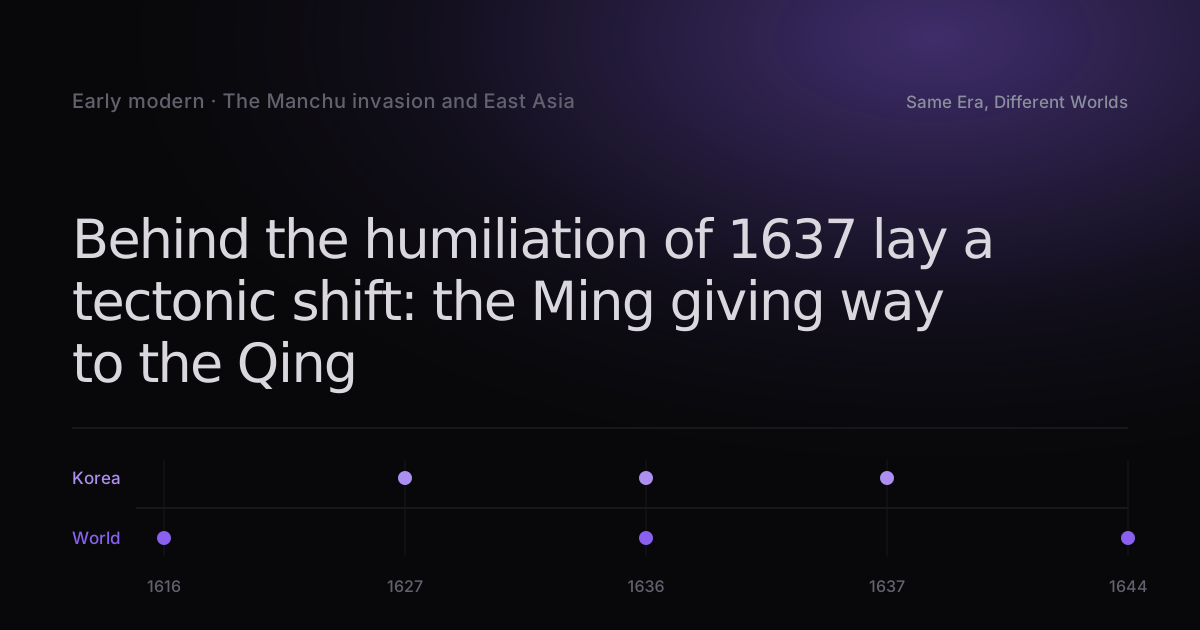
In Korea the Manchu invasion of 1636 is usually remembered as a single humiliation: defeat at the hands of the Jurchen, whom Joseon had regarded as barbarians. But the war was not Joseon's alone. It was part of a far larger remaking of the East Asian order, in which the Ming dynasty collapsed and the Qing took China. The surrender at Samjeondo is the mark that upheaval left as it passed across the peninsula.
From Later Jin to Qing: two invasions
Nurhaci had united the Jurchen of Manchuria and founded the Later Jin; his successor, Hong Taiji, meant to make certain of Joseon at his back before attacking the Ming. In 1627 the Later Jin invaded and imposed a relationship of brotherhood — only the beginning. In 1636, having renamed his state Qing, Hong Taiji demanded that Joseon accept the relationship of ruler and subject, and when Joseon refused he invaded again in force. King Injo held out at the mountain fortress of Namhansanseong before he was finally obliged to perform the rites of surrender before the Qing emperor at Samjeondo.
The timing is what matters. That the Qing invaded Joseon in the very year it took its new dynastic name and declared itself an empire shows that this was no ordinary border raid. It was a symbolic act: a new empire proclaiming itself and choosing Joseon as its first conquest.
The fall of the Ming, and Joseon's position
Just eight years later, in 1644, the Qing brought the Ming down entirely and became the empire ruling all of China. Strictly speaking, the peasant army of Li Zicheng destroyed the Ming first, and Qing forces entered Beijing amid that disorder to become China's new masters. Joseon's submission in 1636 was, in effect, the ground being cleared for the Qing to swallow the Ming whole.
For Joseon the weight of the event went well beyond a lost war. Joseon regarded the Ming as owed a debt for saving the country during the Imjin War and tried to keep faith with it, yet in the end the logic of force required surrender to the Qing it had dismissed as barbarian. Out of that experience grew a conviction among Joseon's scholars that their country was now the last bastion of Chinese civilization in the Ming's place. More than a century would pass before envoys who had seen the Qing's development firsthand began arguing that Joseon should learn from it.
What the comparison tells us
The invasion is more than one country's humiliation: it shows what a small state caught between them must bear when great empires change places. Faced with the tectonic shift from Ming to Qing, Joseon had few options. That is not so different from the position countries between great powers still find themselves in, which is why this war remains worth revisiting.
Joseon later made a northern expedition against the Qing an official aim under King Hyojong, declaring its intent to avenge the defeat, but the sheer gap in strength meant it was never attempted. In the 18th century, on the contrary, scholars who had seen how the Qing had developed formed the Northern Learning school and argued for studying it — a practical reassessment of a state Joseon had regarded only as barbarian. A relationship that began in humiliation turned, in the end, into a source of learning.
The forty-seven days of resistance at Namhansanseong were consumed by hunger, cold, and a fierce argument between those who would fight on and those who would negotiate. The clash between Choe Myeong-gil, who argued for peace, and Kim Sang-heon, who argued for resistance, is still invoked as the emblem of a debate about whether to put reality or principle first. That internal argument compresses the dilemma a weak state faces when great powers force a choice upon it, which is why it is so often cited today.
The wound left its mark on literature and record alike. The ceremony in which Injo bowed three times and knocked his head to the ground nine times before the Qing emperor was remembered by Joseon's scholars as a lasting disgrace, and the memory of that day lay beneath Joseon's view of the outside world for generations afterward.
The Qing, for its part, did not annex Joseon but left it a tributary within a system of investiture — a strategy that put practical advantage ahead of formal claims. Joseon served the Qing as its superior in form while retaining much of its own institutional life internally, and so kept a substantial measure of self-rule.
Why the Qing did not swallow Joseon
To read the decision not to annex Joseon as generosity is to misread the event. It was a calculation. In 1637 the overriding task before the Qing was to break through the Shanhai Pass and bring down the Ming, which meant turning the whole of its strength to the southwest. Ruling Joseon directly would have required leaving an army of occupation, rebuilding a tax system, and absorbing resistance. Taking a surrender and keeping Joseon as a tributary secured the rear and supplied grain and troops without leaving a single soldier behind.
The same logic had operated four centuries earlier. After forcing Goryeo's submission at the end of thirty years of resistance, the Mongols did not abolish the Goryeo dynasty either, but bound it as a royal son-in-law state. Both stopped at the point where the cost of conquest exceeded the benefit of rule. That the peninsula preserved dynastic continuity was not because its conquerors were merciful, but because a land of mountains and fortresses was expensive to govern directly. That such leverage lay hidden inside humiliating peace terms is a reminder that a weaker state's bargaining position is never quite as empty as it looks.
The price of principle was a century and a half
The real cost Joseon paid after the war was not an indemnity but time. Joseon continued to honor the already-fallen Ming as the legitimate center, built the Daebodan altar to sacrifice to Ming emperors, and made a doctrine of "little China" — with the Qing cast as barbarians — into the state's understanding of itself. This was not mere stubbornness. It was a political resource, filling the legitimacy the dynasty and its elite had lost in defeat with the narrative that "we are the last heirs of civilization."
The trouble is that the narrative blocked observation. The eighteenth-century Qing, across the reigns of the Kangxi, Yongzheng and Qianlong emperors, was the largest empire of its age, its population and territory expanding enormously, absorbing even the learning of the European Jesuits. Joseon began to look that reality in the face only with the Bukhak school of Park Ji-won and Park Je-ga in the late eighteenth century — a hundred and fifty years after the war. That the Yeolha ilgi (1780) records the bricks and carts of Qing China with such astonishment means, read the other way, that until then no one had gone and looked properly. Keeping faith with a principle has a price too, and the bill usually arrives late.
At a glance
| Year | Korean history | World history |
|---|---|---|
| 1627 | The first Manchu invasion | Expansion of the Later Jin |
| 1636 | The second invasion; the humiliation at Samjeondo | Founding of the Qing |
| 1644 | — | The Ming falls; the Qing rules China |
Read next
- Era guide: The Imjin War and Late Joseon
- The Imjin War and the Armada — two wars paid for in silver
- The French Revolution and the reforms of King Jeongjo
References
- Veritable Records of King Injo — the siege of Namhansanseong and the terms agreed at Samjeondo
- Sanseong ilgi and the memorials of Choe Myeong-gil and Kim Sang-heon — primary records of the peace-versus-resistance debate
- Yeolha ilgi by Park Ji-won (1780) — a Bukhak scholar’s observations of Qing China
- National Institute of Korean History — entries on the Byeongja War, the northern-expedition and Bukhak debates, and the Daebodan
The facts follow the sources above; the comparisons and interpretation are our own.
You can compare the other events of this era directly in the timeline.
Explore the timeline