Early modern · The French Revolution and Jeongjo
While France tore down its monarchy, Joseon's King Jeongjo reformed from the throne
Published
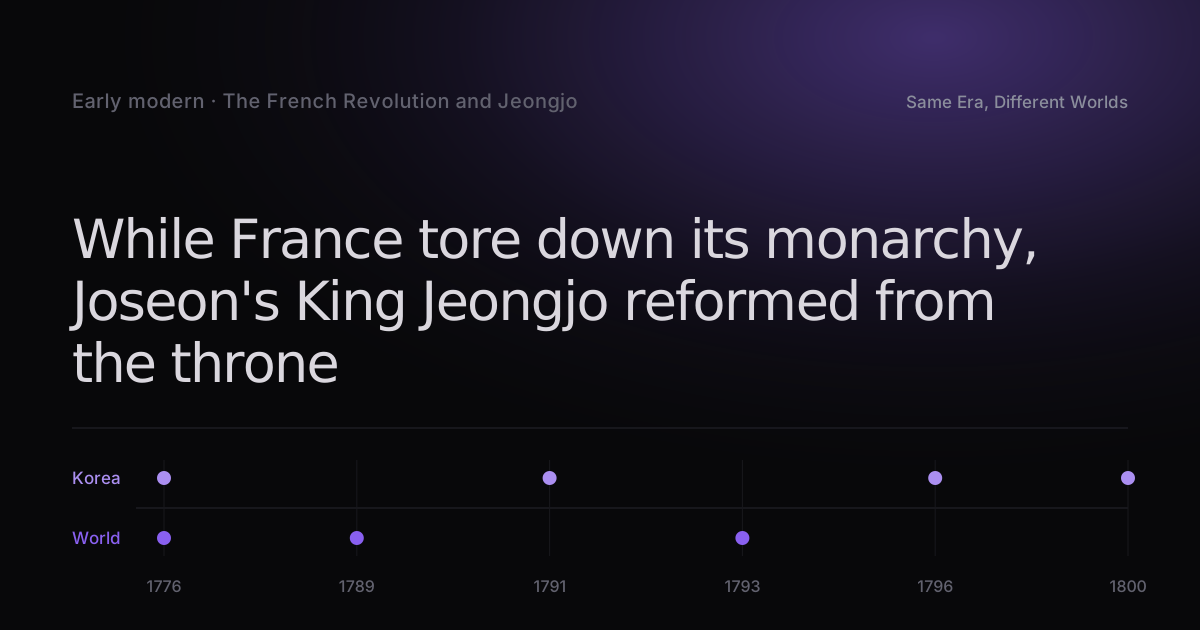
In the late 18th century, France and Joseon stood before a similar question: how to overcome the contradictions of an old order. The answers they chose were opposites. One brought down the monarchy by revolution from below; the other tried to solve the problem by strengthening the throne through reform from above.
Jeongjo and the Gyujanggak: the reforming monarch
King Jeongjo, who came to the throne in 1776, inherited a court in which factional struggle had weakened royal authority. On taking power he established the Gyujanggak — royal library, academy, and policy institute in one — as both his political base and the think tank of his reforms. Through a program of advanced study for promising young officials he trained talent directly, and he sought to steady the court through a policy of impartiality that favored no single faction. The construction of Hwaseong fortress at Suwon was the symbolic product of the same reforming politics.
Jeongjo's reforms rested on the conviction that a country runs straight only when the king is more capable and more even-handed than his officials. The problem, in other words, was not monarchy itself but a monarchy that was not working. His reform therefore stayed within the system as an improvement to it, and when he died suddenly in 1800 its momentum died with him.
The fall of the Bastille: overturning the system itself
France in the same years was on an entirely different road. With its old order of estates — clergy, nobility, and commoners — and the crown's reckless finances piled up past the breaking point, the people of Paris stormed the Bastille, the symbol of absolute monarchy, in 1789. The Declaration of the Rights of Man and of the Citizen followed, putting liberty, equality, and popular sovereignty into the world as principles.
The French Revolution differed fundamentally from Jeongjo's reforms in its diagnosis: the fault lay not in a particular king but in monarchy itself, and in the order of estates above it. The revolution went through great turns with the rise and fall of Napoleon, yet the ideas of popular sovereignty and modern civil society spread across Europe and eventually the world. Roughly a century after Jeongjo's death, Joseon too would face a version of the same question — how to turn a monarchy into a modern political system — through the Gabo Reforms and the Independence Club.
What the comparison tells us
The contrast shows how wide a spectrum the word "reform" can cover. Jeongjo's was a gradual approach that worked through royal authority inside the system; the French Revolution was a radical one that replaced the system outright. Tellingly, Joseon's reforming momentum weakened after Jeongjo's death, while France — for all the turmoil of Napoleon's rise and fall — never managed to undo the ideas the revolution had released.
Those ideas spread across Europe paradoxically through Napoleon's wars of conquest, and became the seed of liberal and nationalist movements throughout the 19th century. In Joseon, by contrast, rule by royal in-law families after Jeongjo's death set reform sharply back, and modern changes such as the abolition of hereditary status were attempted only belatedly, in the Gabo Reforms of 1894 — nearly a century later. Joseon's history after Jeongjo shows how easily gradual reform from above can break with the death of a single king.
Where Jeongjo cultivated talent through the Gyujanggak, post-revolutionary France under Napoleon trained a modern administrative and military elite through institutions such as the grandes écoles. Both made the cultivation of capable people central to governing, but the systems those people served — a hereditary monarchy in one case, a post-revolutionary empire in the other — were entirely different, a reminder that the same instrument can serve quite different ends.
After Jeongjo's death Joseon entered the era of rule by royal in-laws under Sunjo, Heonjong, and Cheoljong, in which royal authority weakened and particular families monopolized power. Where France, after many reversals, moved toward a republic, in Joseon the departure of one reforming monarch severed the current of reform altogether.
Why the king was a reformer in one place and a target in the other
Two kings of the same years stood in opposite positions: Jeongjo was the agent of reform, Louis XVI its target. Before explaining that by the character of the men, look at the treasury. What triggered the French Revolution was not an idea but insolvency. The Bourbon monarchy had exhausted its finances on the Seven Years' War and then on backing American independence, and raising further taxes required the consent of a clergy and nobility who held exemptions. So in 1789 the Estates-General was summoned for the first time in 175 years, and that assembly hall became the ignition point of the revolution.
Jeongjo faced no such bill. Eighteenth-century Joseon fought no foreign war, and its tax system had been rationalized by the Daedong and Gyunyeok reforms. The king had no reason to call representatives of the estates together to beg for money. That is why Jeongjo could establish the Gyujanggak and the Jangyongyeong and drive reform downward from the top. Revolutions begin not because a king is incompetent but because a king is bankrupt; reform stayed in royal hands in Joseon because the Joseon court was not. That is what separates two events sitting on the same line of a timeline.
Do institutions outlive people?
The real test of both reforms came after their protagonists were gone. When Jeongjo died in 1800, what he had built was erased quickly. The Jangyongyeong, his personal guard, was abolished in 1802; the Gyujanggak survived but shrank from a command post of reform into a library. Because the instruments of reform were tied to the personal power of the king, they vanished when he did.
In France the opposite happened. Napoleon fell in 1815 and the Bourbons returned, yet the Napoleonic Code, the metric system and the departmental administration remained — several of them to this day. Even a restoration government could not undo them, for a simple reason: they were not organizations loyal to a particular ruler but infrastructure that any ruler would need. What Jeongjo's frustration teaches is not that reformers have short lives, but that if reform is tied to a person, that person's lifespan becomes the lifespan of the reform.
At a glance
| Year | Korean history | World history |
|---|---|---|
| c. 1765 | — | The Industrial Revolution begins (Britain) |
| 1776 | Jeongjo accedes; the Gyujanggak is established | — |
| 1789 | — | The French Revolution (Declaration of the Rights of Man) |
| 1796 | — | The White Lotus Rebellion (signs of Qing decline) |
| 1799 | — | Napoleon takes power |
Read next
- Era guide: The Imjin War and Late Joseon
- The Catholic persecutions and the legacy of the Reformation
- Era guide: Sedo politics, port opening and modernization
References
- Veritable Records of King Jeongjo and Hongjae jeonseo — the founding of the Gyujanggak and Jangyongyeong
- Veritable Records of King Sunjo — the abolition of the Jangyongyeong in 1802
- National Institute of Korean History — entries on Jeongjo’s reforms and rule by royal in-law families
- South Korean high school world history curriculum — the Estates-General and the French Revolution, the Napoleonic Code
The facts follow the sources above; the comparisons and interpretation are our own.
You can compare the other events of this era directly in the timeline.
Explore the timeline