Era guide · P6 Late Joseon
Late Joseon — how Korea passed through the centuries of revolution and industry
Published
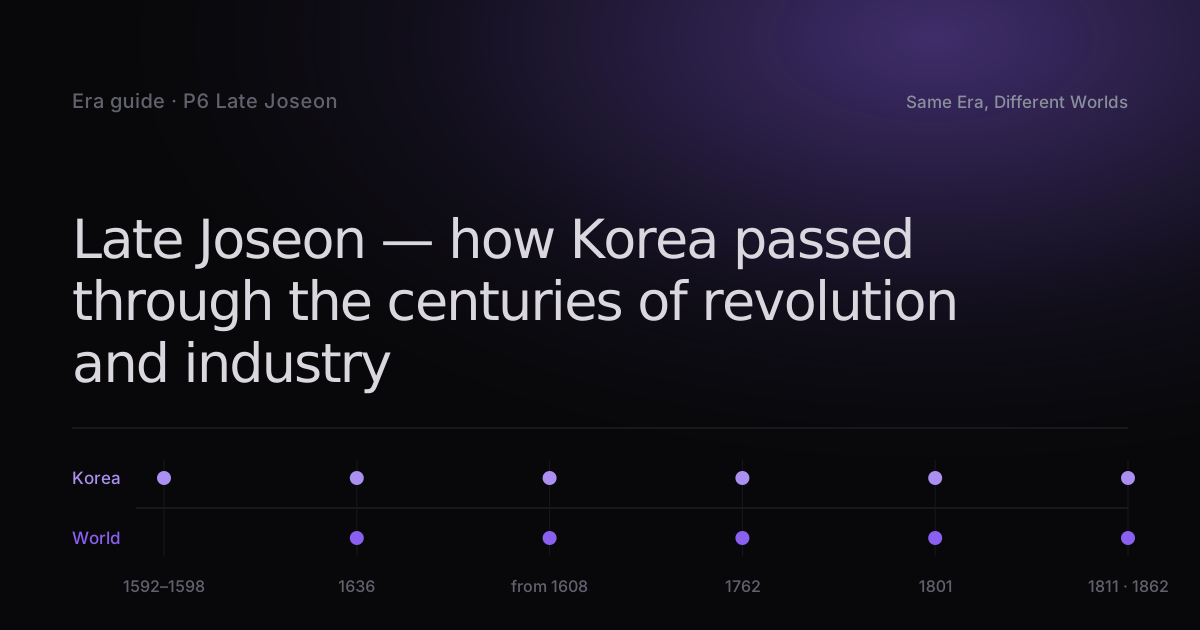
P6 covers some 270 years, from the Imjin War of 1592 to the eve of King Gojong's accession in 1863. It is also the most contested stretch of Korean history, because the question "why was Korea late to modernize?" hangs over all of it. Reading the columns side by side lets us ask that question a little differently.
Korea: reconstruction and fracture
The Imjin War (1592–1598) and the Qing invasion of 1636 shook Joseon materially and psychologically. In the recovery the daedongbeop was extended, converting tribute into rice, cloth and cash and stimulating a commercial money economy. Standard coinage circulated nationally and periodic markets spread: society was visibly moving. The impartial-appointment policy of kings Yeongjo and Jeongjo tried to contain factional conflict, and Jeongjo's royal library and the fortress at Hwaseong remain the symbols of a reforming monarch.
The fractures deepened at the same time. Honorary appointment certificates sold after the wars eroded the status order; Silhak scholars argued for land reform (Yu Hyeongwon, Yi Ik, Jeong Yak-yong) and for commerce and industry (Park Jiwon, Park Je-ga) without becoming policy. After Jeongjo's death in 1800 in-law politics set in, the three fiscal systems fell into disorder, and revolts followed — Hong Gyeong-nae in 1811 and the peasant risings of 1862. It is closer to the truth to read this as an age in which the base of society was already changing and the structure above it could not keep up.
The same centuries elsewhere: from kings to citizens
Seventeenth-century Europe produced the sovereign-state system through the Thirty Years' War and the Peace of Westphalia, and absolutism peaked under Louis XIV. Then the Glorious Revolution of 1688, American independence in 1776 and the French Revolution of 1789 moved the ground of power from kings to citizens. The industrial revolution that began in late-eighteenth-century Britain changed how things were made, and by the mid-nineteenth century European states held overwhelming material force. In China the Opium War of 1840 began the unravelling of the Qing; Japan, opened in 1853, changed course with the Meiji Restoration of 1868.
One thing is easy to miss here: Europe's revolutions were themselves the accumulation of centuries of conflict and failure. After 1789 came the Terror, the Napoleonic empire and the Restoration. Comparing Joseon's failed reforms with Europe's successes erases Europe's own failures and leaves only outcomes.
Where the two currents actually meet
First, Western learning. From the seventeenth century envoys travelling to Qing China brought back Western books and Catholic doctrine, and by the end of the eighteenth what had begun as study had become faith. The persecutions that followed, beginning in 1801, were not simple religious repression: the question of ancestral rites put the new faith in direct collision with the Confucian social order. Set beside a Europe then relativizing church authority through the Enlightenment, the contrast is sharp.
Second, the silver and ginseng trade. Joseon profited as an intermediary between Qing China and Japan, and that trade was part of the global circulation of American silver into Asia. Contrary to the cliché of isolation, economically the kingdom sat squarely inside the East Asian network.
The crack the two wars opened in the status order
The deepest mark left by the Imjin and Byeongja wars was not territorial but in the order of social status. With state finances ruined, the court issued blank patents of office for sale and accepted grain or cash in exchange for rank on a large scale, while slaves who had earned military merit were manumitted. Status had become something money and service could buy.
The result shows up in the registers. Household records through later Joseon show the share of households listed as yangban rising steadily and the number of slaves falling; by 1801 most government slaves had been freed. None of this amounted to equality. The commoner the yangban title became, the more actual power concentrated in a few families, and at the end of that current stands rule by royal in-laws. The spread of formal status and the concentration of real power advanced together — the paradox of later Joseon.
War was shaking social structure in Europe in the same period. In the German lands depopulated by the Thirty Years' War, labor became scarce and a reorganization resembling the aftermath of the Black Death followed. War always does more than kill people, and it is the more that makes the next century.
Factional strife, or politics?
Later Joseon is often described through the word "factional strife," a phrase that carries its verdict already — wasteful infighting. That verdict was substantially reinforced by colonial-era historiography of Korea, for which the story that Joseon fell by dividing against itself was useful in justifying rule.
Read the records directly and another picture appears. The Ye controversies turned on how long a king should be mourned, but the real question was whether the king stood under the same ritual law as the scholar-officials — a question about the nature of the state. The sudden reversals of the Sukjong reign were brutal, and they were also how that king reshuffled the political landscape. Factions competed over policy and doctrine, and worked alongside censorate institutions designed to check them. Set beside the formation of Whigs and Tories in England in the same decades, it is hard to call the phenomenon distinctively pathological.
Nor is it to be romanticized. Competition ran into purges and executions and consumed capable people, and the very need for the tangpyeong policy of even-handed appointment proves the damage. The accurate account does not choose between the two readings but records both the character of the competition and what it cost.
Films and series set in this era
This is the busiest stretch of the film column. Roaring Currents (2014) and Noryang (2023) close out the Imjin War, The Fortress (2017) treats the siege of 1636, The Throne (2015) the killing of Prince Sado in 1762. On the world side sit The Crucible (1996, Salem 1692), Napoleon (2023) and Les Misérables (2012, the June Rebellion of 1832). Put The Throne and Napoleon on one screen and an uncomfortable simultaneity appears: while a Korean king sealed his son in a rice chest, the seeds of citizen revolution were growing across the Atlantic. What to make of that contrast is the reader's business — but knowing the two scenes belong to the same century is where the thinking has to start.
At a glance
| Year | Korean history | World history |
|---|---|---|
| 1592–1598 | The Imjin War | — |
| 1636 | Qing invasion of Joseon | Thirty Years' War (1618–1648) |
| from 1608 | Daedongbeop extended | Glorious Revolution (1688) |
| 1762 | Death of Prince Sado | American independence (1776); French Revolution (1789) |
| 1801 | Catholic persecution of 1801 | Spread of the industrial revolution |
| 1811 · 1862 | Hong Gyeong-nae's revolt; peasant risings | Opium War (1840) |
Read next
- Behind the humiliation of 1636 lay the Ming–Qing transition
- The French Revolution and King Jeongjo’s reforms
- Next era: Port opening and modernization
References
- National Institute of Korean History, Korean History Chronicle — Late Joseon
- South Korean high-school world history curriculum — absolutism, revolutions, industry
The facts follow the sources above; the comparisons and interpretation are our own.
You can compare the other events of this era directly in the timeline.
Explore the timeline