Analysis · 37 historical films
When people praise a film’s "accuracy" they usually mean the costumes — four layers of accuracy across 37 films
Published
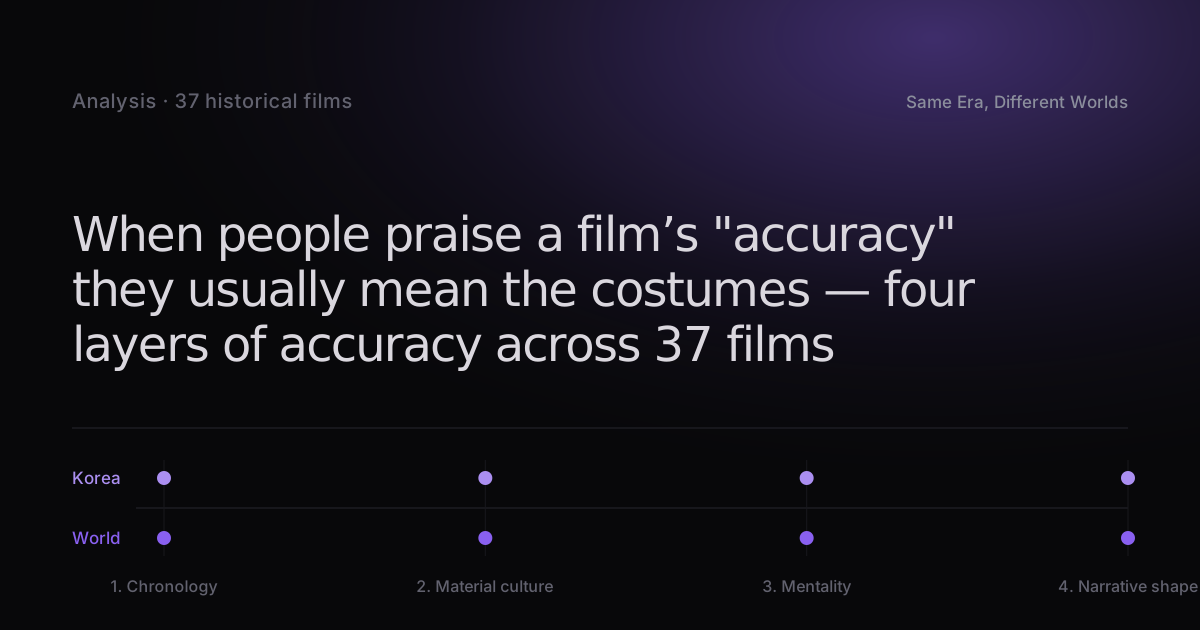
The film timeline on this site carries 37 historical films and series, arranged by the year in which they are set. The earliest setting is around 3000 BCE (Noah) and the latest is 1987 (1987: When the Day Comes). Using that list as material, this piece asks a single question: when we say a film's history is "well researched," what are we actually praising?
Accuracy is not one thing
Historical accuracy in film separates into at least four layers. The distinction is one this site arrived at while organizing the 37 titles, and each layer differs entirely in how easily it can be checked and how often it is violated.
1. Chronology and events — what happened, and when. The easiest to verify, and so rarely wrong outright. 2. Material culture — clothing, buildings, weapons, tools. Visible on screen, so the layer audiences react to immediately. 3. The mentality of the period — what people of that time took for granted. Invisible on screen, and hardest to check. 4. Narrative shape — what kind of story the events are poured into. Usually not recognized as a question of accuracy at all.
1. Chronology: compressed rather than wrong
Run through the 37 and outright chronological error is uncommon. What is common is compression: years reduced to days, several people merged into one. The way The Admiral (1597), Hansan (1592) and Noryang (1598) each place a single naval battle at the center and rearrange what surrounds it works exactly this way.
Occasionally the chronology itself is altered. Braveheart (set around 1300) puts its hero in a kilt of a kind that did not appear for roughly another three centuries. Gladiator (set in 177) stages the death of Commodus in the arena, whereas he was in fact killed in his bath. What is striking is how little such errors damaged either film's standing. Audiences care less about layer one than one might assume.
2. Material culture: where the praise collects
Most compliments about historical accuracy are aimed at this layer: the armor and the winter fortress of The Fortress (1636), the court dress and ritual of The Throne (1762), the streets of Jerusalem in Kingdom of Heaven (1184). Because you can see them.
The difficulty is that quality in this layer guarantees nothing about the others. If anything it works the other way. The more meticulous the material detail, the more readily an audience believes the rest is true as well, and accurate clothing becomes the vehicle carrying inaccurate thought. This is the trickiest point in the whole genre.
3. Mentality: the layer most often modernized
This is the layer adjusted most widely across the 37. The reason is simple: transplant the thinking of the period unchanged and a modern audience cannot identify with the protagonist.
The characters of The Face Reader (1453) and The Throne (1762) are torn between their own desires and a father's expectations, and the vocabulary of that conflict is largely that of modern psychology. There is little evidence that Joseon scholar-officials described their inner lives in such terms. Elizabeth (1558) presents the queen's choices as personal self-determination, whereas for a sixteenth-century monarch marriage was not a private decision but an act of diplomacy. The Last Samurai (1877) organizes samurai resistance into the twentieth-century frame of tradition against modernity.
It is hard to call this simply error. A character whose mentality is entirely alien is not comprehensible to an audience, and without comprehension there is no film. Still, it is worth noting that when audiences praise a film's research, this layer is generally not under review. What we are watching, often enough, is a modern person in period dress.
4. Narrative: the era chooses the story shape
The fourth layer concerns what kind of story the events are made into, and here the data shows something. Consider when the works about recent Korean history were released. 12.12: The Day, about the coup of December 1979, came out in 2023; A Taxi Driver, about Gwangju in 1980, in 2017; 1987, about the June Struggle, also in 2017 — 44, 37 and 30 years after the events respectively.
Works set in Joseon on the same list suffer no such delay. The Imjin War trilogy or The Fortress carry no political cost whenever they are made. In other words, the nearer the period, the longer it takes to reach the screen. A historical film is a statement about the past and simultaneously a statement about when it became permissible to say it.
The distribution of the list says something too. Of the 37, 22 are set after 1500 — close to three fifths — and 10 are set in the twentieth century. Antiquity and the middle ages are comparatively thin. The scarcer the sources, the more room there is to imagine, and the harder it is to find the specific individual an audience can attach itself to.
What the platform changed
The list also records a change of form. Of the 37, 31 are cinema releases, 5 are Netflix originals and one is on Apple TV+. Every one of the streaming titles is a series running many hours. Pachinko (set from 1915) covers four generations, and Mr. Sunshine (1902) covers a few years at the end of the Korean Empire, each across dozens of hours.
That difference connects directly to the layers above. A two-hour film has no choice but to compress layer one; a twenty-hour series trades compression for room to unfold layer three, because it can afford scenes that explain why a character thinks as they do. Much of the credit Pachinko earned for its portrayal of Koreans in Japan comes from exactly that room.
Series carry a different risk in return. Filling the running time means inventing events and characters the sources do not contain, and fiction in layer one increases. Some works, like Kingdom (set in the 1600s), dodge the problem head-on by mixing genres outright. Change the form and the weak point of the accuracy moves with it.
So what should one watch for?
The purpose of this analysis is not to rule films wrong. A historical film is not a monograph, and without compression and adaptation there is no two-hour story. The useful posture is this: watch for which layer is accurate and which has been adjusted.
Demanding layer-one accuracy from Noah (set around 3000 BCE), a film working with myth to begin with, is a category error. In a film like 12.12: The Day, dealing with events whose survivors are living, accuracy in layer one becomes a matter of ethics. Applying one standard to every film is itself an inaccurate posture.
And this is where the timeline on this site comes in. Placing a film at the year it is set in puts the Korean, world and Christian history entries of that same moment in the columns beside it — The Fortress next to the entries for the Byeongja War and for the Thirty Years' War. What a film compressed and what it left out is easiest to see when the neighboring columns are read alongside it.
At a glance
| Layer | What it gets right | How checkable | Examples from the list |
|---|---|---|---|
| 1. Chronology | What happened and when | Easy | 1987, Schindler’s List / diverging: Braveheart, Gladiator |
| 2. Material culture | Dress, buildings, weapons, tools | Moderate (visible) | The Fortress, The Throne, Kingdom of Heaven |
| 3. Mentality | What people then took for granted | Hard (invisible) | The Face Reader, Elizabeth, The Last Samurai |
| 4. Narrative shape | The story form events are poured into | Rarely discussed | Ode to My Father (family saga), the Imjin War trilogy |
Read next
- Era guide: The Imjin War and Late Joseon
- Era guide: Contemporary Korea, since liberation
- The Byeongja War and the Ming–Qing transition
References
- This site’s own data/movies.json — setting year, release year, platform and synopsis for all 37 titles. Every figure in this analysis is counted from that file.
- Publicly available production information for each title (release year, original title, distribution platform)
- Primary sources for the events depicted, such as the Samguk sagi and the Veritable Records of the Joseon Dynasty
- National Institute of Korean History — entries for the periods depicted
The facts follow the sources above; the comparisons and interpretation are our own.
You can compare the other events of this era directly in the timeline.
Explore the timeline