Modern · Industry and the age of in-law rule
The steam engine and rule by royal in-laws — what each society was optimizing
Published
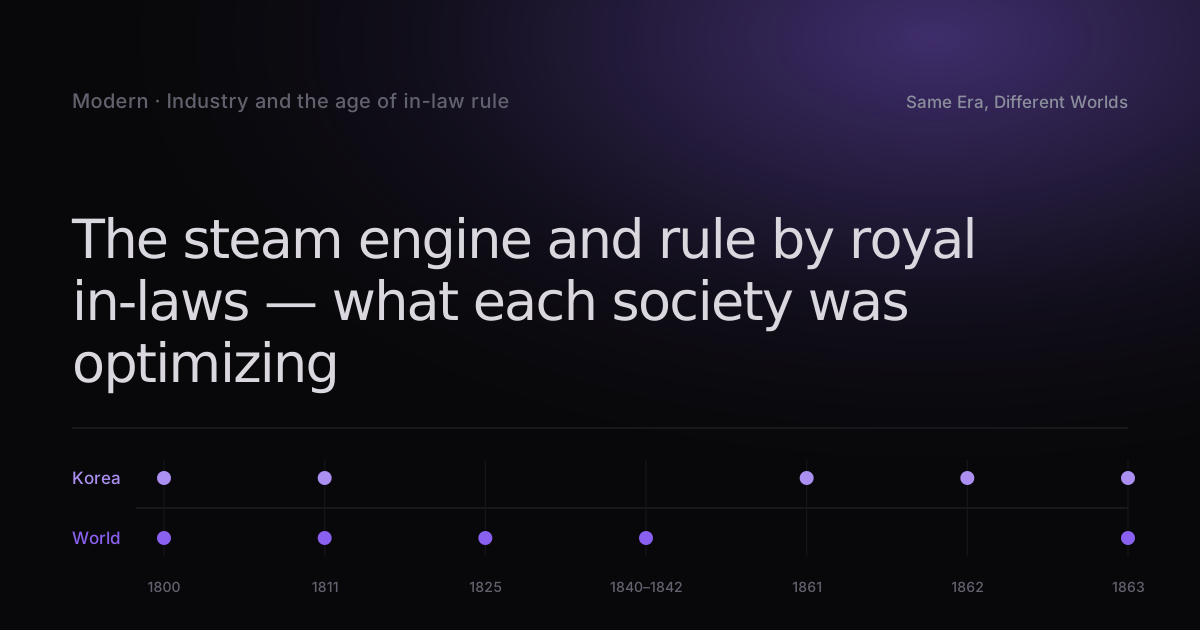
When King Jeongjo died in 1800 and the eleven-year-old Sunjo took the throne, Joseon entered some sixty years of rule by royal in-law families. In the same year Volta invented the battery; in 1804 Trevithick ran the first steam locomotive; in 1825 the Stockton and Darlington Railway opened. Korean accounts usually summarize this period as stagnation and corruption — a summary that writes down the result of a comparison as though it were the cause. It is worth asking what actually differed.
What Britain optimized: energy
The heart of the industrial revolution was not a list of inventions but a change of energy source. Until then the power available to humanity was muscle, animals, water wheels and wind, all of which are capped by however much sun arrived that year. Coal was a store of hundreds of millions of years of sunlight, and the steam engine was the device that opened the store.
That it opened in Britain first had conditions behind it. Coal seams lay near the surface; flooding in the mines was an urgent problem, and pumping water out was precisely what the first steam engines did; colonies and slavery had accumulated capital and markets; and enclosure had pushed labor off the land and into the towns. The steam engine was not a cause but the answer that emerged once those conditions had gathered. A single technology did not remake a society; a society was ready to carry that technology.
What Joseon optimized: stability
Look at Joseon and a different kind of achievement appears. Kings Sunjo, Heonjong and Cheoljong were all either children or without any political base. Heonjong acceded at eight; Cheoljong was fetched from farming on Ganghwado. In most dynasties such a situation produces civil war or usurpation. In Joseon there was no armed conflict over the succession for sixty years.
The way the Andong Kim and Pungyang Jo houses monopolized power was corrupt, and it was at the same time a system in which the machinery of state functioned without the king governing. A bureaucracy, documentary administration, the examination system and Confucian legitimacy kept the country running irrespective of the abilities of any individual monarch. That is no trivial technique. Europe in the same years was having its borders redrawn repeatedly by the Napoleonic wars.
The problem was that this was a stability incapable of absorbing change. For the in-law houses the optimal state of affairs was exactly the present one, so the disorder of the tax system went untouched until it erupted in nationwide risings in 1862. The capacity to maintain stability and the capacity to break stability and change direction are entirely different things, and Joseon possessed only the first.
What the word "stagnation" conceals
Joseon was not idle in these years. Commerce in fact grew livelier. Private merchant groups — the Songsang of Kaesong, the Mansang of Uiju, the Naesang of Dongnae — took hold of nationwide distribution, and the licensed purveyors and periodic markets that had grown since the Daedong reforms widened the money economy. Kim Jeong-ho completed the Daedong yeojido, his great map of Korea, in 1861, and the writings of Jeong Yak-yong were assembled in this period. The accumulation of Silhak scholarship and the flourishing of popular culture — pansori, genre painting, vernacular fiction — belong to these same decades.
That this accumulation did not turn into industrialization comes down to an absence of connections. In Britain, merchant capital, inventors' techniques and the coal of the mines were bound together by institutions: patents and joint-stock companies. In Joseon, commercial capital could grow and still have no channel into productive plant, and so went into buying office or buying land. Wealth accumulated, but there was no plumbing for it to flow through. The word "stagnation" makes this structural problem sound like laziness or incapacity, and so gets in the way of the explanation.
What the neighbors were doing
Judged alone, Joseon is hard to assess; compared with its East Asian neighbors the lines sharpen. Qing China lost the Opium War in 1840, was forced open, and from 1861 imported Western arms and machinery in the Self-Strengthening Movement. Japan, after Perry's arrival in 1853, replaced its entire order with the Meiji Restoration of 1868. All three faced the same pressure; the timing and intensity of their responses differed.
The decisive difference was when the shock arrived. China and Japan met Western fleets directly in the 1840s and 1850s, whereas Joseon experienced nothing on that scale until the French and American expeditions of 1866 and 1871. What is more, Joseon repelled both. Successful defense left, paradoxically, the mistaken conviction that the existing methods worked, and the isolationist policy of the Heungseon Daewongun was built on that conviction.
One reason Joseon was late, in other words, is that it never lost painfully enough. China began to learn because it was badly beaten; Japan decided to learn before being beaten. Joseon's small victories delayed its discovery of any reason to learn. If crisis produces learning, the absence of crisis produces its absence.
What the comparison tells us
By 1863, when Gojong acceded and in-law rule ended, Britain already accounted for a large share of world industrial output and had opened the London Underground. That gap did not appear in sixty years; it appeared because only one side accelerated for sixty years. Joseon did not move backwards. It stood still while the world moved forward at a speed without precedent.
What to take from this is not a moral but a structural observation. Every system optimizes what it is good at, and past a certain point that optimization makes it unable to do anything else. In-law rule maximized stability and lost the capacity to respond to change, and the bill arrived sixty years later with the opening of the ports. That things are running smoothly is not the same as heading in the right direction — which is what early nineteenth-century Joseon has to show us.
At a glance
| Year | Korean history | World history |
|---|---|---|
| 1800 | Jeongjo dies; Sunjo accedes; in-law rule begins | Volta invents the battery |
| 1811 | The Hong Gyeong-nae rebellion | The Luddite movement |
| 1825 | — | The Stockton and Darlington Railway opens |
| 1840–1842 | — | The Opium War |
| 1861 | Kim Jeong-ho completes the Daedong yeojido | — |
| 1862 | Nationwide risings over the collapse of the tax system | — |
| 1863 | Gojong accedes; in-law rule ends | The London Underground opens |
Read next
- Era guide: Sedo politics, port opening and modernization
- The French Revolution and the reforms of King Jeongjo
- The Donghak revolution and the age of imperialism
References
- Veritable Records of Sunjo and Cheoljong — the in-law houses’ monopoly of appointments and the tax disorder
- Jeong Yak-yong, Mongmin simseo and Gyeongse yupyo — a contemporary diagnosis of the system
- National Institute of Korean History — entries on in-law rule, the tax disorder, the 1862 risings, and private merchants
- South Korean high school world history curriculum — the background and course of the industrial revolution, enclosure
The facts follow the sources above; the comparisons and interpretation are our own.
You can compare the other events of this era directly in the timeline.
Explore the timeline