Modern · The Donghak Revolution and imperialism
In 1894, the year of the Donghak uprising, the great powers began their scramble for Korea
Published
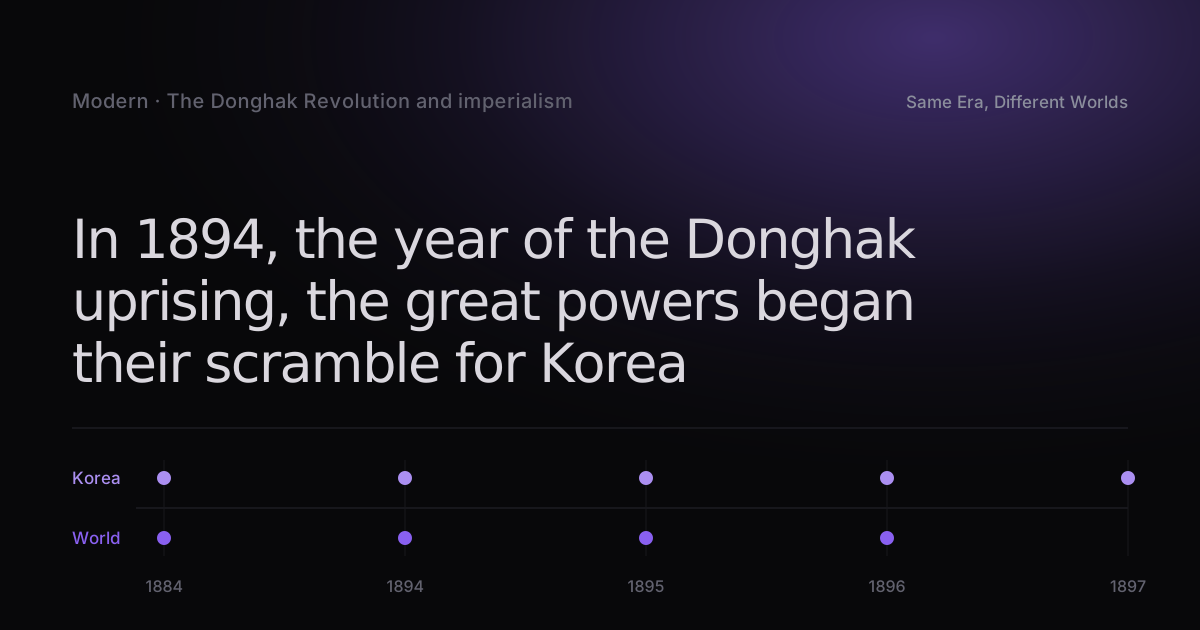
1894 is the watershed of modern Korean history. Inside the country, farmers rose against both feudal exploitation and foreign encroachment; outside it, Qing China and Japan went to war over control of Korea. The two were not separate events. Both were entangled in the larger current by which Western imperialism was eating into East Asia.
Grievance from within, pressure from without
Already in 1882, old-style soldiers resentful of the favor shown to Korea's new Western-style units had mutinied, and Qing troops had suppressed the revolt, deepening Chinese interference in Korean affairs. Twelve years later, in 1894, peasants of the Donghak movement led by Jeon Bong-jun rose against the extortion of local officials. They gathered enough force to take the fortress city of Jeonju, but when the Korean government asked the Qing to send troops to put them down, Japan invoked an earlier treaty to send troops of its own, and the situation escaped anyone's control. The peasant army eventually made terms with the government and disbanded — but the Chinese and Japanese forces already on Korean soil did not leave.
That same year the First Sino-Japanese War was fought over control of Korea, and the rising power of Japan won it. The Qing lost its standing as the traditional suzerain of East Asia, and Japan rapidly extended its influence over Korea. Even during the war the Korean government, under Japanese pressure, pushed through modern reforms — abolishing hereditary status and the civil service examination among them — a mixture of self-directed reform and foreign intervention that captures the complicated character of Korea's modernization.
The larger picture: East Asia in the age of imperialism
The upheaval of 1894 did not come from nowhere. Ever since the Qing lost the Opium War of 1840-1842 and was forced to open its ports, East Asia had been steadily exposed to Western pressure. In the decades when European empires were making colonies across Africa and Asia, the three states of East Asia responded to that wave at different speeds. Japan modernized quickly after the Meiji Restoration of 1868 and joined the ranks of the imperial powers itself; the Qing reformed slowly for all its size; and Korea, caught between them, could rarely find an opening for modernization on its own terms.
The contest over Korea did not end with that war. In 1904-1905 Russia and Japan fought over interests in Manchuria and the peninsula, and Japan won again, decisively tightening its grip on the Korean Empire through the Eulsa Treaty of 1905. The upheaval that began with the Donghak uprising of 1894 was, in the end, the first chapter of a long descent toward the loss of sovereignty in 1910.
What the comparison tells us
Placed in world history, 1894 on the Korean peninsula was not simply domestic unrest but a textbook path for a weak state in the age of imperialism. A demand for reform from within becomes the pretext for foreign intervention, and the country turns into a battlefield for other powers — a course that overlaps with the colonization of many regions of Africa and Southeast Asia in the same years. The Donghak Revolution is remembered so particularly in Korea because its urgent demand for reform ended in the loss of the nation itself.
The uprising failed, but it is hard to call it a total failure: its demands for the abolition of hereditary status and for tax reform were reflected in substantial part in the Gabo Reforms of the same year. Today it is reassessed as an event with two faces — resistance against foreign power, and a demand for modernization from below. The last words Jeon Bong-jun left at his execution still carry the urgency the movement held.
Donghak itself, the religion behind the uprising, taught that "man is heaven" and that every person is worthy of dignity regardless of social rank. That teaching of equality gave exhausted farmers something to unite around, which makes the movement an unusual case of religious conviction and a demand for social reform fusing into one.
The mechanism that turned a revolt into a war
Why did Chinese and Japanese troops arrive the moment farmers rose at Gobu? Not by chance: the mechanism had been laid in advance. In 1885, settling the aftermath of the Gapsin coup, Qing China and Japan concluded the Convention of Tianjin, which required each to notify the other before sending troops to Korea. In practice it meant that if one dispatched forces, so would the other. Internal unrest in Korea thereby became an automatic switch summoning two foreign armies at once.
The decisive point is that Korea was not party to that convention. The conditions under which armies would enter Korean territory had been agreed between third parties, and the instant the Korean government requested Qing troops, a Japanese landing followed regardless of Korean intent. The tragedy of 1894, then, happened not because farmers rose but because the system had already been designed so that a rising would start a war. The loss of sovereignty was not an event of 1910 but a process that had been advancing clause by clause for twenty-five years.
The same reforms, and who carried them out
What followed is bitterer still. The Gabo Reforms of 1894 abolished hereditary status and the civil service examinations and converted taxes to cash payment — much of what the Donghak army had demanded. On content alone, a demand from below had been accepted from above. Yet these reforms were driven under the supervision of Japanese troops who had seized Gyeongbok Palace, and for that reason they lost their legitimacy. That the peasant army's second uprising was aimed not at the Korean government but at Japan says it all.
Here is where Korea's path diverged from Japan's Meiji Restoration. Meiji reform was also radical and imposed from above, but the agents carrying it out were domestic. In Korea, reforms whose content was right arrived in the hands of a foreign army, so that accepting the reform meant accepting subjugation. The legitimacy of a reform is not settled by its content alone. Who executes it accounts for half — and Korea in 1894 had to take the second half having already lost the first.
At a glance
| Year | Korean history | World history |
|---|---|---|
| 1840-1842 | — | The Opium War (the Qing forced open to the West) |
| 1882 | The Imo military mutiny | — |
| 1894 | The Donghak Peasant Revolution; the Gabo Reforms | The First Sino-Japanese War |
| 1904-1905 | — | The Russo-Japanese War |
| 1905 | The Eulsa Treaty | — |
Read next
- Era guide: Sedo politics, port opening and modernization
- The March First Movement and the world of 1919
- Era guide: The Japanese colonial period
References
- The Mujang proclamation and the twelve reform demands — the peasant army’s own texts
- The Convention of Tianjin (1885) — the mutual notification clause on troop dispatch
- Veritable Records of King Gojong — the Gabo Reform bills and the dispatch of Qing and Japanese troops
- National Institute of Korean History — entries on the Donghak Peasant Revolution, the Gabo Reforms and the First Sino-Japanese War
The facts follow the sources above; the comparisons and interpretation are our own.
You can compare the other events of this era directly in the timeline.
Explore the timeline