Era guide · P7 Port opening and modernization
Port opening and modernization — forty-seven years on imperialism’s timetable
Published
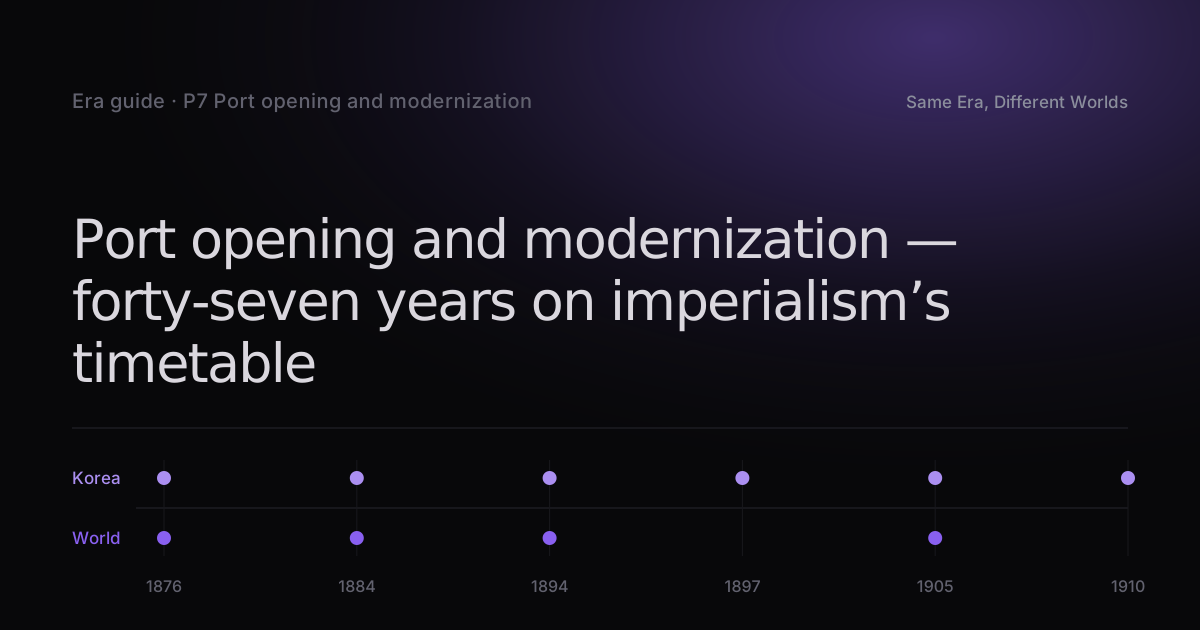
P7 runs the forty-seven years from King Gojong's accession in 1863 to the loss of sovereignty in 1910. It is shorter than a generation, yet the density of entries here is the highest in the timeline — an era in which too much arrived in too little time.
Korea: forty-seven years of reforms that kept running aground
The era opens with the Daewongun's reforms and refusal of foreign trade and turns on the Ganghwa treaty of 1876, Korea's first modern treaty and an unequal one, granting extraterritoriality and denying tariff autonomy. Conflict over enlightenment policy produced the soldiers' revolt of 1882 and the coup of 1884; in 1894 the Donghak peasant uprising and the Gabo reforms ran at once. The proclamation of the Korean Empire in 1897 and its Gwangmu reforms were the last attempt at self-strengthening.
No single sentence explains why these reforms kept failing, but the timeline makes one thing plain: almost every domestic political event ended through foreign intervention. The 1884 coup lasted three days before Qing troops ended it; the Donghak uprising brought both Qing and Japanese armies and led into the Sino-Japanese War; the murder of Queen Min and the king's flight to the Russian legation happened inside a Japanese–Russian contest. Judging these reforms by domestic capacity alone misses the structure they were caught in.
The same decades elsewhere: the partition nearly complete
The East Asian order had been shifting since the Opium War of 1840. Japan built a centralized modern state through the Meiji Restoration of 1868 and soon expanded toward Korea, Taiwan and Manchuria. The European powers partitioned Africa at the Berlin Conference of 1884–85, and the Suez Canal, steamships and the telegraph physically shrank the world. The Sino-Japanese War of 1894 and the Russo-Japanese War of 1904 were two international wars fought over control of the Korean peninsula.
Korea's fate had become a question settled by the balance among imperial powers. The Taft–Katsura memorandum and the Anglo-Japanese alliance of 1905 amounted to American and British acceptance of Japanese control over Korea. The protectorate treaty of that year rested on that international acquiescence.
Where the two currents actually meet
The clearest link is technology and time. Telegraphs, railways and steamships were the infrastructure that let empires control distant places in something close to real time, and the lines laid in Korea — Seoul–Incheon in 1899, Seoul–Busan in 1905 — were not innocent of that purpose. The paradox of this era is that importing modern technology was not the same as gaining modern autonomy; often it built the infrastructure of domination.
A second link is religion and ideas. Donghak began as a response to Western learning but carried an egalitarian message that became the ideology of a peasant rising, while Protestant missionaries founded schools and hospitals and so intervened in the modernization of education and medicine — Baejae and Ewha academies and Severance hospital all date from this period. The way religion entangled itself with politics and schooling here resembled neither the Western modern experience nor earlier Joseon.
Why every reform came late or was reversed
The four decades of P7 could be described as a list of attempted reforms, none of which was completed. The Gapsin coup of 1884 ended in three days when Qing troops intervened. The Gabo Reforms of 1894 were modern in content and lost their legitimacy because they were carried out under the supervision of Japanese troops occupying Gyeongbok Palace. The Independence Club and its mass assemblies in 1898 came within reach of establishing an assembly before being dissolved. The Gwangmu reforms lacked both money and time.
The four failures share conditions. First, time. Japan had fifteen years between Perry's arrival in 1853 and the Meiji Restoration of 1868, whereas Korea had to pass through the rivalry of the great powers in the twenty-nine years between the Treaty of Ganghwa in 1876 and the Eulsa Treaty of 1905. Second, agency: whoever pushed reform repeatedly had to take a foreign hand, and lost domestic support at that moment. Third, finance: modernization costs money, and Korea did not even hold tariff autonomy.
Placed beside other countries in the same years the differences in condition stand out. Japan bought time while the powers were preoccupied with China; Qing China was large enough not to collapse from one defeat. Korea was small, late, and between two empires. That is why the success or failure of reform cannot be explained by the resolve of leaders alone.
What was the Korean Empire?
In 1897 Gojong took the title of emperor and renamed the state the Great Han Empire. The declaration was calculation rather than form. In the East Asian tributary order the title of emperor belonged to China, and the Korean king was defined as a vassal beneath it. When Qing China lost the war of 1894 and that order broke, proclaiming an empire became a statement that Korea was no longer anyone's dependency. Building the Wongudan altar and adopting the Gwangmu era name belong to the same logic.
There was substance too. Land surveys were carried out and title deeds issued; streetcars, telephones, modern schools and hospitals arrived. Streetcars ran in Seoul from 1899, earlier than in Tokyo. But these reforms were bound to the strengthening of imperial authority. The 1899 constitution granted the emperor unlimited powers and so collided head-on with the assembly the Independence Club had demanded.
The Korean Empire thus chose to modernize from above while excluding participation from below, and that path could not be sustained against the outcome of the Russo-Japanese War. Defending sovereignty required modernization, modernization required sharing power, and there was far too little time left to do both. The dilemma running through P7 is compressed in that sentence.
Films and series set in this era
The Last Samurai (2003) is set during Japan's samurai rebellion of the 1870s, Mr. Sunshine (2018) in the Korean Empire of the 1900s. Together they show how the same wave of modernization worked differently in two countries: in Japan an old order fell and a new state rose; in Korea that new state arrived and brought down both the old order and the new. The righteous-army story of Mr. Sunshine is also what fixed the mood of P7's final years in popular memory.
At a glance
| Year | Korean history | World history |
|---|---|---|
| 1876 | Treaty of Ganghwa | Meiji Restoration (1868) |
| 1884 | Gapsin coup | Berlin Conference (1884–85) |
| 1894 | Donghak uprising; Gabo reforms | Sino-Japanese War |
| 1897 | Proclamation of the Korean Empire | — |
| 1905 | Protectorate treaty | End of the Russo-Japanese War; Taft–Katsura |
| 1910 | Annexation | — |
Read next
- Korea and Japan faced the same gunboats — why did only one rebuild?
- The Donghak uprising in the age of imperialism
- Next era: the colonial period
References
- National Institute of Korean History, Korean History Chronicle — port opening and the Korean Empire
- South Korean high-school world history curriculum — imperialism and modernity
The facts follow the sources above; the comparisons and interpretation are our own.
You can compare the other events of this era directly in the timeline.
Explore the timeline