Contemporary · The Korean War and decolonization
Korea in 1950 was not an exception — where the Cold War and decolonization overlapped
Published
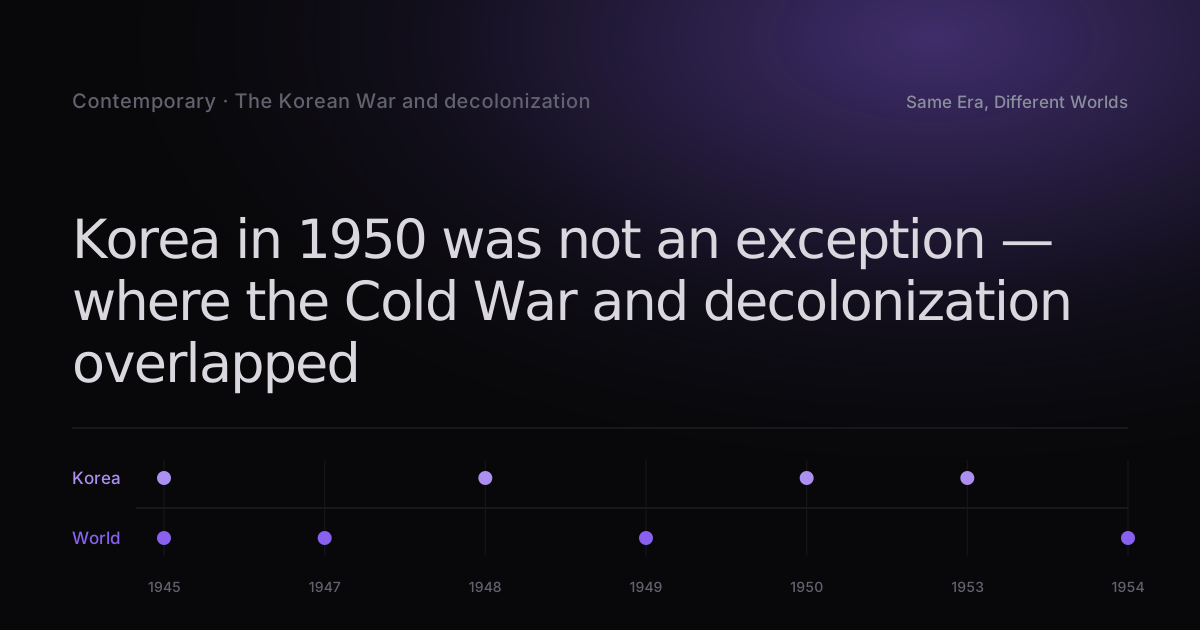
The Korean War is usually explained as a proxy war of the Cold War. That is true and it is half the story. The other half is that it was also a war of decolonization. An internal struggle over what to build in the space left by the collapse of the Japanese empire in 1945 was translated into the grammar of the Cold War and became an international war. Only with both layers in view does 1950 come properly into focus.
The places that split in the same years
Line up the years from 1945 to 1954 and Korea looks anything but special. India in 1947 was partitioned into India and Pakistan at the moment of independence; more than ten million people crossed the new borders and hundreds of thousands died. Indonesia, 1945–1949, declared independence and fought the Netherlands for four years. In Indochina, 1946–1954, the Viet Minh fought France, and after the defeat at Dien Bien Phu the Geneva Accords divided Vietnam at the 17th parallel.
The 38th parallel and the 17th. The resemblance is not coincidence. When an empire withdrew and no single successor government could be agreed, the standard solution the great powers reached for was provisional division along a line of latitude. And the provisional generally set hard.
Why only Korea is still divided
Why, then, was Vietnam unified in 1975 and Germany in 1990, while Korea was not? Comparing the three cases makes the conditions visible.
In Vietnam, one side won militarily. Unification came not by negotiation but with the fall of Saigon. In Germany, the patron disappeared. The Soviet Union that propped up East Germany withdrew of its own accord, and integration became possible. Neither happened on the Korean peninsula. After the armistice of 1953 neither side could settle matters by force, and the patronage structure behind North Korea survived the fall of the Soviet Union in the form of China. Add nuclear weapons to the equation and the cost of a military solution rose further still.
There is another difference: Korea's dividing line is a line redrawn after a war. The 38th parallel was drawn in a meeting room, but the Military Demarcation Line is the product of three years of fighting that killed well over three million people. A boundary written in blood is harder to erase than one written on a map.
The decolonization layer: who inherits the state?
What does it mean to say this was also a war of decolonization? The question actually contested on the peninsula after August 1945 was who would inherit the place Japan had vacated. That was not only a contest of ideologies. Those who had fought the armed anti-Japanese struggle, the left that had maintained organizations at home, the Provisional Government line, figures who had worked from the United States, and people who had served in the colonial administration and police all competed for the same positions.
Every decolonizing society faces this. In Indonesia and Vietnam too, the reckoning between independence movements and those who had collaborated with colonial administration was fierce. What made it explosive on the Korean peninsula was that the conflict mapped exactly onto Cold War alignments. Demands to purge collaborators were classified as a leftist agenda, and anti-communism became a pass that asked no questions about the past. The gutting of the Anti-National Activities Investigation Committee in 1949 is that process in miniature.
Behind the Korean War, in short, two unresolved problems had fused into one: the internal question of what to do with the colonial legacy, and the external question of which camp to join. That is why attempts to explain the war by either one alone always come up short.
What sixteen countries under one flag meant
What distinguishes the Korean War from other wars of decolonization is the form of a United Nations command. Sixteen countries sent combat forces and five more sent medical units. This was the first time the UN, five years old, put collective security into practice. It was possible, however, not because the principle prevailed but through the accident that the Soviet Union was boycotting the Security Council and so cast no veto.
The accident did not last. Once the Soviets returned the Council was paralyzed again, and for the rest of the Cold War there was effectively no comparable UN intervention. The Korean War is almost the only case in which collective security functioned, and a demonstration of how much that functioning depended on chance. China's entry into the war in October 1950 was, at the same time, the moment the new People's Republic announced itself on the international stage by force of arms.
What the comparison tells us
Read the Korean War through the Cold War frame alone and the fact that it was also a war among Koreans blurs. Read it as a civil war alone and the structure that made it international disappears. The accurate account keeps both layers. A society emerging from empire, in the course of choosing its own direction, met a world already divided into two camps, and as its internal options were translated into that external opposition the result was total war.
This was an experience shared by many regions in the mid-twentieth century. So when this site sets its timelines side by side, the 1950 line is not only about the Korean entries. Look at what was happening in Indochina that same year, and in India and Indonesia a few years earlier, and it becomes clear that division was not a peculiar Korean misfortune but the standard outcome of that era. What is peculiar is not the division but the fact that it has not yet ended.
What the war left also runs beyond the peninsula. Japan rebuilt its defeated economy on procurement for the war; the United States multiplied its defense spending in its wake and fixed the Cold War as a military confrontation; China gained prestige for a new regime by facing the United States directly, and paid for it with the indefinite postponement of any settlement over Taiwan. Three years on the Korean peninsula shaped the following seventy across East Asia. That is why the 1950 line deserves to be read across, not down.
At a glance
| Year | Korean history | World history |
|---|---|---|
| 1945 | Liberation; occupation zones at the 38th parallel | Indonesia declares independence |
| 1947 | — | India and Pakistan partitioned at independence |
| 1948 | Separate governments established in South and North | — |
| 1949 | — | The People’s Republic of China founded; Indonesian independence recognized |
| 1950 | The Korean War begins; UN forces and then Chinese forces enter | — |
| 1953 | The armistice is signed | — |
| 1954 | — | Dien Bien Phu falls; the Geneva Accords divide Vietnam at the 17th parallel |
Read next
- Era guide: Contemporary Korea, since liberation
- Liberation, the Cold War and division
- June 1987 and the third wave of democratization
References
- UN Security Council Resolutions 82, 83 and 84 (1950) — the legal basis of the UN Command
- The Korean Armistice Agreement (1953) — the demarcation line and the demilitarized zone
- The Geneva Accords (1954) — the clause dividing Vietnam at the 17th parallel
- National Institute of Korean History — entries on the Korean War, the founding of governments, and the armistice
The facts follow the sources above; the comparisons and interpretation are our own.
You can compare the other events of this era directly in the timeline.
Explore the timeline