Contemporary · A wave of democratization
June 1987 did not stand alone — Manila, Taipei, Seoul, then Berlin
Published
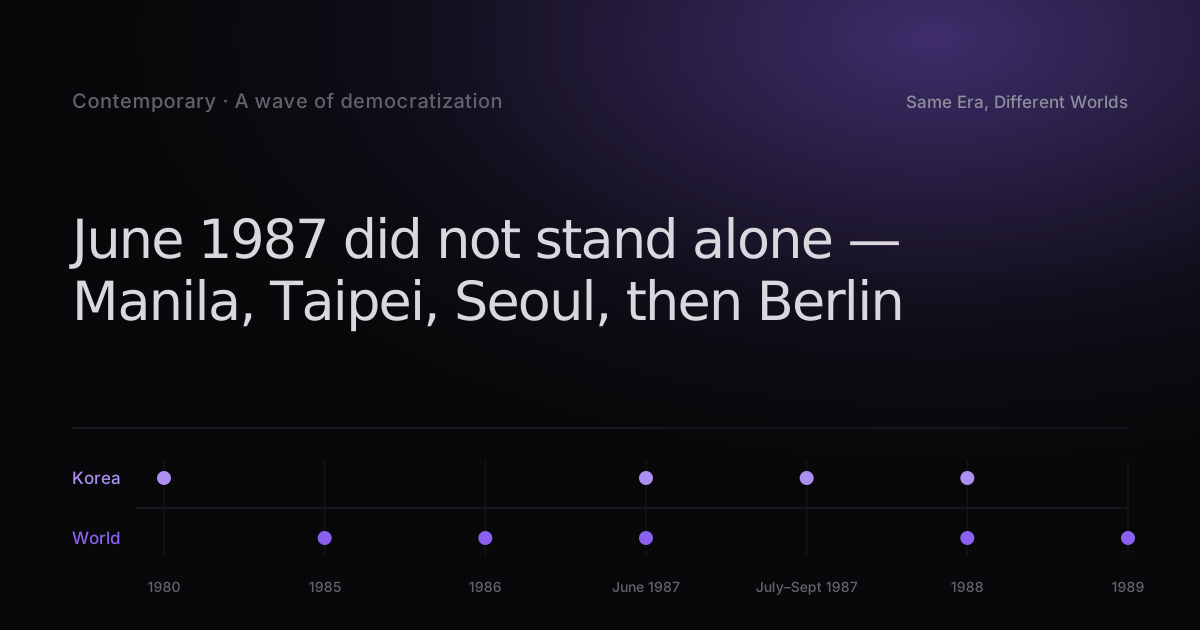
In June 1987 citizens took to the streets in Seoul and across the country, and the government conceded direct presidential elections in the June 29 Declaration. Korean accounts generally narrate this within a domestic frame. Widen the timeline, however, and these years turn out to be remarkably crowded: Manila in 1986, Taipei in 1987, Yangon in 1988, Beijing and Eastern Europe in 1989. Within a few years, one authoritarian system after another was put to the test.
Why those particular years?
There are reasons for the simultaneity. First, the social structure that growth had built. Decades of rapid development in Korea and Taiwan had produced an urban middle class, a college-educated population and a large industrial workforce. These groups were the product of developmental authoritarianism and at the same time the bearers of demands that system could no longer explain away. The argument that the government had solved the problem of making a living and should therefore be left to handle politics loses its force once making a living is no longer the problem.
Second, the loosening of the Cold War. After Gorbachev came to power in 1985, the United States had less reason to shield anti-communist dictatorships unconditionally. It advised Marcos to step down in 1986 and signaled disapproval of martial law being contemplated in Korea in 1987. Third, media. Satellite broadcasting carried the scenes from Manila almost in real time, and those pictures served citizens elsewhere as proof that it could be done.
Each stepped back differently
On that shared foundation, the paths taken diverged sharply. In the Philippines the regime collapsed. Marcos fled to Hawaii and the system ended with the man. In Taiwan it was released from above. Chiang Ching-kuo himself lifted thirty-eight years of martial law in 1987 and tolerated an opposition party. China blocked it. At Tiananmen in 1989 the demands were suppressed by force. In Eastern Europe the patron let go. Once the Soviet Union made clear it would not intervene, the governments fell in sequence.
Korea fits none of the four exactly. The government did not collapse, nor did it open up voluntarily from above; suppression was not attempted successfully, and no outside power removed it. The June 29 Declaration was a form in which the regime accepted the demands without standing down. In the December election that year the opposition failed to agree on a single candidate and the ruling party's nominee won. Citizens changed the rules, and the first match under the new rules went to the incumbents.
What was particular to Korea
There is no need to read that compromise as failure. Several conditions were specific to Korea.
One was the precedent of Gwangju in 1980. Both sides knew what the military's use of force produced, and that memory made choosing suppression in 1987 far harder. Another was the 1988 Seoul Olympics. An international event one year away made the cost of a bloody crackdown impossible for the government to bear. A third was the breadth of the movement. When office workers and the urban middle class — the so-called necktie brigade — joined students and dissidents, the struggle read not as the demand of a particular group but as a demand of the society at large.
That the Great Workers' Struggle followed through July, August and September is also particular to Korea. The demand for political democratization extended immediately into the workplace, and the union organizations built in those months went on to reshape the structure of Korean society. Nothing of comparable scale in the labor sector followed directly in the Philippines or Taiwan.
The trap in the phrase "third wave"
The political scientist Samuel Huntington named the current that began in southern Europe in the 1970s and ran through Latin America and Asia in the 1980s to Eastern Europe in 1989 the third wave of democratization. The concept is useful for explaining simultaneity, and it invites two misunderstandings.
The first is the impression that a wave arrives by itself. In fact, in each country people went to prison and were injured in the streets. What lit the June Struggle in Korea in 1987 was the deaths of two young men, Park Jong-chul and Lee Han-yeol. The metaphor of a wave erases that concrete price. The second is the impression that arrival is the end. As Huntington himself noted, each of the two earlier waves was followed by a reverse wave — European fascism in the 1920s and 1930s, the military governments of Latin America in the 1960s and 1970s.
Seen that way, the years after 1987 read differently too. Establishing procedural democracy does not make it self-sustaining, and the twenty-first century has produced a series of cases in which forces elected under such rules went on to erode the institutions that elected them. The history of the waves reminds us that democratization is not a destination but a condition with ongoing maintenance costs.
What the comparison tells us
Set 1987 beside a world timeline and two things become clear at once. One is that this was not a uniquely Korean miracle. Where comparable economic, demographic and international conditions had gathered, the same pressure broke out at the same time in several places. The other is that conditions did not determine outcomes. On the same wave, some places made the transition and some were crushed.
Conditions only open a door; passing through it is the work of a particular society. Korea in 1987 passed through the door those conditions opened using materials of its own — the memory of Gwangju, the deadline of the Olympics, and the participation of the middle class. Placing an achievement within a wave of world history does not diminish it; it separates what was accident from what was choice. That is exactly why this site sets its timelines side by side.
It is worth adding that 1987 is one of the rare cases in Korean history in which a demand from below was converted into an institution. Look along the other lines of this timeline and such conversions are uncommon. The demands of the Donghak peasants were distorted into reforms that arrived with a foreign army; the demands of March First never reached the conference table; the gains of the April Revolution of 1960 were overturned by a military coup the following year. That 1987 survives in the form of a constitutional amendment reads more heavily once one sees how many generations had made the same demand before it stuck.
At a glance
| Year | Korean history | World history |
|---|---|---|
| 1980 | The Gwangju Democratization Movement | — |
| 1985 | — | Gorbachev comes to power; the Cold War loosens |
| 1986 | — | People Power in the Philippines; Marcos falls |
| June 1987 | The June Struggle; the June 29 Declaration | Taiwan lifts martial law after 38 years |
| July–Sept 1987 | The Great Workers’ Struggle | — |
| 1988 | The Seoul Olympics | The 8888 uprising in Myanmar |
| 1989 | — | Tiananmen; the fall of the Berlin Wall |
Read next
- Era guide: Contemporary Korea, since liberation
- Korea in 1950 was not an exception
- The March First Movement and the world of 1919
References
- The June 29 Declaration (1987), full text
- The ninth amendment of the Constitution of the Republic of Korea (1987)
- National Institute of Korean History — entries on the June Struggle, the Great Workers’ Struggle, and Gwangju
- South Korean high school world history curriculum — People Power, Taiwan’s martial law, the revolutions of 1989, Tiananmen
The facts follow the sources above; the comparisons and interpretation are our own.
You can compare the other events of this era directly in the timeline.
Explore the timeline