Modern · 1919 and the world
In 1919, Korea rose while the world was rebuilding order from the rubble of war
Published
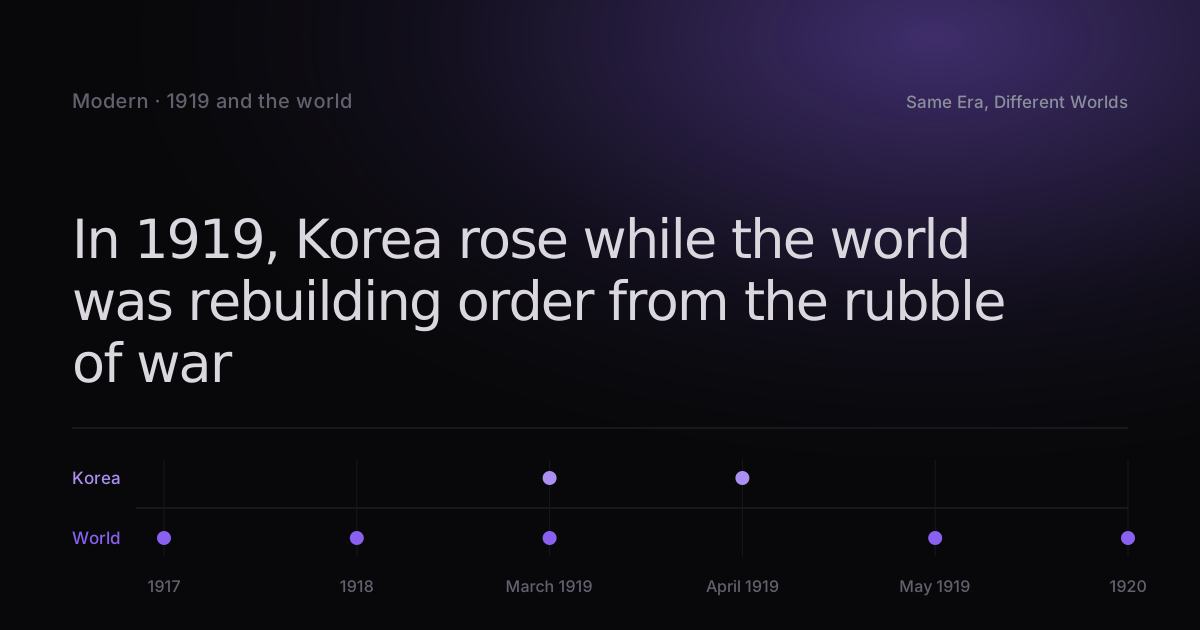
On March 1, 1919, thirty-three national representatives read out a declaration of independence, and the demonstrations that followed grew into the largest national movement in Korean history, joined by every region and every class. It did not happen in a vacuum. Behind it lay the most devastating war humanity had yet fought, which had ended only months earlier, and the new principle that war had left behind.
What total war left behind: national self-determination
The First World War, fought from 1914 to 1918, was the first total war, with the European powers split into two camps. Trench warfare, machine guns, and poison gas produced tens of millions of casualties and brought down old multiethnic empires — Austria-Hungary, the Ottomans, and Russia among them. At the Paris Peace Conference that followed, the American president Woodrow Wilson advanced the principle of national self-determination: that each people should decide its own fate.
In practice Wilson's principle was meant to apply to the colonies and subject territories of the defeated powers, Germany and Austria among them, and there was little room to apply it directly to Korea, a colony of victorious Japan. But the news was enough to convince independence activists abroad and intellectuals at home that here at last was a chance to put Korea's case to the world. The sudden death of the former emperor Gojong in January 1919 — attended by rumors of poisoning, and by public anger — served as the detonator, and the two currents met and exploded into the March First Movement.
Announcing independence to the world, and a provisional government
Japan suppressed the movement by force, at a heavy cost in lives, and the Korean question was never actually taken up at the Paris conference. Yet the movement left two clear results. The scattered independence forces at home and abroad drew together and founded the Provisional Government of the Republic of Korea in Shanghai that April; and Japan found itself compelled to change its colonial method from rule by force to what it called cultural rule.
Similar resistance was rising elsewhere in the same period. In India, Gandhi was beginning to organize nonviolent resistance; in China, anger at the conference's handling of Shandong produced the May Fourth Movement — in May 1919, two months after March First. The First World War began as a war among European powers, but its aftermath lit independence movements across the colonized world, and in that sense the March First Movement was never an isolated Korean event.
What the comparison tells us
That the movement was bound up with global currents does not diminish it. If anything, what makes March First remarkable is precisely the planning and execution behind it: reading an opening in the international situation, then organizing an entire people to raise its voice to the world. That similar resistance broke out in India and China at the same moment shows that the First World War shook the colonial order everywhere, not only in Europe.
Japan replaced its military police regime with so-called cultural rule after March First, but this was closer to a conciliatory cover for continued repression. Wilson's self-determination, too, faded before long against the interests of the victorious powers. Even so, the Provisional Government the movement brought into being, and the tradition of organized independence work it began, became the root of a resistance that continued without a break for the twenty-six years until liberation.
The declaration read out that day is notable for what it did not do: rather than dwell on resentment toward Japan, it set out a case for contributing to the common good of humanity as advocates of peace. The movement's commitment to nonviolence carried into the Provisional Government's own constitution, and helped ensure that the Republic of Korea began, from the outset, as a state aspiring to be a democratic republic.
The movement is now written into the preamble of the Constitution of the Republic of Korea, which declares that the country upholds the legitimacy of the Provisional Government established by the March First Movement. That is also why March 1 is observed each year as a national holiday.
Self-determination was never addressed to Korea
Accounts of the March First Movement almost always begin with Wilson's principle of national self-determination. Look at where that principle was actually applied, though, and the story shifts. In Wilson's Fourteen Points, self-determination was raised chiefly for lands ruled by the defeated powers — the territories of Austria-Hungary and the Ottoman Empire. Japan was among the victors, and Korea was therefore never on the list of intended beneficiaries.
The decisions at the Paris Peace Conference prove the point. Korea was not placed on the agenda at all; instead the conference transferred Germany's concessions in Shandong to Japan. When that news reached Beijing, students took to the streets on 4 May 1919. The March First and May Fourth movements influenced one another, and were at the same time two responses to a single betrayal. Set the 1919 line of this site's timelines side by side and the Korean entry and the world entry turn out to be, in substance, one event.
Does that make the March First Movement a miscalculation built on false hope? It does not. What Korea's leaders counted on was not the goodwill of the great powers but a window in which they could be heard. For the few months in which the world was rewriting the postwar order, a colony's voice could be entered into the record, and the aim was to enter it before the window closed. The record was duly made, and it continued for twenty-six years in the form of a provisional government.
The infrastructure of colonial rule carried the uprising
The other thing worth noticing is how the movement erupted almost simultaneously across the country. The declaration was read the same day in Seoul, Pyongyang and other cities, and over the following two months demonstrations spread nationwide. What made that simultaneity possible was, paradoxically, the railways, postal service and printing the colonial state had built. Some twenty thousand copies of the declaration were printed at the Boseongsa press and distributed by rail, carried by the nationwide organizational networks of Cheondogyo, the Christian churches, the Buddhist orders, and student groups.
Colonial rule requires a standardized network in order to govern — and that network is never used by the ruler alone. Gandhi could organize nationwide nonviolent campaigns in India on railways the British had laid and in English as a common language. Empires create the conditions under which resistance can be organized at national scale. That large movements arose in Korea, India and China at about the same moment in 1919 owed something not only to a shared international conjuncture but to this shared physical condition.
At a glance
| Year | Korean history | World history |
|---|---|---|
| 1914-1918 | — | The First World War |
| January 1919 | Death of Gojong | The Paris Peace Conference opens |
| March 1919 | The March First Movement | — |
| April 1919 | The Korean Provisional Government is founded | — |
| May 1919 | — | The May Fourth Movement in China |
Read next
- Era guide: The Japanese colonial period
- The Donghak revolution and the age of imperialism
- Liberation, the Cold War and division
References
- The Korean Declaration of Independence (1919), full text
- Wilson’s Fourteen Points (1918) and the Shandong clause of the Paris Peace Conference
- Government-General of Korea, files on the 1919 disturbances — the authorities’ own record of the protests
- National Institute of Korean History — entries on the March First Movement, the Provisional Government, and "cultural rule"
The facts follow the sources above; the comparisons and interpretation are our own.
You can compare the other events of this era directly in the timeline.
Explore the timeline