Early modern · Reformation and Joseon
While Luther lit the Reformation, Joseon's own reformer failed
Published
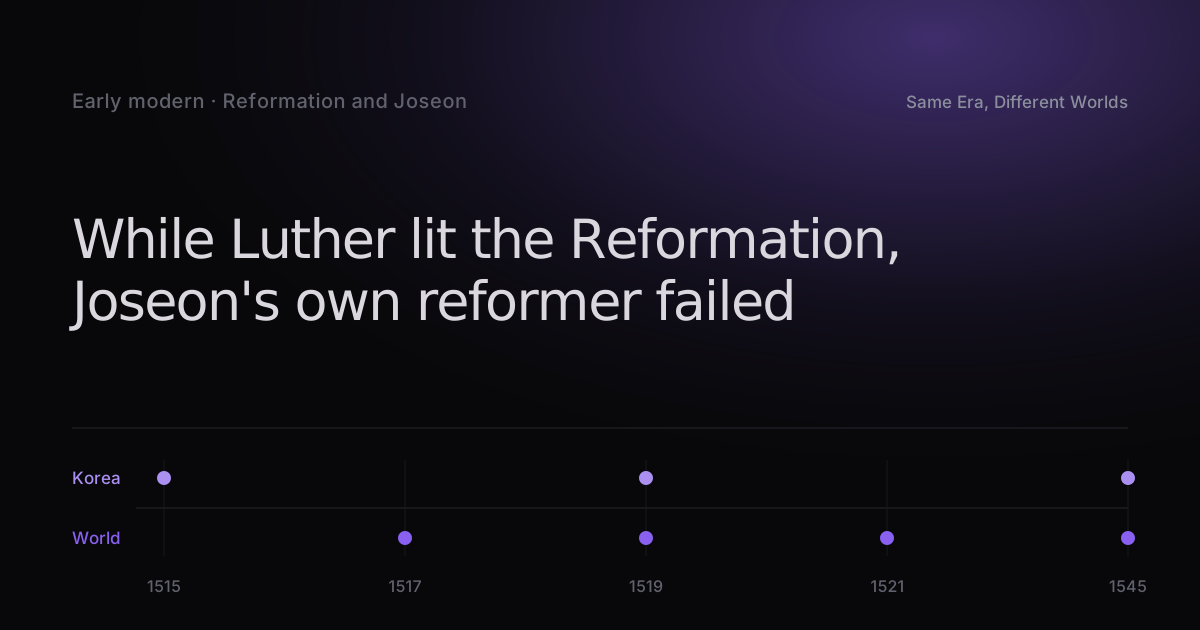
1517 and 1519. Within two years of each other, a challenge to entrenched power began in Europe and in Joseon. One succeeded and redrew the map of a continent; the other failed and ended with the death of the man who led it. These are Luther's Reformation and the reforms of Jo Gwang-jo.
A theologian against indulgences, a scholar against the old guard
In 1517 the German theologian Martin Luther posted his Ninety-five Theses on the door of the church at Wittenberg, attacking the sale of indulgences — the practice of remitting sin for money. Printing had just come into wide use, and the text spread across Europe within weeks, swelling into a reform movement that challenged the authority of the Catholic church itself. Europe would spend the next centuries divided between Catholic and Protestant.
Joseon had its own reform movement at almost the same moment. After the coup of 1506 deposed the tyrant Yeonsangun and put King Jungjong on the throne, a faction of Neo-Confucian scholars led by Jo Gwang-jo pressed a radical program. They introduced a recommendation examination to recruit officials by reputation rather than by test, tried to strike unearned merit awards from the rolls of the ruling elite, and promoted village codes meant to build a Confucian ideal society. It was reform aimed directly at the privileges of the entrenched old guard.
One changed an age; the other was broken in a purge
The two reforms met dramatically different fates. Luther was excommunicated and declared a heretic by the Holy Roman Emperor, yet he survived under the protection of sympathetic princes and with popular support. His ideas travelled Europe in printed pamphlets and ultimately broke the Roman church's monopoly on authority, opening the door to the modern era.
Jo Gwang-jo's reforms, by contrast, were halted in 1519, only a few years after they began. The old guard, alarmed by their pace, is said to have traced the characters "Jo will become king" onto leaves so that insects would eat the shapes into them, fabricating a charge that Jo meant to seize the throne — a story that conveys how thoroughly the king's favor was turned against him. The purge that followed swept away Jo and the reformist scholars with him, and Jo himself was ordered to drink poison.
Many things explain why two reforms begun at the same moment ended so differently, but the decisive factors were whether the message could spread to a wider public through print, how well the base of support was organized, and whether any faction was in a position to sustain the reform. Luther's movement went on to produce religious wars across Europe; Jo's unfinished program had to wait until the late 16th century, when the Neo-Confucian scholars finally returned to central politics.
What the comparison tells us
The decisive difference between the two lay in the means of transmission. Luther's argument reached ordinary people across Europe within weeks on the back of a newly available printing press; Jo Gwang-jo's reform never escaped the narrow enclosure of the court and his own faction. For a new idea to survive, it needs not only to be right but to have a medium to carry it and a constituency to hold it — a lesson written in the diverging fortunes of two reformers of the same era.
The ideals Jo left unfinished did not vanish. By the reign of King Seonjo in the late 16th century the Neo-Confucian scholars had become the mainstream of central politics, and they went on to shape Joseon for a long time through the new form of factional government. In Europe, too, the aftershocks of the Reformation were slow to settle: in the early 17th century the conflict between Protestants and Catholics exploded into the Thirty Years' War, the largest religious war Europe had seen.
Another reason Luther's reform could succeed was that the Holy Roman Empire was fragmented into hundreds of territorial states, leaving the emperor's control weak. Princes protected or suppressed the Lutherans according to their own interests, and that decentralized structure opened the very gaps in which a new idea could take root. In Joseon, with its strong centralized state, the reformers lost their footing the moment the king's mind turned.
Luther's German translation of the Bible did more than advance the Reformation; it helped standardize the German language itself. Joseon had created its own alphabet, Hunminjeongeum, back in the 15th century, yet Chinese characters remained dominant as the official script well into the 16th — so the experiment of spreading ideas in the vernacular can be said to have turned out differently in the two places as well.
Was there a door to walk out of?
There is one difference as decisive as the means of distribution, and perhaps more so. Luther had a door to walk out of, and Jo Gwang-jo did not. What Luther attacked was the authority of the church itself, and the moment he denied that authority he could build a new church outside Rome. He duly did. What Jo Gwang-jo attacked was the entrenched meritorious-subject faction, not the king. His reform worked by drawing the ideal Neo-Confucian sovereign out of the king himself, which meant that when the king turned away there was no ground to retreat to and no alternative to appeal to.
The difference shows plainly in how each man ended. Luther stood before the emperor at the Diet of Worms, survived, and was spirited away to a castle of the Elector of Saxony. Jo Gwang-jo had no other prince to flee to. Joseon was a single system in which the king was the sole source of legitimacy; the Holy Roman Empire was a plural system in which hundreds of powers competed. What decided these two reforms was not the courage of the reformer but how many exits existed in the political terrain he stood on.
When do we render the verdict?
Still, the summary that Luther succeeded and Jo Gwang-jo failed holds only if the verdict is fixed at the 1520s. Widen the frame to a century and the picture changes. Jo Gwang-jo was made to drink poison, yet within fifty years of his death the Sarim had become the mainstream of central politics, and in 1610 he was enshrined in the Confucian shrine, canonized as orthodox in Joseon learning. The village codes and private academies that were his agenda became the skeleton of local order in later Joseon. What was defeated was a man, not a program.
Luther's victory, conversely, was billed late. The division his Reformation opened exploded a century later into the Thirty Years' War (1618–1648), which erased a substantial share of the population of the German lands. What filled the space left by a collapsed authority was not tolerance but a long war, and only when that war ended did a settlement emerge in which each territory set its own religion. Joseon in the same period suffered its purges, but its population was not split and set against itself over religion. Which of the two counts as success depends on what one is willing to enter on the cost side of the ledger.
At a glance
| Year | Korean history | World history |
|---|---|---|
| 1506 | The Jungjong restoration | — |
| 1517 | — | Luther's Reformation (the Ninety-five Theses) |
| 1519 | The literati purge of 1519 (removal of Jo Gwang-jo) | — |
| 1524 | — | The German Peasants' War (aftermath of the Reformation) |
Read next
- Era guide: Early Joseon
- Hangul and Gutenberg are seven years apart
- The Catholic persecutions and the legacy of the Reformation
References
- Veritable Records of King Jungjong — on the hyeollyanggwa examinations and the purge of 1519
- Jeongam jip, the collected works of Jo Gwang-jo, and the record of his 1610 enshrinement
- National Institute of Korean History — entries on Jo Gwang-jo, the 1519 purge, and the rise of the Sarim
- South Korean high school world history curriculum — Luther’s Reformation, the Diet of Worms, the Thirty Years’ War
The facts follow the sources above; the comparisons and interpretation are our own.
You can compare the other events of this era directly in the timeline.
Explore the timeline