Era guide · P4 Goryeo
Goryeo — how the peninsula endured while crusades and Mongols shook the world
Published
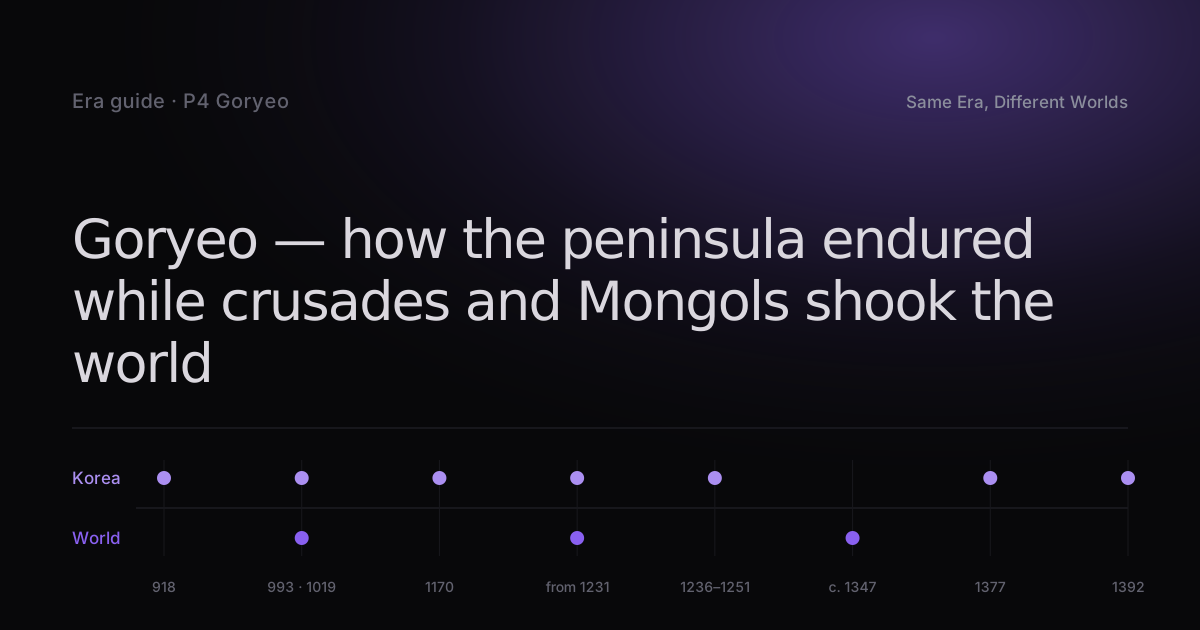
P4 covers the 474 years from Wang Geon's founding of Goryeo in 918 to the founding of Joseon in 1392. One question runs through it: how does a medium-sized state survive next to a continental superpower? Goryeo's foreign policy is a four-century answer.
Korea: three invasions, three different solutions
Against the Khitan Liao, Goryeo combined diplomacy — Seo Hui's negotiation in 993, which gained six districts east of the Yalu — with force, in Gang Gam-chan's victory at Gwiju in 1019. When the Jurchen Jin rose, the Yi Ja-gyeom government accepted tributary terms and avoided war, provoking the backlash of Myocheong's movement to move the capital to Seogyeong. Facing the Mongols from 1231, the court moved to Ganghwa Island and held out for some thirty years before making terms, after which came roughly eighty years of Yuan oversight. The real substance of Goryeo's foreign history is that one state played diplomacy, war, resistance and submission in turn as circumstances changed.
Internally, the military coup of 1170 is the hinge. The aristocratic order gave way to sixty years of Choe family rule, under which uprisings such as Manjeok's revolt broke out. In thought, Uicheon's Cheontae and Jinul's Jogye schools reorganized Buddhism, and in the late Goryeo period Neo-Confucianism arrived and became the ideological weapon of the new scholar-officials — the same doctrine that would justify the founding of Joseon. The end of P4 leads directly into the beginning of P5.
The same centuries elsewhere: the Mongol variable
The crusades that began in 1096 turned the eastern Mediterranean into a battleground for two centuries and, as a by-product, drew eastern goods and knowledge into Europe. But the true protagonist of this era is the Mongol empire. After Genghis Khan's rise in 1206, the Mongols conquered China, Central Asia, Russia and West Asia in turn, creating the largest contiguous land empire in history. The east–west routes of Eurasia came under a single power, which is what made it possible for a Marco Polo to reach the Yuan court.
That integration moved more than goods and people. The Black Death that struck Europe in the mid-fourteenth century is widely understood to have travelled these same routes — the first time the price of a connected Eurasia was paid in epidemic. In the very decades when Goryeo lived under Yuan oversight, Europe lost perhaps a third of its population and its medieval order began to crack.
Where the two currents actually meet
The most famous meeting point is printing. The Tripitaka Koreana, carved during the Mongol invasions between 1236 and 1251, is the summit of woodblock printing; the Jikji, printed at Heungdeok Temple in Cheongju in 1377, is the oldest surviving book printed with movable metal type and is listed by UNESCO. It precedes Gutenberg by some seventy years. The social consequences, however, differed: in Europe movable type combined with the Reformation to produce a mass information revolution, while in Korea metal type mostly served the state printing small editions. The difference is best read not as technological superiority but as a difference in the social structure the technology sat in.
A second meeting point is cultural exchange under Yuan oversight. Korean fashions circulated at the Yuan court while Mongol dress and food entered Goryeo; distilled soju is widely said to have arrived in this period. That an age of political subordination was also an age of exchange is what keeps this era from being read as simple victimhood.
Two military governments, opposite endings
In 1170 a military coup in Goryeo brought down the civil aristocracy. Twenty-two years later, in 1192, Minamoto no Yoritomo opened the Kamakura shogunate in Japan. The two events resemble each other closely: a group holding armed force pushed aside an established civil elite and took real power, while a king or an emperor formally remained. And yet the following seven centuries ran in opposite directions.
In Japan the shogunate hardened into an institution. Running from Kamakura to Muromachi to Edo, warrior government became the standard form of rule, and the emperor settled into a figure of authority without power. In Goryeo the reverse happened. The Choe regime lasted sixty years but never completed a governing apparatus of its own. It set up private organs such as the Jeongbang and the Dobang while still running the state through the existing bureaucracy, and when the Choe fell in 1258 the king and the civil bureaucracy were restored almost at once.
What made the difference was land and bureaucracy. Japanese warriors were local powers who governed their own estates directly, so a shogunate could stand as a league of those local powers. Goryeo's military men were central officers dependent on stipends and on state land allocation. Power with no independent means of support has to rebuild the system it overturned. That is why the military regime never abolished the examinations and went on appointing civil officials.
Byeongnando and the name "Korea"
Read Goryeo as one invasion after another and something is missed: this was one of the most open periods in Korean history. Byeongnando, at the mouth of the Yeseong River, was an international port frequented not only by Song and Japanese traders but by Arab merchants. The Goryeosa records several occasions on which merchants from the "Dashi country" presented mercury and aromatics. That the country is called Korea in Western languages today follows from the name Goryeo reaching the West by way of those Arab traders.
The same holds in the realm of ideas. Where Joseon would later align society on the single ideology of Neo-Confucianism, in Goryeo Buddhism and Confucianism divided the ground between them while geomancy, Daoism and local cults coexisted alongside. The Palgwanhoe festival displayed that mixture as a state occasion, and foreign envoys and merchants took part in it. A system that did not enforce one correct answer characterizes this era, and that flexibility is arguably part of why the dynasty survived a shock as large as the Mongols.
Films and series set in this era
Kingdom of Heaven (2005) is set in Jerusalem at the end of the twelfth century, Marco Polo (2014–) at the Yuan court in the thirteenth, Braveheart (1995) in the Scottish wars of independence. Marco Polo in particular unfolds in the very court that oversaw Goryeo, so clicking it and looking at the Korean column puts two faces of the same empire on one row: the dazzling khan's court as a Venetian merchant saw it, and the kingdom obliged to send tribute to it. This contrast is where the film column earns its place.
At a glance
| Year | Korean history | World history |
|---|---|---|
| 918 | Founding of Goryeo | — |
| 993 · 1019 | Seo Hui's negotiation; victory at Gwiju | First Crusade begins (1096) |
| 1170 | Military coup | — |
| from 1231 | Mongol invasions; court moves to Ganghwa | Mongol expansion (from 1206) |
| 1236–1251 | Carving of the Tripitaka Koreana | — |
| c. 1347 | — | Black Death in Europe |
| 1377 | Jikji printed with movable metal type | — |
| 1392 | End of Goryeo; founding of Joseon | — |
Read next
References
- National Institute of Korean History, Korean History Chronicle — Goryeo
- UNESCO Memory of the World — Jikji (1377)
- South Korean high-school world history curriculum — the high and late Middle Ages
The facts follow the sources above; the comparisons and interpretation are our own.
You can compare the other events of this era directly in the timeline.
Explore the timeline