Era guide · P3 North–South States
The North–South States — Unified Silla and Balhae between three world empires
Published
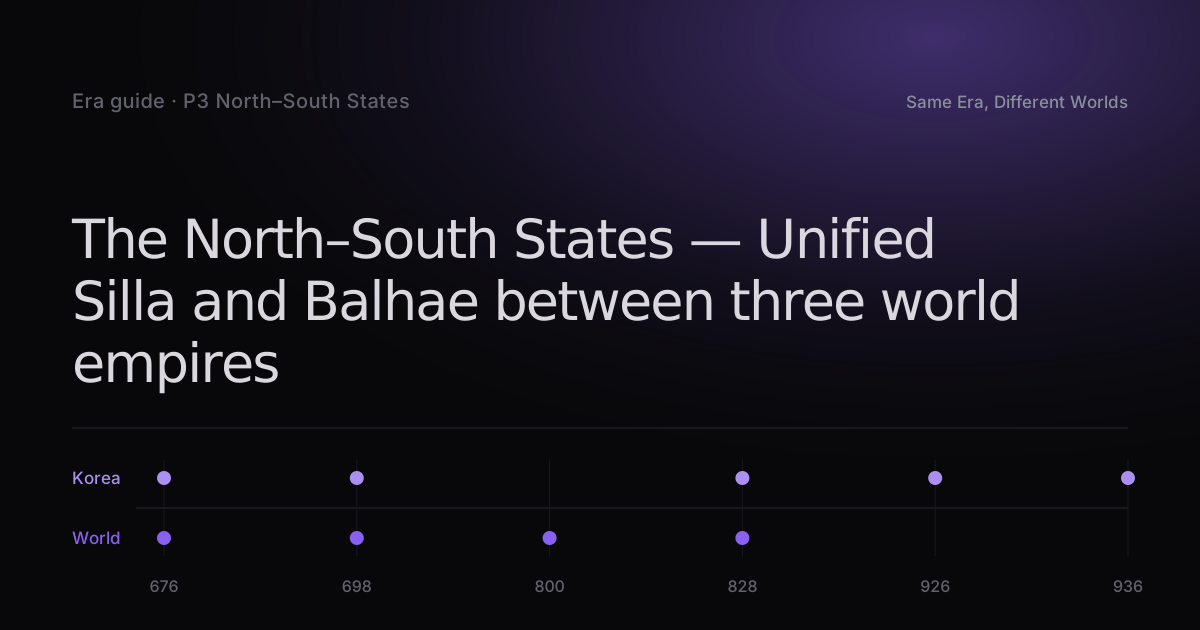
P3 runs from 676, when Silla expelled the Tang armies, to 936, when Silla surrendered to Goryeo. The name refers to the coexistence of Unified Silla in the south and Balhae in the north. These 260 years are often treated as a quiet stretch of Korean history; putting the world column beside them changes that impression entirely.
Korea: redesign after unification
The task after a war is always administration. Silla reorganized the provinces into nine ju and five secondary capitals, founded a national academy to teach Confucian learning, and introduced an examination-like reading grade system for officials. That the bone-rank system never gave way is the structural limit most often noted: the yukdupum literati hit a ceiling. Choe Chiwon, who studied in Tang, passed its examination for foreign candidates and returned home only to be sidelined, is the emblem of that limit.
Balhae, founded by Dae Joyeong in 698, ruled territory wide enough by the ninth century to be called "the flourishing land of the east." It claimed the legacy of Goguryeo while adopting Tang institutions and trading with Japan — a textbook case of multi-directional diplomacy. From the late ninth century Silla was destabilized by succession struggles among the true-bone aristocracy and by the rise of regional strongmen; Gyeon Hwon and Gung Ye founded Later Baekje and Later Goguryeo, opening the Later Three Kingdoms. Balhae fell to the Khitan in 926.
The same centuries elsewhere: three orders form at once
The world column here is unusually symmetrical. In East Asia, Tang made Chang'an a cosmopolitan capital. In West Asia, Islamic expansion after the Hijra of 622 produced the Umayyad and Abbasid empires within a century. In Europe, the Frankish realm filled the vacuum left by Rome and, with the coronation of Charlemagne in 800, declared a new Christian empire. Three civilizational orders completed themselves almost simultaneously.
What tied Eurasia together was the Silk Road, overland and maritime. Persian and Sogdian merchants moved through Chang'an; Abbasid Baghdad became the centre of a translation movement rendering Greek classics into Arabic. Jang Bogo's command of Korea–China–Japan trade from his base at Cheonghaejin belongs at the eastern end of that same network.
Where the two currents actually meet
The Arab geographer Ibn Khordadbeh's mention of Silla (al-Sila) as a gold-rich land to the east captures the character of this era. That the peninsula's name survives in Islamic-world sources means Silla was indirectly plugged into the Eurasian network through Tang. Western-style glassware excavated in Gyeongju and the Central-Asian-looking guardians at King Wonseong's tomb point the same way.
A second convergence is the institutionalization of religion. Silla Buddhism put down roots in both popular and state life through Wonhyo's reconciliation of doctrines and Uisang's Hwaeom school, and in the ninth century Seon Buddhism allied with regional strongmen to become a new intellectual base. In the same decades monasteries in western Europe became centres of learning and agricultural technique, and madrasas were founded across the Islamic world. In all three regions religious institutions came to hold knowledge and land together.
Where does Balhae belong?
The name of this era is itself an argument. For a long time Korean historiography called everything after 676 "Unified Silla," mentioning Balhae briefly as a frontier state of another people. The first to confront that frame directly was the late-Joseon scholar Yu Deuk-gong. In the preface to his Balhaego (1784) he reproached Goryeo for never writing a history of Balhae, arguing that because Balhae was not established as part of Korea's own history, the claim to the northern territory was lost with it. That today's textbooks call this the North–South States period is his argument being accepted two centuries later.
The sources make it more tangled still. Balhae's ruler styled himself king of Goryeo in a letter to Japan; Tang records describe a Mohe state; the ruling stratum was of Goguryeo descent while most inhabitants were Mohe. The differing accounts written today in China, Russia and Korea follow from this. A polity's identity shifts with the needs of whoever records it. This site labels the third band the North–South States not to force a conclusion but to keep the timeline from erasing a fact: a unified kingdom in the south and another state in the north and Manchuria coexisted for more than two centuries.
Why late Silla collapsed
Silla enjoyed more than a century of stability after unification, then destabilized rapidly from the late eighth century. The cause was not invasion but an internal design: the bone-rank system. It fixed a ceiling on the offices a person could reach according to birth. However capable, a man of the sixth head rank could rise only so far, and those who had studied in Tang and returned with practical ability felt the ceiling most sharply. Choe Chi-won submitting reform proposals, being ignored, and retiring into seclusion is the emblematic scene.
A system that cannot find places for capable people pushes those people outward. The sixth head rank combined with provincial strongmen, tax collection broke down, and the rising of Wonjong and Aeno followed in 889. Gyeon Hwon and Gung Ye then founded states of their own, producing the Later Three Kingdoms. Tang was collapsing in the same decades after the Huang Chao rebellion of 875, and in Europe the Carolingian empire had been split three ways by the Treaty of Verdun in 843. The ninth century is one in which large polities came apart simultaneously across Eurasia, and the disorder of late Silla belongs on that list.
Films and series set in this era
The representative title on this row is Vikings (2013–), set in eighth- and ninth-century Scandinavia. In the very decades when Viking raids and voyages were unsettling Europe, Jang Bogo dominated maritime trade off Korea. Reading two sea stories from the same century side by side makes clear that this was an age when wealth and power moved by water at both ends of Eurasia. That so few dramatizations of the Korean side exist is a gap — but in a timeline, the gap is itself information.
At a glance
| Year | Korean history | World history |
|---|---|---|
| 676 | Silla completes unification | Tang at its height |
| 698 | Founding of Balhae | Expansion of the Islamic empires |
| 800 | — | Coronation of Charlemagne |
| 828 | Jang Bogo establishes Cheonghaejin | Abbasid translation movement |
| 926 | Balhae falls to the Khitan | — |
| 936 | Later Three Kingdoms unified under Goryeo | — |
Read next
- While Balhae found its footing, the other end of Eurasia
- Previous era: the Three Kingdoms
- Next era: Goryeo
References
- National Institute of Korean History, Korean History Chronicle — North–South States
- South Korean high-school world history curriculum — formation of the medieval order
The facts follow the sources above; the comparisons and interpretation are our own.
You can compare the other events of this era directly in the timeline.
Explore the timeline