Era guide · P2 Three Kingdoms
The Three Kingdoms — three states rise in Korea while Rome grows and falls
Published
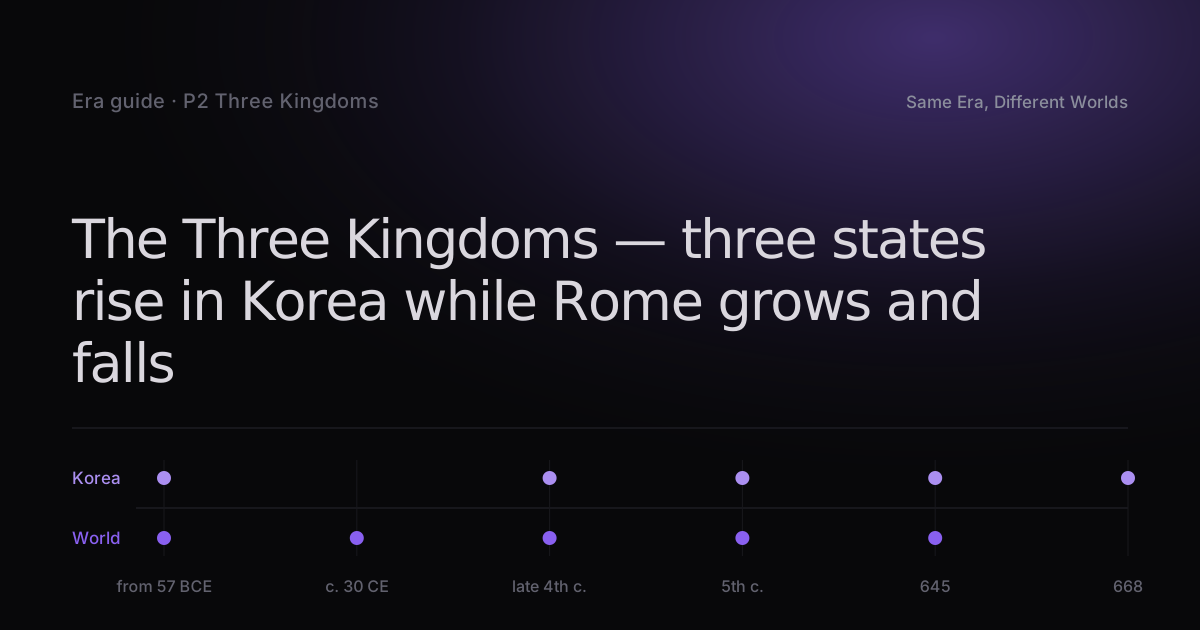
P2 runs from the traditional founding of Silla in 57 BCE to the fall of Goguryeo in 668 CE. It is more than seven centuries long, yet unlike P1 the events are dense, because texts survive: the Samguk sagi, the Chinese dynastic histories and inscriptions such as the stele of King Gwanggaeto carry this era.
Korea: from conquest states to law-code states
The three kingdoms were not born complete. They grew by absorbing smaller polities and only then built the institutions to govern what they had taken. That the peak passed from Baekje under King Geunchogo in the fourth century to Goguryeo under Gwanggaeto and Jangsu in the fifth and to Silla under Jinheung in the sixth is not coincidence but the same growth sequence reached at different times. Two measures recur in all three: promulgating a law code and adopting Buddhism — grounding rule in law, and legitimacy in religion. The pattern repeats across contemporary Eurasia.
The international war of the mid-seventh century is both the climax and the closing scene. Goguryeo turned back Tang Taizong at the siege of Ansi in 645, but Baekje fell in 660 and Goguryeo in 668 to the combined Silla–Tang forces. Silla completed unification by driving Tang armies out in 676 — a unification achieved by inviting an outside empire in and then pushing it back out, which is why assessments of it still differ.
The same centuries elsewhere: from Pax Romana to fragmentation
While the three kingdoms were consolidating in the first and second centuries, Rome was at its height. Jesus was executed in Roman Judea around 30 CE and Christianity spread through the empire thereafter. After the Five Good Emperors came the crisis of the third century, the Edict of Milan in 313, the division of the empire in 395 and the fall of the west in 476. In China the Han collapsed in 220, followed by the long division of the Wei–Jin and Northern–Southern dynasties until Sui reunified in 589 and Tang in 618.
The theme of the world column here is the breakup and remaking of large empires. The international space in which the three kingdoms could grow coincided with China's fragmentation — and the fact that Sui and Tang launched campaigns against Goguryeo almost as soon as they reunified shows how directly the peninsula's fate was tied to whether the mainland was whole.
Where the two currents actually meet
The clearest link is Buddhism. Travelling from India through Central Asia and China, it was officially adopted by Goguryeo and Baekje in the late fourth century and by Silla in the sixth. In the same window Christianity was legalized and then established in Rome. Two regions, at almost the same time, saw a universal religion absorbed into the state. Less a coincidence than a shared solution: ancient states that had grown large needed a single idea to hold the territory together.
The second link is the movement of goods and people. Roman glass found in Silla tombs, and the Central-Asian-looking guardian figures at the tomb of King Wonseong in Gyeongju, are regularly cited as traces of indirect contact along the Silk Road. They do not prove direct travel, but they do place the peninsula at the far end of a Eurasian trade network.
Why Gaya never became one
We call this the age of Three Kingdoms, but a fourth power occupied the southern peninsula. Gaya held the iron-producing districts of the lower Nakdong River and prospered by trading with Lelang and with Japan. The iron ingots excavated from the Daeseong-dong tombs at Gimhae show that this region was one axis of iron distribution in East Asia. On economic strength alone it was ahead of early Silla.
Yet Gaya never advanced beyond a confederation, and the reason lies in the terrain. The lower Nakdong is a set of basins formed by tributaries and separated by hills, so the cost for any one polity to absorb and hold the others was high. That each small state could trade profitably on its own further reduced the incentive to unify. When Gwanggaeto's southern campaign of 400 dealt Geumgwan Gaya a decisive blow, even the time to unify was gone.
Contrast this with the contemporary Mediterranean. Rome used the sea as a connector and held one polity together, whereas for Gaya the mountains and rivers were dividers. Wealth does not produce unification; a state grows only when the benefit of unifying exceeds its cost. The fall of Dae Gaya in 562 is the record that the arithmetic never came out right.
It is therefore more accurate to see Gaya not as a failed state but as a form that endured a long time on different terms. It lasted over five centuries, accumulating expertise in iron and pottery, and neither that expertise nor the people who held it vanished when Silla absorbed the region. Traces of the same technologies are clear in the early state formation of the Japanese islands. Not having unified does not mean having left nothing behind.
Writing and Buddhism as shared infrastructure
In the late fourth century the three kingdoms adopted almost the same three things in close succession: Buddhism, a state academy, and a legal code. Goguryeo legalized Buddhism in 372, Baekje in 384, Silla in 527, with law codes following in roughly the same order. The bundle is not coincidental. Binding several tribes under one king required a universal ideology reaching beyond kinship (Buddhism), the trained people to administer it (the academy), and rules that could be enforced (the code).
Seen more widely, East Asia in this period was acquiring a shared infrastructure of Chinese writing and Buddhism. Regions whose spoken languages were mutually unintelligible came to exchange documents in one script and read the same scriptures. The structure matches what Latin and Christianity did in Europe, binding several Germanic kingdoms into one cultural sphere. In both regions script and religion took over the connective work an empire had done. That Korea, China, Japan and Vietnam could read one another's texts directly for more than a millennium afterwards rests on the foundation laid here.
Films and series set in this era
Ben-Hur (1959) and The Passion of the Christ (2004) are set in Roman Judea around 30 CE, Gladiator (2000) in Rome at the end of the second century. The Korean title on the same row is The Great Battle (2018), on the siege of Ansi in 645. Lining the four up shows that the beginning of the Roman Empire and the East Asia that came after its disappearance both fall inside a single era band — a reminder of just how long P2 is.
At a glance
| Year | Korean history | World history |
|---|---|---|
| from 57 BCE | Traditional founding of Silla, Goguryeo, Baekje | Rise of the Roman Empire |
| c. 30 CE | — | Execution of Jesus; beginnings of Christianity |
| late 4th c. | Buddhism adopted; law codes promulgated | Christianity legalized in Rome (313) |
| 5th c. | Goguryeo at its height | Fall of the Western Roman Empire (476) |
| 645 | Siege of Ansi | Tang expansion |
| 668 | Fall of Goguryeo | — |
Read next
- While the three kingdoms took shape, Rome entered the age of emperors
- When Jesus was born, the peninsula was at the dawn of its three kingdoms
- Next era: the North–South States
References
- National Institute of Korean History, Korean History Chronicle — Three Kingdoms
- Kim Busik, Samguk sagi; epigraphy including the Gwanggaeto stele
- South Korean high-school world history curriculum — ancient empires
The facts follow the sources above; the comparisons and interpretation are our own.
You can compare the other events of this era directly in the timeline.
Explore the timeline