Late medieval · The collapses of the 14th century
While the Black Death erased Europe, Goryeo was collapsing — two ruins of the 14th century
Published
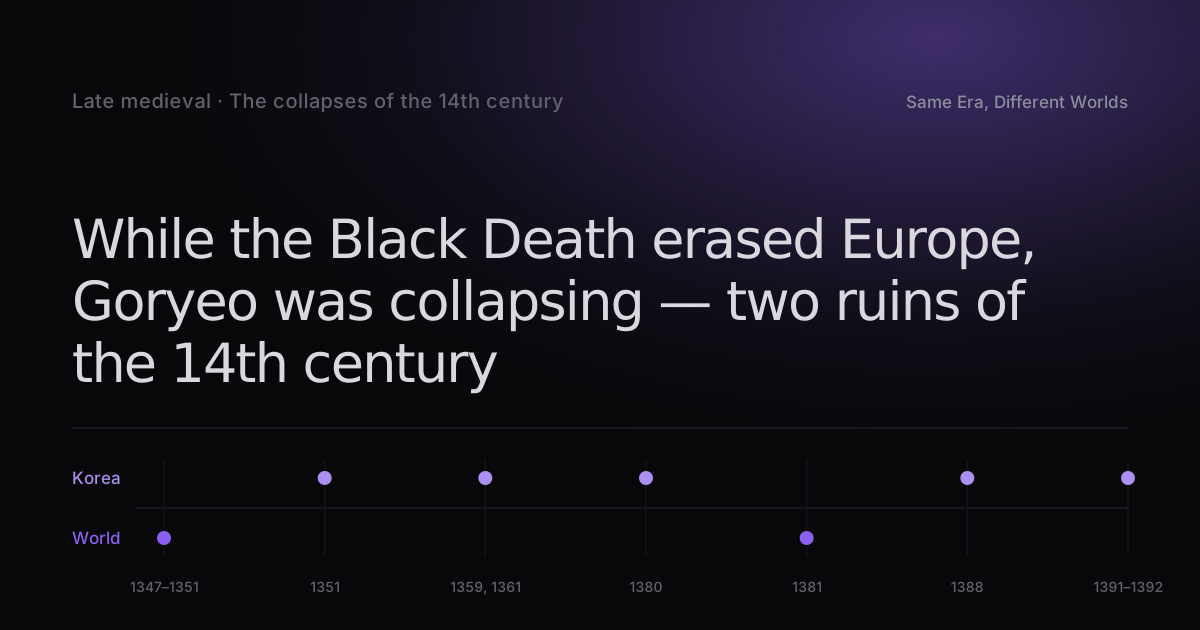
The fourteenth century is the century in which both ends of Eurasia collapsed at once. In Europe, roughly a third of the population disappeared within a few years of 1347. On the Korean peninsula, wako raiders and Red Turban armies swept the country in turn while a five-hundred-year dynasty moved toward its end. Textbooks file the two in entirely separate chapters; on a timeline they sit on the same line.
The two collapses were not unrelated
The simultaneity is not pure coincidence. Trace the spread of the Black Death backwards and you arrive at the trade network the Mongol empire built. The post stations and caravan routes that bound Eurasia together in the thirteenth century carried silk and silver — and carried pathogens too. The path from Caffa on the Black Sea into the Mediterranean aboard Genoese ships is well documented.
The loosening of that same Mongol order appeared differently in East Asia. By the mid-fourteenth century the Yuan had lost control to fiscal ruin, flooding and rebellion, and the vacuum pressed on Goryeo from two directions. One was the Red Turbans. This rebel movement against the Yuan spilled into Goryeo twice, in 1359 and 1361; in 1361 the capital at Gaegyeong fell and King Gongmin fled as far as Andong. The other was the wako. As the maritime order of East Asia broke down during the Yuan–Ming transition, their raiding reached far past the coast into the interior.
Why the collapses produced opposite results
The outcomes ran in opposite directions. In Europe the plague made labor scarce. With population collapsing, the bargaining power of surviving peasants rose, wages climbed, and the manorial system built on labor dues began to give way. England's rising of 1381 was a revolt against statutes meant to hold wages down. Loss of population, in short, produced structural change from below.
In Goryeo the pressure ran the other way. As war drove farmers off their land, the great estates of the entrenched aristocracy grew larger. Ruined farmers were absorbed as slaves or tenants, and the state lost the land registers by which it taxed. Labor did not become precious through depopulation; land concentrated in few hands and the peasants' bargaining power fell further. The same century's crisis loosened dependency in Europe and tightened it in Goryeo.
What made the difference was the kind of crisis. The plague erased people; the wars in Goryeo left people and erased property and records. When labor becomes scarce its price rises; when the land registers vanish, whoever holds power swallows the land. The character of a disaster determines the direction in which a society is remade.
Both places tried reform, and both were broken
Both also attempted reform in the face of crisis. King Gongmin read the weakening of the Yuan precisely, recovering the Ssangseong Commandery in 1356 and with it the Hamgyong region, and abolishing the Yuan office that supervised Goryeo's internal affairs. He banned Mongol hairstyle and dress and restored the original Goryeo system of offices. Thus far it was a successful diplomatic reform.
The trouble was internal reform. The land and census directorate established under the monk Sin Don returned illegally seized land to its original owners and restored to commoner status those wrongly enslaved. This struck directly at the foundation of the great estates, and the reaction was ferocious. Sin Don was executed in 1371, and Gongmin himself was assassinated in 1374. Reform that touches land always draws the fiercest resistance.
England's peasant revolt was suppressed in the same years. Wat Tyler was killed at a parley and the concessions withdrawn. Yet the aftertaste of the two failures differed. In England, the revolt was crushed but the underlying scarcity of labor remained, and the drift from labor dues to rents and then to wages continued. In Goryeo, once reform was broken, the concentration of land simply continued, and could in the end be resolved only by changing the dynasty. What remains after a reform fails is what decides the following century.
How the wako changed a dynasty
The decisive variable at the end of Goryeo was, unexpectedly, the response to the wako. Faced with a threat the court could not control, field commanders rose. Choe Yeong won a great victory at Hongsan and Yi Seong-gye another at Hwangsan, while Choe Mu-seon developed gunpowder weapons and burned some five hundred raider ships at Jinpo in 1380. Where the state had failed, a new kind of legitimacy — military merit — was manufactured.
When these new commanders joined the Neo-Confucian scholar-officials, the conditions for a change of dynasty were complete. Yi Seong-gye's turning back of his army at Wihwa Island in 1388 was the moment that combination acted politically, and the founding of Joseon in 1392 was its result. What ended Goryeo, in short, was not the invasions themselves but the power that grew in the course of answering them. That the Hundred Years' War in the same period was building longbowmen and standing armies at the expense of the knightly class shows, from the other end of Eurasia, that war serves as a channel through which old ruling classes are replaced.
What the comparison tells us
Read the fourteenth century side by side and the phrase "the disorder of late Goryeo" reveals how narrow it is. That disorder cannot be explained by misgovernment or incapacity inside the peninsula alone. The dissolution of the Yuan empire, a change on a continental scale, reached Korea in the form of Red Turbans and wako — and reached the far end of Eurasia in the form of a travelling pathogen.
Both regions emerged from the century as different societies. Europe moved from the ruins of manorialism toward wage labor and an urban economy; on the peninsula, Joseon replaced Goryeo and rebuilt the land system from the ground up with the Rank Land Law of 1391. A collapse is not an ending in itself; depending on what fills the space, it becomes the starting point of a different century. The two ruins of the fourteenth century produced two quite different fifteenths.
At a glance
| Year | Korean history | World history |
|---|---|---|
| 1347–1351 | — | The Black Death kills roughly a third of Europe |
| 1351 | King Gongmin accedes and begins anti-Yuan reform | — |
| 1359, 1361 | Red Turban invasions; Gaegyeong falls in 1361 | — |
| 1380 | Battle of Jinpo; Choe Mu-seon’s gunpowder weapons | — |
| 1381 | — | The English Peasants’ Revolt |
| 1388 | Yi Seong-gye turns his army back at Wihwa Island | — |
| 1391–1392 | The Rank Land Law; Joseon founded | — |
Read next
References
- Goryeosa, annals of King Gongmin and the biographies of Choe Yeong and Choe Mu-seon
- Goryeosa, treatise on food and money — the collapse and remaking of the land system
- National Institute of Korean History — entries on Gongmin’s reforms, the wako and Red Turbans, and the Rank Land Law
- South Korean high school world history curriculum — the Black Death and manorial decline, the Hundred Years’ War, the Peasants’ Revolt
The facts follow the sources above; the comparisons and interpretation are our own.
You can compare the other events of this era directly in the timeline.
Explore the timeline