Medieval · The Mongol shock of the 13th century
Three answers to the thirteenth century — Goryeo endured, the Mamluks stopped them, Europe got lucky
Published
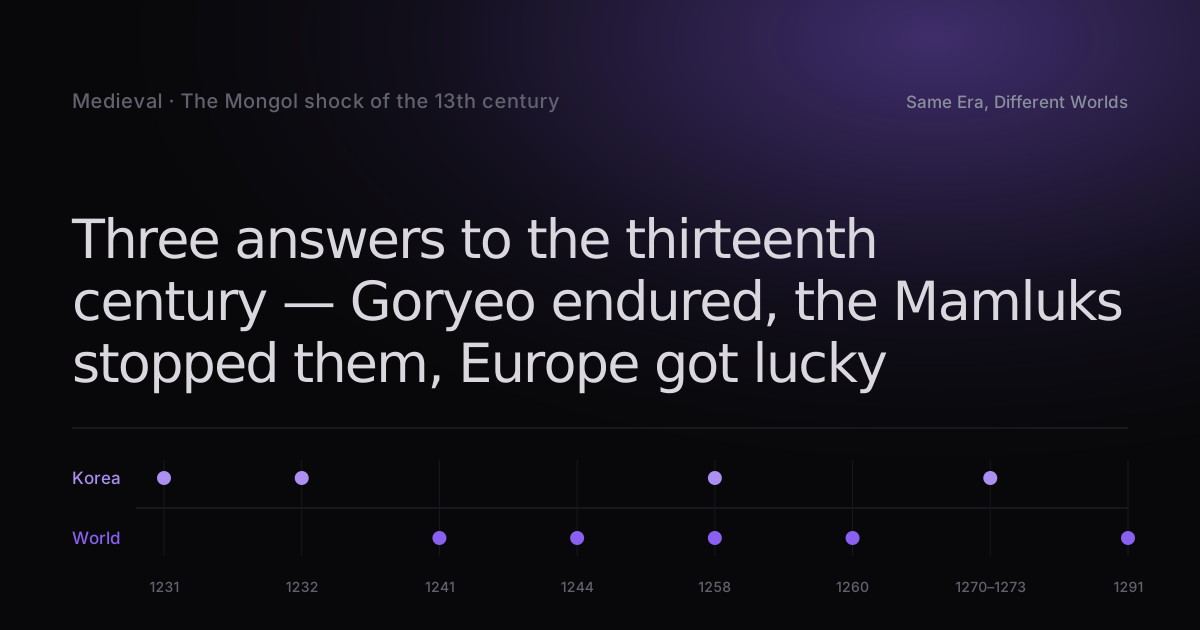
In 1231 a Mongol army crossed the Yalu. In 1241 Mongol forces destroyed the knights of Poland and Hungary at Legnica and Mohi. In 1258 Hulagu sacked Baghdad and ended five centuries of the Abbasid caliphate. The three events happened on different continents and are one event, caused by one organization. To understand the thirteenth century you have to set down, briefly, the habit of reading Korean and world history separately.
One force, three answers
The Mongol empire assembled the largest contiguous land empire in human history. The answers different regions gave to it, however, were entirely unalike, and those differences set their courses for centuries.
Mamluk Egypt stopped them head-on. At Ain Jalut in 1260 a Mamluk army destroyed a Mongol detachment. It helped that Hulagu had already withdrawn eastward with the bulk of his forces after the death of Möngke Khan — but the Mongol advance westward ended there. Europe did not survive by fighting. The army that reached the Hungarian plain in 1241 withdrew when Ögedei Khan died and a succession had to be settled. What saved Europe was neither its walls nor its knights but the succession customs of the steppe.
Goryeo took a third road. Unable either to win or to be excused by luck, it moved its court to the island of Ganghwado in 1232 and held out for some thirty years. Six invasions laid the country waste; the records report two hundred thousand people taken captive in the year 1254 alone. And yet the dynasty did not fall.
How thirty years were possible
What made that long war of attrition possible was not courage but a combination of terrain and tactics. The Mongols' greatest strength was cavalry mobility, and Ganghwado is an island of extreme tidal range and broad mudflats — precisely the ground on which steppe horsemen are most useless. To this was joined a scorched-earth policy of moving people and supplies into mountain fortresses and offshore islands. The Mongols were unbeatable in open country, but an emptied countryside had nothing to give them.
The strategy carried a hidden cost. The Choe military regime was safe on Ganghwado while the population left on the mainland was fully exposed; the burden of resistance was distributed quite differently between rulers and ruled. When the Choe regime fell in 1258 and peace followed the next year, it was not because the Mongols had grown stronger but because that cost could no longer be borne. The Sambyeolcho, who rejected the return to Gaegyeong in 1270 and fought on from Jindo and Jeju until 1273, show exactly where the fracture lay.
What it means to carve eighty thousand blocks during a war
The best evidence of what this resistance actually was is not a battle record but the Tripitaka Koreana. Between 1236 and 1251, over sixteen years, Goryeo cut more than eighty thousand woodblocks — in the middle of continuing invasion, and as a project of a government in exile.
The fact says two things at once. First, the capacity to mobilize was still there. Felling timber, soaking it in brine, drying, carving and lacquering it demanded enormous labor and material, and an administration able to organize both. Second, this was a war of legitimacy. The stated purpose — repelling invaders by the power of the Buddha — worked not as a practical measure but as a device for demonstrating, at home and abroad, that the regime still claimed the mandate. For a military government on an island, that declaration was as necessary as a victory in the field.
Something comparable was happening in Europe in the same century. While crusade after crusade failed, the great Gothic cathedrals rose at Chartres and Amiens. The further a war goes against a society, the greater the pressure to prove its faith in visible form. The Tripitaka and the cathedrals differ in material and in creed, but they are the same kind of evidence about what a community pours its resources into when the age turns against it.
Why the crusades ended in the same century
In the same decades the crusader states of the eastern Mediterranean were disappearing. This is usually explained as a Muslim counteroffensive alone, but here too the decisive turn was made by the Mongols. A band of Khwarazmian mercenaries, displaced westward by the Mongol advance, took Jerusalem in 1244, and the city never returned to crusader hands.
More fundamentally, the Mongol drive west reorganized the Islamic world and brought the Mamluks, a formidable military regime, to the front. The same organization that halted the Mongols at Ain Jalut proceeded to reduce the crusader states one by one, and with the fall of Acre in 1291 two centuries of crusading came to an end. From Europe's point of view the Mongols were both deliverer and destroyer. Pope Innocent IV sent Plano Carpini to them in 1245 and Louis IX of France sent William of Rubruck in 1253, sounding out an alliance against Islam. The attempts failed, and the party that profited from the board the Mongols had overturned was the Mamluks.
What the comparison tells us
Laid side by side, the thirteenth century changes the character of the question "why did Goryeo resist so long?" Polities that held out against the Mongols for thirty years can be counted on one hand across all of Eurasia. Western Xia and Jin were extinguished; the Abbasid caliphate ended in a single siege; so did the cities of Kievan Rus. That Goryeo reached terms with its dynasty and its name intact is an exceptional outcome.
It is hard, even so, to romanticize that outcome. Through some eighty years of Yuan overlordship that followed, Goryeo accepted a son-in-law-state arrangement in which its kings married Yuan princesses and its offices and royal titles were downgraded. Goryeo's answer, in short, was neither victory nor defeat but conditional survival. Set the three answers together and one thing becomes clear. When an overwhelming force arrives, what decides the outcome is not the measure of courage but terrain, time, and whatever trouble the adversary is having somewhere else. The three answers of the thirteenth century each demonstrate that in their own way.
At a glance
| Year | Korean history | World history |
|---|---|---|
| 1231 | First Mongol invasion of Goryeo | — |
| 1232 | The court moves to Ganghwado | — |
| 1241 | — | Legnica and Mohi; the Mongols withdraw on Ögedei’s death |
| 1244 | — | Khwarazmian mercenaries take Jerusalem |
| 1258 | The Choe military regime collapses | Hulagu sacks Baghdad; the Abbasid caliphate ends |
| 1260 | — | Ain Jalut: the Mamluks halt the Mongols |
| 1270–1273 | Return to Gaegyeong; the Sambyeolcho resistance | — |
| 1291 | — | The fall of Acre ends the crusader era |
Read next
- Era guide: Goryeo
- Late Goryeo while the Black Death swept Eurasia
- The Byeongja War and the Ming–Qing transition
References
- Goryeosa, annals of Kings Gojong and Wonjong, and Goryeosa jeoryo — the invasions and the peace
- History of the Yuan, treatise on Goryeo — the Mongol side of the record
- Plano Carpini’s History of the Mongols (1247) and William of Rubruck’s account (1255)
- National Institute of Korean History — entries on the Mongol wars, the Sambyeolcho, and the Yuan interregnum
The facts follow the sources above; the comparisons and interpretation are our own.
You can compare the other events of this era directly in the timeline.
Explore the timeline