Modern · Christian history · Persecution of Catholics
While Joseon persecuted Catholics, Europe was already separating church from state
Published
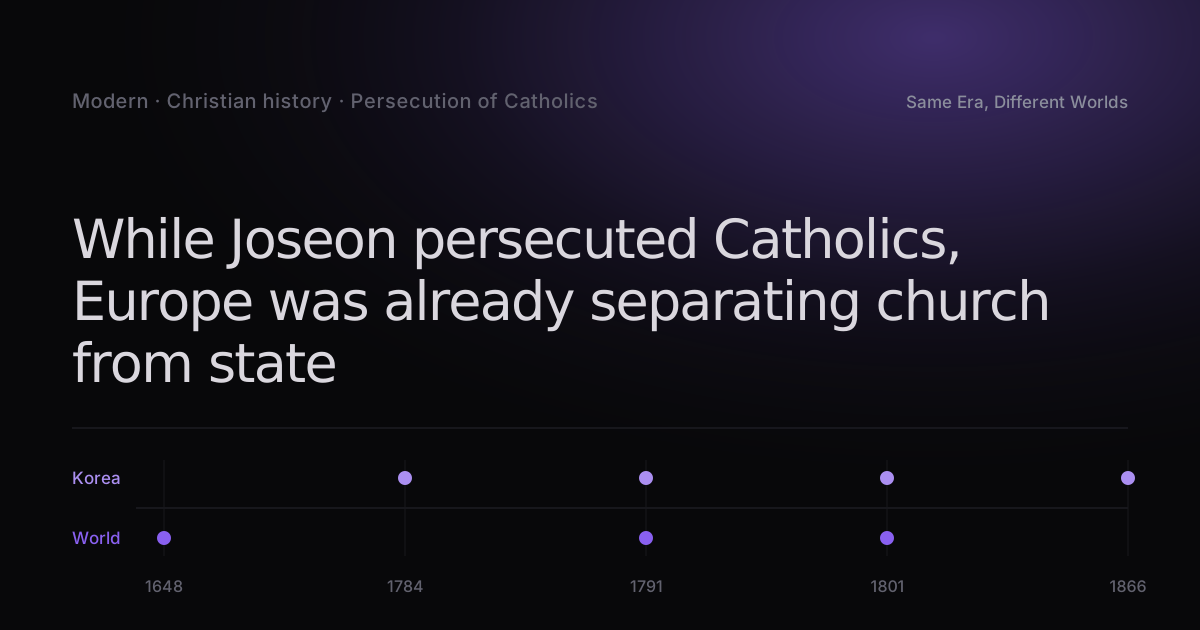
Catholicism, which reached Joseon at the end of the 18th century, was met with sweeping state repression for nearly a hundred years afterward. Europe in those same years had already passed through its long age of religious war and was working out a new relationship between state and religion. The two regions faced the same problem — religion and power — in strikingly different ways.
Persecution after persecution, from 1801 to 1866
In 1801, just after King Sunjo came to the throne, the Noron Byeokpa faction branded their political opponents, the Southerner Sipa, as Catholics and suppressed them on a large scale. The Silhak scholar Jeong Yak-yong and his brothers were exiled, and the repression grew harsher still when a silk letter written by Hwang Sa-yeong, appealing for outside help for the Korean church, was discovered. Catholics continued to be persecuted intermittently for refusing ancestral rites, which was taken as a challenge to the Confucian order, and the persecutions peaked in 1866. That year French missionaries and thousands of Korean believers were executed, and France used the killings as a pretext to send a fleet against Ganghwa Island.
Joseon's persecution of Catholics was more than religious repression. It was a head-on collision between a state built on Neo-Confucian social ranks and ancestral veneration and an entirely foreign worldview. Catholic teaching on human equality and its refusal of ancestral rites were understood as striking at the foundations of a society ordered by the yangban elite.
Europe's different road, toward separating church and state
As it happens, Europe in the same years was moving in the opposite direction. The French Revolution of 1789 transferred the Catholic church's vast privileges and lands to the state, and Napoleon, who took the imperial title in 1804, wrote freedom of religion and secular rule of law into the Napoleonic Code. Tension between Catholic and Protestant, and between state and church, hardly disappeared in Europe either, but the broad current ran toward states gradually recognizing freedom of belief rather than imposing a particular faith.
At the same time the European powers were expanding into Asia behind missions and trade. The Opium War of 1840-1842, which forced open Qing China, is the clearest case. The French expedition against Ganghwa in 1866 was not unrelated to that same westward push into East Asia. Joseon's persecution of Catholics was, internally, a struggle to preserve the Neo-Confucian order — but externally it was also a defensive reaction to the pressure of Western expansion. While Joseon strained to bar its doors and control belief and thought, Europe had already arrived at those doors. After the French and American expeditions Joseon leaned into an even harder refusal to open relations, which only postponed a larger upheaval.
What the comparison tells us
Joseon's persecutions and Europe's separation of church and state look like opposite directions, but they were answers from different moments to the same question: how far may a state control religion and thought? Europe reached its answer only after long religious wars and a revolution. Seen that way, Joseon's persecutions can be read as one stage of the strain a Neo-Confucian order underwent in colliding with new ideas — a strain that entered a new phase after the opening of the ports in 1876, when Joseon confronted the modern world in earnest.
Joseon's control of religion did not last. After the Treaty of Ganghwa opened the ports in 1876 and commercial treaties with Western powers followed, freedom to preach came to be permitted in practice, and in the 20th century the constitution of the Republic of Korea wrote freedom of religion into fundamental rights. That a faith once punishable by death became a constitutionally guaranteed right within little more than a century shows how far the relationship between state and religion can shift from one age to the next.
Many of those martyred in the persecution of 1866 have since been canonized and are honored as saints by the Catholic church in Korea — a case of the memory of persecution being transformed, well over a century later, into the identity of a community of faith.
A church that began without missionaries
The Catholic church in Korea has a feature rare in the global history of the faith: believers appeared before missionaries did. In the late eighteenth century, scholars of the Namin faction read Chinese-language works on Western learning brought back from Beijing and accepted the doctrine on their own; in 1784 Yi Seung-hun was baptized in Beijing and returned to organize a community of faith. No clergyman was sent to convert anyone. The church was built by people who read books and reached a conclusion themselves.
That origin determined the character of the persecutions. What the court confronted was not the infiltration of foreign missionaries but defection from within its own elite. That sons of the scholar-official class, men who had studied the Confucian classics and prepared for the state examinations, had abandoned the Neo-Confucian view of the world for another system read to the state not as a diplomatic problem but as a fracture in its governing ideology. That is why the persecutions in Joseon were so relentless. Where religious repression in Europe was aimed largely at another group, in Joseon it was aimed inside the ruling class.
The breaking point was ancestral rites
The point at which conflict detonated was not a doctrinal dispute either, but ancestral rites. In 1790 the bishop in Beijing classified rites for ancestors as idolatry and forbade them; the following year Yun Ji-chung of Jinsan, in Jeolla province, burned the ancestral tablets at his mother's funeral, setting off the persecution of 1791. In a Neo-Confucian state, refusing the rites was not a private matter of belief. It denied filial piety and the lineage system — the ground of the entire social order. Where the European Reformation split over sacraments and salvation, the conflict in Joseon split over how one treats one's ancestors.
The long irony comes next. In 1939 the Vatican recognized ancestral rites as an expression of respect rather than a religious act, and permitted them. The prohibition that had cost thousands of lives over a century and a half turned out, belatedly, to have been a matter of interpretation rather than theological necessity. Whether a culture's custom is read as idolatry or as courtesy — that single judgment changed the direction of a history. When systems of thought collide, what is actually being fought over is often not the doctrine itself but its translation into an unfamiliar culture.
At a glance
| Year | Korean history | World history |
|---|---|---|
| 1789 | — | The French Revolution |
| 1801 | The Sinyu persecution | — |
| 1804 | — | Napoleon crowned emperor; the Napoleonic Code |
| 1840-1842 | — | The Opium War |
| 1866 | The Byeongin persecution and the French expedition | — |
Read next
- Era guide: The Imjin War and Late Joseon
- Rome and the peninsula in the years Jesus was born
- Luther’s Reformation and Jo Gwang-jo’s failure
References
- Veritable Records of Kings Jeongjo and Sunjo — the persecutions of 1791 and 1801
- The Hwang Sa-yeong silk letter (1801) — a primary record from the persecuted side
- Vatican instruction on the Chinese Rites (1939) — the permission of ancestral rites
- National Institute of Korean History — entries on the reception of Western learning and the Catholic persecutions
The facts follow the sources above; the comparisons and interpretation are our own.
You can compare the other events of this era directly in the timeline.
Explore the timeline