Ancient · Christian history
In the age Jesus was born, Rome was at peace and Korea's Three Kingdoms were just dawning
Published
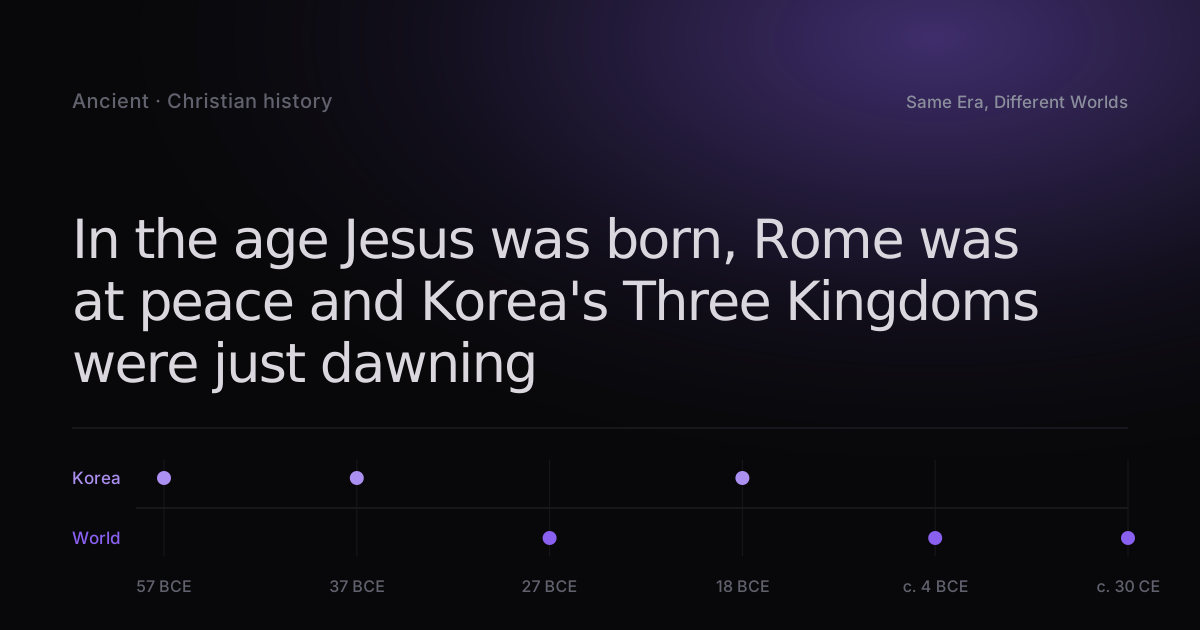
The birth of Jesus, the starting point of Christianity, is usually treated as a purely religious event. Put it on the coordinates of world and Korean history, though, and a striking simultaneity appears. The few decades in which Jesus was born and taught were the years Rome was completing the framework of its empire — and the years the Korean peninsula's three kingdoms were taking their very first steps.
A child born in Judea, under Roman rule
Long before Jesus was born, in 63 BCE, the Roman general Pompey occupied Jerusalem and Judea came under Roman control. Rome governed indirectly, installing Herod as king of the Jews, and the Gospels place Jesus' birth at Bethlehem in the last years of Herod the Great's reign. Since Herod died in 4 BCE, scholars generally date the birth to around 6-4 BCE. There is an irony in this: the calendar era used worldwide today was devised by a 6th-century monk calculating the year of Jesus' birth, and because his calculation was off, Jesus now appears to have been born several years "before Christ."
That birth falls within the peace and prosperity known as the Pax Romana, under Augustus, who had taken power in 27 BCE. Rome's stable administration and well-built road network would later become an unintended foundation for Jesus' disciples, letting them carry his teaching across the Mediterranean quickly. The years of his public ministry, around 27-29 CE, and of his crucifixion, around 30, likewise fell under Tiberius, Augustus' successor, while the Roman peace still held.
The same era, and kingdoms only beginning to walk
Barely half a century before Jesus was born, Silla was founded in 57 BCE, Goguryeo in 37 BCE, and Baekje in 18 BCE. The three kingdoms of the peninsula were, during Jesus' lifetime, new states only starting to take the shape of kingdoms. While Rome enjoyed peace as a mature empire spanning the Mediterranean, the three kingdoms were still in their early growth, absorbing the smaller polities around them.
After the crucifixion and resurrection, the early church his disciples founded spread rapidly across the Roman Empire, beginning with Pentecost around 30 CE. Reaching the Korean peninsula in any serious way, however, would take more than another thousand years. Rome legalized Christianity in 313, by Constantine's Edict of Milan; at that date the peninsula was still divided among three competing kingdoms. The age of Jesus marks the starting point from which two regions, the Mediterranean and Korea, wrote their histories on strikingly different schedules.
What the comparison tells us
Setting the age of Jesus beside world and Korean history makes plain that the history of a faith is, in the end, human history unfolding in particular times and places. A new idea could sweep the Mediterranean because the stable order of a vast empire was there to carry it, and the spread of any idea or belief depends on the conditions of its age as much as on its content. That is also why the faith took several more centuries to reach the still-young kingdoms of Korea.
Christianity would not actually take root on the peninsula until more than 1,700 years after Jesus' lifetime. It began in the late 18th century, when Joseon scholars of Silhak, or practical learning, encountered Chinese-language Catholic texts in Beijing and took the faith up on their own initiative. That a religion carried swiftly across the Mediterranean by the great conduit of the Roman Empire reached a geographically much closer East Asia only after so long shows that the channels of exchange between civilizations are not set by distance alone.
Judea in Jesus' time was a Roman province, but it was also a multicultural, multilingual society in which Greek, Hebrew, and Aramaic mixed. That complex environment was itself fertile ground for a new set of ideas.
Why the faith travelled west first
Seen from Jerusalem, Rome lay to the west and Persia to the east at broadly comparable distances. Yet the early church expanded overwhelmingly westward, and the reason is not theological but a matter of infrastructure. Rome's paved roads and Mediterranean sea lanes moved people and letters cheaply, and the eastern Mediterranean had a common tongue in Koine Greek, left behind by the conquests of Alexander. It is no accident that the New Testament was written in Greek rather than Hebrew or Aramaic. The moment Paul's letters began linking the cities of Asia Minor and Greece, they were already running on roads the empire had laid.
Eastward the situation was different. Parthia, Rome's standing adversary, sat astride the routes; the language changed at every oasis town; and the trade roads were optimized for moving goods rather than people. The same distance carried an entirely different cost. What set the speed at which an idea spread was never the appeal of the idea alone, but the roads that carried it and the language those roads spoke.
The moment it came closest to Korea
Christianity did not, in fact, arrive in East Asia late. In 635 a Syrian missionary known in Chinese as Alopen reached Chang'an, the Tang capital, received permission from Emperor Taizong, and founded a church. This Church of the East tradition was known in Tang China as Jingjiao, the Luminous Religion, and the Nestorian Stele erected in 781 testifies to two centuries of its activity. Six hundred years after the lifetime of Jesus, in other words, Christianity was already established in the capital of East Asia.
Line the timelines up and a striking scene emerges. The year 635 falls exactly when Silla was allying with Tang on the road to unification, and when Sillan students and monks were resident in Chang'an. It is unlikely, rather than likely, that Koreans were unaware Jingjiao existed. That the faith did not take root on the peninsula, then, was not for want of a channel. Jingjiao remained a minority foreign religion even in Tang China, and it was swept away with the rest in the Huichang persecution of 845. In the end another nine centuries passed before Joseon scholars, reading Chinese-language Catholic works in Beijing in the late eighteenth century, sought the faith out and adopted it themselves. That nine-hundred-year gap shows that transmission is not a question of distance but of need and circumstance on the receiving side.
At a glance
| Year | Christian history | World history | Korean history |
|---|---|---|---|
| 63 BCE | Roman rule over Judea begins | — | — |
| 57-18 BCE | — | — | Silla, Goguryeo, and Baekje founded |
| 27 BCE | — | The Roman Empire founded (Augustus) | — |
| c. 6-4 BCE | The birth of Jesus | — | — |
| c. 30 CE | Crucifixion, resurrection, and Pentecost | — | — |
Read next
- Era guide: The Three Kingdoms and Gaya
- The Catholic persecutions and the legacy of the Reformation
- While the Three Kingdoms took shape, Rome entered the age of emperors
References
- The Nestorian Stele (781, Xi’an Beilin) — a contemporary inscription on Jingjiao in Tang China
- Old Book of Tang and Tang huiyao — records of Alopen’s arrival in Chang’an (635)
- National Institute of Korean History — entries on the founding of the Three Kingdoms and the reception of Catholicism
- South Korean high school world history curriculum — Roman Judea, the Pax Romana, the Edict of Milan
The facts follow the sources above; the comparisons and interpretation are our own.
You can compare the other events of this era directly in the timeline.
Explore the timeline