Early modern · Joseon and Tokugawa Japan
How two centuries of peace held after a war — the tongsinsa and Westphalia
Published
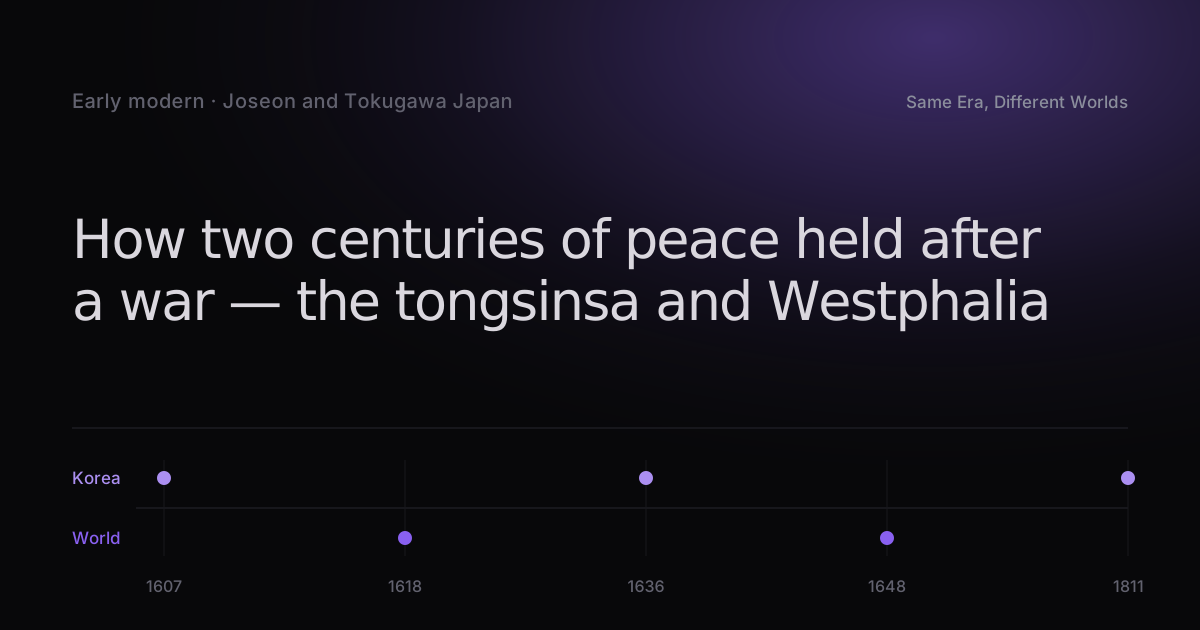
The Imjin War ended in 1598. Joseon and Japan then did not fight again for some 270 years, until the Meiji Restoration of 1868. Two countries maintaining peace that long after one had ravaged the other for seven years is not a common outcome. Europe in the same period fought the Thirty Years' War (1618–1648) and built a new order at Westphalia — and went on fighting anyway. What was different?
The reconciliation began with a forged letter
The story of the tongsinsa is easily consumed as an uplifting tale, but its beginning is rather grubby. After the war Tokugawa Ieyasu wanted relations with Joseon restored. He had come to power by removing the Toyotomi faction that started the war, and reopening relations with Joseon was a card that demonstrated the legitimacy of the new regime.
The difficulty was Joseon's conditions. It demanded first a letter of apology in the name of the Japanese sovereign and the surrender of those who had desecrated the royal tombs. In fact the Sō house of Tsushima forged the letter and produced substitute culprits, brokering between the two sides. The forgery was exposed in the Yanagawa affair of 1633, and although the shogunate punished the Sō it preserved the relationship. Both sides needed the relationship enough to live with a forgery. The first mission went out in 1607, and twelve embassies followed through to 1811.
Cause of the peace, or its result?
A single embassy numbered four to five hundred people, and the round trip from Busan to Edo took between six months and a year. Japan bore most of the enormous cost. Why accept that burden? The answer lies in domestic politics. The shogunate used the splendid procession of the Korean embassy as a stage on which its authority was displayed to the daimyo and the population. The spectacle of a foreign embassy paying respects to the shogun proved the legitimacy of the Tokugawa order in visible form.
Joseon's calculation was equally clear. The missions were also an intelligence operation to verify whether Japan intended to invade again. The delegations observed conditions and military preparations along their route and reported on them. The tongsinsa were, before they were an expression of goodwill, an institution each side maintained for its own reasons. On that reading the missions were not the cause of the peace. They are more accurately described as a result of the fact that peace served both sides, and a device for confirming it.
What actually held the peace up
The deeper condition lay elsewhere. The Tokugawa shogunate deliberately built a structure in which it could not wage war. The sankin-kōtai system, which kept daimyo families in Edo and required the lords to alternate residence year by year, drained daimyo finances and removed the capacity for rebellion and for expedition alike. To this were added bans on overseas travel and limits on building large ships. Japan, in short, abolished the very means of foreign expedition, and did so not for Joseon's sake but for the stability of the shogunate.
The Westphalian system in Europe worked in the opposite direction. The settlement of 1648 designed peace by recognizing each sovereign state's right to arm itself and to make alliances. Peace would hold as long as the balance of power did — so war recurred every time the balance shifted. East Asia obtained peace by reducing the capacity to fight; Europe managed peace by accepting armament and managing the balance. The former lasted longer but shrank the capacity to respond to change; the latter broke often, and produced modern international law and diplomacy.
What actually crossed in 260 years
That there were only twelve embassies is misleading. The real contact surface between the two countries was not the missions but the Japan House at Busan. Staffed permanently by people from Tsushima, who handled trade and working-level negotiation, it was a standing establishment of several hundred residents on a site of some tens of hectares. Joseon sent out ginseng, rice and cotton cloth and brought in Japanese silver and copper. If the tongsinsa were ceremony, the Japan House was daily life.
Goods were not all that crossed. At every stop along the embassy's route Japanese Confucian scholars asked for written conversations and exchanges of verse, and the results survive in printed collections. Korean Neo-Confucian books and calligraphy flowed into Japanese scholarship; in the other direction, the chief envoy of the 1763 mission, Jo Eom, brought back the sweet potato from Tsushima and established it as a famine crop in Korea. The channel the two states permitted was narrow, but a great deal passed through it.
The form of the relationship is worth noting too. Joseon applied one principle to Qing China — sadae, serving the great — and another to Japan — gyorin, neighborly relations between equals. It ran a hierarchical relationship and a relationship of parity at the same time. Where Europe after Westphalia moved toward a single principle placing all sovereign states formally equal, East Asia maintained a dual system in which the principle varied with the counterpart. That difference lies behind the confusion Joseon met in the nineteenth century, when Western international law arrived assuming a single standard for all.
How that peace ended
The difference showed itself in the nineteenth century. The last embassy went in 1811, after which the missions lapsed on grounds of cost — and within sixty years the relationship between the two countries was redefined by force: the Un'yō incident of 1875 and the Treaty of Ganghwa in 1876. Two centuries of peace had rested in part not on mutual understanding but on mutual irrelevance, and when a new power entered from outside, that structure gave way quickly.
Remember the tongsinsa only as an uplifting tale and this part is lost. The accurate lesson is this. Peace is not sustained by goodwill but by structure. The 260 years between Joseon and Japan were possible because war was all cost and no gain for both, and when that structure was changed by an external shock, the peace ended with it. Which is why the question worth asking of any peace is what, exactly, is holding it up.
Read next
- Era guide: The Imjin War and Late Joseon
- The Imjin War and the Armada — two wars paid for in silver
- The age of exploration and later Joseon
References
- Travel accounts of the missions such as Sin Yu-han’s Haeyurok (1719)
- Veritable Records of Gwanghaegun and Injo — the terms of restored relations and the Yanagawa affair
- The Peace of Westphalia (1648) — recognition of sovereignty and the right of alliance
- National Institute of Korean History — entries on the tongsinsa and the Treaty of Ganghwa
The facts follow the sources above; the comparisons and interpretation are our own.
You can compare the other events of this era directly in the timeline.
Explore the timeline