Ancient · Unification and the Tang empire
What the unification of 676 cost — the bargain between Silla and Tang
Published
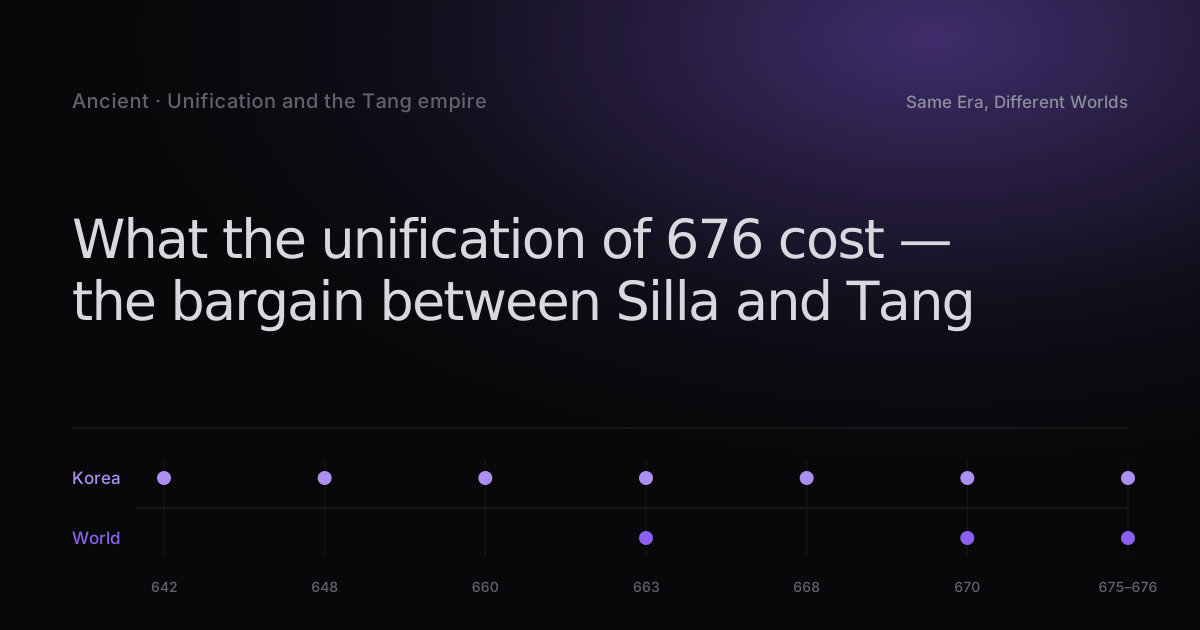
In Korean history, 676 is recorded as the completion of unification. Set that year beside a world timeline, though, and a different question surfaces. The Tang empire of the mid-seventh century was the largest state in the world at the time, fighting Goguryeo and Baekje in the east, holding the oasis states of Central Asia in the west, and confronting the Tibetan empire to the southwest. What, exactly, was given and what received in a unification achieved by joining hands with such a power?
How the alliance came about
It began in crisis. In 642 Baekje took the fortress of Daeya, collapsing Silla's western defensive line, and Kim Chun-chu lost his daughter and son-in-law in the fall. He went first to Goguryeo to ask Yeon Gaesomun for help, was met with a demand to hand over the territory north of Jungnyeong Pass, and returned empty-handed. His next option was Yamato Japan, and when that too came to nothing he crossed to Tang in 648. Silla's alliance with Tang was not an ideal choice but the last door left after every other had closed.
Tang's calculation was quite different. Emperor Taizong had personally led two campaigns against Goguryeo and failed at both. Once it was clear that battering through the fortresses of Liaodong did not work, Tang needed a force that could push from the south. To Silla, Tang was a means of survival; to Tang, Silla was an instrument for taking Goguryeo. That the two states understood the same alliance in wholly different terms is the seed of everything that followed.
What Tang wanted was not an ally but a protectorate
Baekje fell in 660 and Goguryeo in 668. Tang then established the Ungjin Commandery in the former Baekje lands and the Andong Protectorate at Pyongyang. In 663 it went further, naming King Munmu of Silla the Grand Governor of the Gyerim area — which is to say, folding Silla itself into Tang's provincial administration.
This was Tang's standard method. Rather than governing conquests directly, Tang granted local rulers the titles of governor and prefect and supervised them through protectorates — the jimi, or "loose-rein," system. What had been applied to the Turks and to Central Asia was now to be applied to the peninsula. From Silla's side this was the whole difference between an ally that had fought alongside Tang and a conquered dependency. The war began there.
The gap that Tibet opened
Silla's ability to hold out in the Silla–Tang War of 670–676 cannot be explained by Silla's own strength alone. The decisive variable lay two thousand kilometers away. In 670 the Tibetan empire seized the Four Garrisons of Anxi, and the great army Tang sent against it was annihilated at the Battle of Dafeichuan — among the worst defeats Tang had suffered since its founding.
An empire can concentrate in only one place at a time. With the capital at Chang'an exposed from the west, Tang had no choice but to keep drawing down the forces committed to the peninsula. That structure lies behind Silla's victories at Maesoseong in 675 and Gibeolpo in 676. Tang subsequently moved the Andong Protectorate from Pyongyang to Liaodong and in effect conceded Silla's control of the land south of the Daedong River. What Silla won was less a victory than an improvement in the terms — and the leverage behind it was a war on the Tibetan plateau.
The same years, across the water
The consequences did not stop at the peninsula. At the Battle of Baekgang in 663, the Yamato fleet was crushed by the combined Silla–Tang forces. After that defeat Japan abandoned intervention on the peninsula and turned inward. It built water fortifications and mountain castles in Kyushu, organized a ritsuryō state on Tang institutional models, adopted the name Nihon, and settled the title of tennō for its sovereign — all in these decades.
A single war, in other words, set the course of three states at once in later seventh-century East Asia. Silla became a unified kingdom; Japan withdrew from the continent and built an independent state order; Tang gave up eastward expansion and concentrated on its western front. What Korean textbooks call the unification of the Three Kingdoms was a moment when the whole board of East Asia was reset, and it cannot be explained by looking at Silla alone.
How much of it was unification?
One more thing needs saying. What Silla secured was the territory south of a line from the Daedong River to Wonsan Bay. Most of the old Goguryeo lands lay outside it, and in 698 Dae Joyeong founded Balhae there. Balhae declared itself the successor of Goguryeo, and a diplomatic letter it sent to Japan survives in which its ruler styles himself king of Goryeo. Is it accurate, then, to call 676 the unification of the Three Kingdoms?
The question is an old dispute. Silla-centered accounts call it unification; critical accounts call it closer to an absorption of Baekje. The late-Joseon scholar Yu Deuk-gong, in the preface to his Balhaego (1784), reproached Goryeo for never writing a history of Balhae, observing that the northern territory was truly lost only once Balhae had been let go, and proposed treating Silla and Balhae together as the North–South States. That today's textbooks use exactly that name for the period is the belated acceptance of his argument.
It is also why this site labels its third period band the North–South States. The aim is to keep the timeline from erasing what the single word "unification" cannot hold — that a unified kingdom in the south and another state in the north and in Manchuria coexisted for more than two centuries. The choice of a term is itself a decision about what to remember and what to forget.
What the comparison tells us
Both familiar accounts — that 676 was an incomplete unification achieved by inviting a foreign power in, and that it was a sovereign victory — are half right. The accurate statement is this. Silla made use of a power it could not match, came close to being absorbed as a dependency as the price, and then read precisely the moment when that power was in trouble elsewhere in order to claw the terms back.
This is also the characteristic structure of small-state diplomacy. Borrowing a great power's strength always comes with an invoice, and the only moment at which the invoice can be reduced is when the great power is pinned down on another front. Silla did not miss that moment. Yet the boundary at the Daedong River was equally a product of that bargain, which is why this unification is an event that is only fully recorded when what was gained and what was given up are written down together.
At a glance
| Year | Korean history | World history |
|---|---|---|
| 642 | Baekje takes Daeyaseong; Kim Chun-chu begins his search for allies | — |
| 648 | The Silla–Tang alliance concluded | — |
| 660 | Baekje falls; the Ungjin Commandery established | — |
| 663 | Battle of Baekgang; the Yamato fleet destroyed | Japan withdraws from the peninsula |
| 668 | Goguryeo falls; the Andong Protectorate established | — |
| 670 | The Silla–Tang War begins | Tibet destroys a Tang army at Dafeichuan |
| 675–676 | Victories at Maesoseong and Gibeolpo complete unification | Tang moves the Andong Protectorate to Liaodong |
Read next
- Era guide: The North–South States (Unified Silla and Balhae)
- While the Three Kingdoms took shape, Rome entered the age of emperors
- Rome and the peninsula in the years Jesus was born
References
- Samguk sagi, Silla annals, reign of King Munmu — the Silla–Tang War and diplomacy with Tang
- Old and New Books of Tang, treatises on the eastern peoples and on Tibet — the protectorates and Dafeichuan
- Nihon shoki — the Battle of Baekgang and the Yamato withdrawal
- National Institute of Korean History — entries on unification, the Silla–Tang War, and the founding of Unified Silla
The facts follow the sources above; the comparisons and interpretation are our own.
You can compare the other events of this era directly in the timeline.
Explore the timeline